


Proxy Authentication Methods Explained: Username/Password vs IP Whitelisting
06.10.2026 10 min
When using proxies, one of the choices you need to make is the proxy type to use. Datacenter proxies are among the most common for many users, thanks to their fast speeds and affordable pricing. Datacenter proxies act as an intermediary between a server and a client, allowing you to access online services without revealing your IP address and location.
Keep reading to learn more about datacenter proxy servers, including how they work, their ideal use cases, limitations, and more. But first, we will start with a summary of everything covered in this guide to give you an idea of what to expect.
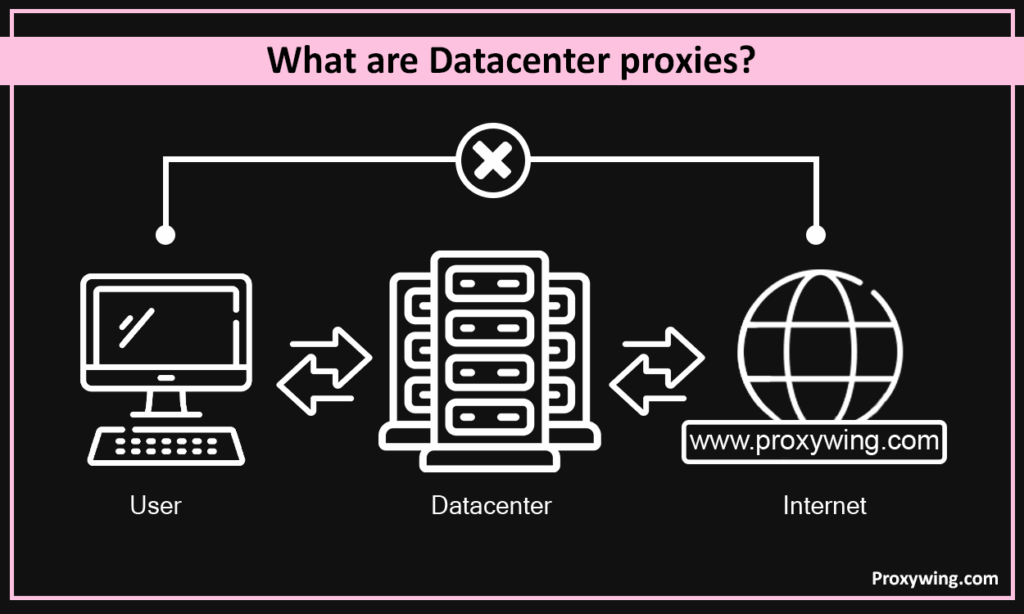
Datacenter proxies are intermediary servers sitting between client devices and the internet. They rely on IP addresses from datacenters instead of real home or mobile devices, offering faster speeds and lower prices. When you use these proxy servers, websites see the data center’s IP address, not yours, making your connection more anonymous.
Datacenter proxies route your internet traffic through IPs of servers hosted in a data center somewhere. When using a proxy, it first sends your requests to the proxy server and then forwards them to the target websites and any internet services on your behalf. The response also follows the same path. So, in the process, your IP address is totally hidden from the target online services you use.
Unlike residential or mobile proxies, datacenter proxies are not tied to real users, which allows them to offer higher speeds, but are less trusted. This makes them ideal for tasks that need the fastest speeds possible, but they may not be a great option in applications where success rate is the most important metric.
Here is what happens step by step when you send a request through a datacenter proxy:
A forward proxy sends requests on behalf of the client (user) and hides the user’s IP address. This is what scraping and automation tools usually use. The goal is to hide the IP address of the user from the target server. Forward proxies allow users to bypass geo-restriction on online services like Netflix or Prime Video.
A reverse proxy on the other hand sits in front of a website and manages incoming traffic. These proxies are mainly used for security and performance, not anonymity. The people that visit websites using reverse proxies cannot notice that a proxy is being used .
A data center IP address is assigned to servers hosted in data centers. Unlike ISP-assigned IPs, datacenters IPs are generated by hosting companies and cloud providers. These IPs are fast and reliable, making them ideal for tasks that need the fastest speeds. The main disadvantage of using IP addresses assigned by cloud providers or hosting companies is that they are pretty easy for websites to detect and block.
Datacenter proxy servers use IP addresses from large data centers, not home or mobile networks. Providers offering proxy services pay for and configure servers in these data centers and assign them public IPs. Server hosting is done by cloud providers or website hosting companies.
These servers route traffic on behalf of users, allowing fast and scalable internet access through data center IPs. Depending on the plan you choose, the IP address used to route your traffic can be shared with others or dedicated to your traffic alone.
They are commonly used for legitimate tasks like research and monitoring when provider rules are followed. It is easier to follow regulations in several jurisdictions since the IP addresses from datacenter servers are fully controlled by the proxy services providers.
Datacenter proxies hide your real IP address by replacing it with a server IP. This makes your connection more anonymous and private, reducing basic tracking risks. Users can even switch between different IPs to further enhance anonymity and privacy.
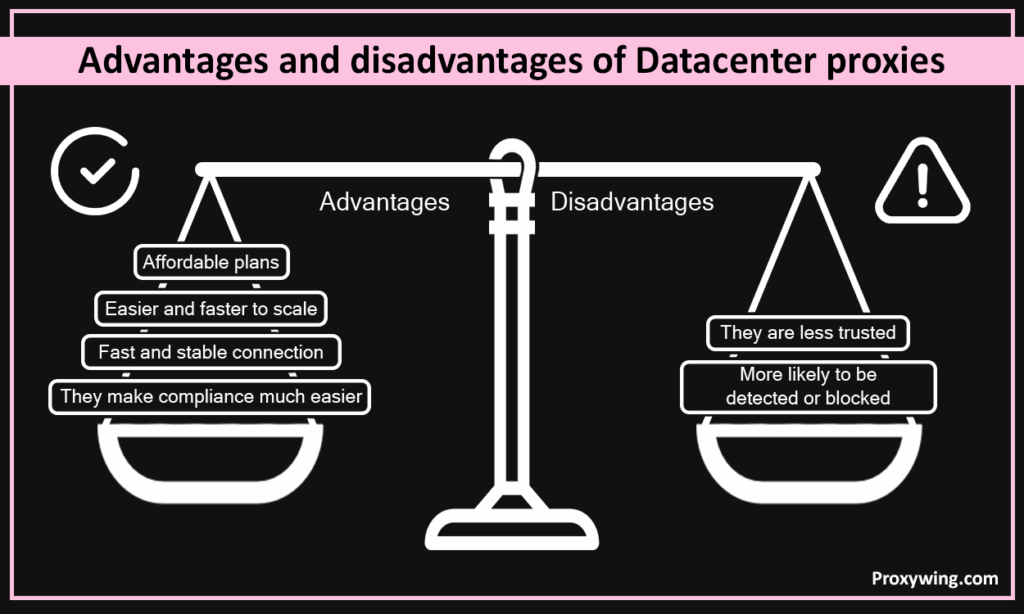
A datacenter proxy offers high speed and stable connections. They are also easier to scale if you need more performance for specific tasks like data scraping. For tasks that need the fastest possible speeds, these proxies are the best choice.
They are more affordable than residential or mobile proxies. It is much easier and cheaper to set up servers and configure them with IP ranges than sourcing residential or mobile IPs from real home devices. So, for tasks that are not as sensitive, using proxies with data center IPs is worth it, considering their cost advantage.
They handle large numbers of requests quickly, making them ideal for scraping public data. Their ability to handle large web scraping projects is primarily driven by the reliable and fast speeds they offer compared to other proxy types.
They allow fast collection of public data such as product listings, reviews, and search results. Datacenter proxies also support IP rotations, which allows users to automatically change IPs after each request or session. This can help bypass IP bans that are common with this proxy type.
Businesses can use datacenter proxies to check search rankings, ads, and SERP results from different locations. Datacenter IPs are available in most of the major regions, allowing precise SEO monitoring without spending a fortune.
Datacenter proxies can also be used to track competitor prices and product availability at scale on the various e-commerce websites. By switching to different IPs, it is possible to even access geo-limited platforms and view pricing for products limited to those regions.
They make it possible to view region-based content by using IPs from specific countries. This makes them ideal for streaming TV shows on platforms like Netflix or accessing websites that are available in certain regions.
They help test apps, APIs, and websites from different locations in a controlled way. Developers can simply switch to different IPs to get first-hand experience of users in those regions. This can be done both during testing and when fixing bugs that may affect specific regions.
They are used to improve speed and success when buying high-demand items. Purchasing items such as limited edition sneakers requires speed, and datacenter proxies provide just that. They also allow users to switch IP addresses if these products are only available in certain regions.
Datacenter proxies support managing multiple accounts by separating login activity and reducing IP-based restrictions. Users can simply use a different IP address every time they switch to another account on the same device. This minimizes chances of account bans.
Rotating IPs change automatically after each request, session, and pre-determine duration. Using fast rotating IPs is ideal for web scraping and tasks that need many requests. They make it easy to bypass possible IP bans.
Datacenter proxies with static IPs on the other hand maintain the same IP over time. They are better for tasks such as account logins, testing, and long sessions that require using the same IP for longer periods to ensure consistency.
Dedicated IPs are used by one customer only and usually offer better performance. In addition to performance, they also offer more privacy and better control. However, it costs more to use these IPs than shared ones.
Shared IPs on the other hand are used by multiple users. They are cheaper but have a higher risk of blocks, making them only ideal for light or non-sensitive tasks.
HTTP/HTTPS proxies work at the web level and are mainly used for browsing and scraping websites. These handle only web traffic, which limits their use cases.
SOCKS5 proxies on the other hand work with different types of traffic and are preferred for apps, gaming, and advanced use cases. They can even be used for UDP traffic that is common with online gaming, streaming, and online calls.
In this section, we will compare datacenter proxies with other common proxy types, including residential proxy and mobile proxy solutions.
Residential proxies route your traffic through residential IPs from real home devices such as mobile phones and personal computers. They are highly trusted and less likely to be blocked, making them ideal for sensitive tasks like account management or accessing sensitive sites. You can also use rotating residential IPs for even more anonymity. The main downside of residential proxies is that they are slower and also way more than datacenter proxies.
Mobile proxies route traffic through IPs of devices connected to 4G or 5G mobile networks. They offer high legitimacy for tasks like app testing or social media since most websites trust mobile traffic. But just like residential proxies, they are slower and cost more than datacenter proxies.
Summary of the four main proxy types so you can quickly pick the right one for your task:
| Type | Speed | Cost | Detection Risk | Best For |
|---|---|---|---|---|
| Datacenter | Fastest | Lowest | Higher | High-volume scraping, SEO monitoring, app testing |
| Residential | Medium | High | Lowest | Account managemen, sensitive sites, ad verification |
| ISP | Fast | Medium-High | Low | Long sessions, social media, sneaker drops |
| Mobile (4G/5G) | Medium | Highest | Lowest | App testing, mobile-only platforms, social media |
Datacenter proxies win on speed and price, but if your target website uses advanced detection systems like Akamai, Cloudflare, DataDome, or PerimeterX, residential proxies or ISP proxies usually deliver better success rates.
| Advantages | Disadvantages |
|---|---|
| Fastest of all proxy types: connection speeds often match or exceed direct connections | IPs are easier to detect because they belong to known data center ASNs |
| Lowest cost per IP, typically 5–10x cheaper than residential | Higher block rate on websites with advanced anti-bot systems |
| Easy to scale to thousands of IPs without performance loss | Less effective for tasks that require trust signals (banking, ticketing, dating apps) |
| Stable, predictable performance: no dependency on home internet quality | Shared IPs can be pre-blocked by previous users’ activity |
| Wide geographic coverage with consistent quality | Static IPs limit the range of anti-detection strategies you can use |
| Easy compliance: IPs are owned and controlled by the provider | Not anonymous in the legal sense, providers can log activity |
Datacenter proxies are the right choice when:
Switch to residential, ISP, or mobile proxies when:
The cheapest datacenter proxy plans often share IPs across thousands of users, which leads to slow speeds and pre-banned subnets on day one. Here is what to look for when picking a provider in 2026.
You can purchase reliable datacenter proxies from ProxyWing with flexible plans and global IP coverage for any project. Once you subscribe to any of our plans, we will provide you with the proxy server details, including the hostname (IP address) and port number. You get HTTP, HTTPS, and SOCKS5 support, instant activation, and a 24-hour refund window if the proxies don’t fit your use case.
Your choice between these proxy types should largely depend on your project’s speed, cost, and reliability needs.
Article written by:

Product & Support Operations Lead
Built Proxywing's support department from scratch — documented workflows, clear escalations, consistent quality. Now bridges the CEO and engineering, keeping infrastructure projects on track.
All articles by author (68)Yes, using datacenter proxies is legal, as long as you follow laws and website terms of service. You should use datacenter proxies from trusted proxy providers like ProxyWing. It is also best to avoid free and public proxies. With free or public proxies, IPs are often shared among several users, including those who may use them for unethical tasks.
They are easier to produce, use data center IPs, and don’t rely on residential or mobile networks. So, automatically the cost savings are passed over to the end users.
Yes, some sites can detect and block datacenter IPs, especially if traffic looks automated. To minimize the impact of IP bans, you can use automated IP rotation, especially when doing tasks like data scraping that involve sending many requests.
Yes, they are fast and scalable, making them ideal for scraping large amounts of public data. The only downside of these proxies is that their IPs are easy to detect and are often blocked. This makes them less ideal for scraping websites with strict bot policies.
A datacenter IP is just an IP address assigned to a server in a data center. A datacenter proxy is the full service that routes your traffic through that IP, including the server, authentication, and management layer. You cannot use a raw datacenter IP as a proxy without the proxy software running on top of it.
They are anonymous in the sense that the target website sees the proxy’s IP instead of yours. But they are not anonymous from the provider’s perspective — proxy providers can log activity, and some are required to by law. If you need full anonymity, combine a datacenter proxy with a VPN or use a residential proxy.
Datacenter proxies are typically 3–10x faster than residential proxies. A good datacenter proxy delivers response times under 200ms, while residential proxies often run 500ms–2 seconds depending on the underlying home connection. For scraping tasks, this can mean the difference between finishing a job in an hour vs. half a day.
Most modern sneaker sites (Nike, Adidas, Supreme) and ticketing platforms (Ticketmaster) block datacenter IPs aggressively. For those use cases, ISP proxies or residential proxies are usually the correct choice. Datacenter proxies still work on smaller drops and less-protected sites.
A shared datacenter proxy gives you an IP used by multiple customers at the same time, which lowers the cost but increases block risk. A dedicated datacenter proxy assigns an IP to you alone — same speed, but better reliability and no “neighbor” history. A private datacenter proxy is the same as dedicated in most provider terminology.