

Proxy Authentication Methods Explained: Username/Password vs IP Whitelisting
06.10.2026 10 min
Traffic arbitrage has long turned into a highly competitive environment, where the difference between a profitable campaign and a burned budget is often determined by a single factor: the tools you choose. Whether you are driving traffic from Facebook, TikTok, Google, or native networks, your technical stack is the foundation of your entire work. Yet, even experienced media buyers repeatedly step on the same rake when choosing software. Below are five of the most costly mistakes and ways to avoid them.
Perhaps this is the most common mistake — especially among beginners and those working with a limited budget. The logic seems reasonable: why pay for an expensive tool if a cheap alternative covers the basic needs? The problem is that in traffic arbitrage, the “basics” rarely remain basic for long.Imagine: you start with a free or cheap tracker. As long as there are few campaigns, everything works. But as the volume grows, the tracker starts to lag, event data becomes unreliable, and normal landing page split tests can no longer be conducted. You have to change the tool on the fly — migrate data (or lose it), and reconfigure everything from scratch. And these are hours you could have spent on optimization.
The real cost of a cheap tool is not the subscription amount. It is lost conversions, a drained advertising budget, and time that cannot be returned. Always evaluate tools not by their monthly price, but by the cost of the result. Ask yourself: if this tool helps me avoid at least one wrong decision a month, will it pay for itself? In most cases, yes.
At the same time, there is no need to blindly pay for the most expensive tool on the market. The goal is to find a tool that fits your current tasks and scales with you. Pay for what you will actually use — but do not skimp on features that matter.
Most media buyers start thinking about cloaking only after their first account ban. And then it becomes an obsession. But by that time, the damage has already been done: ad accounts are blocked, domains are flagged, money is lost, and weeks of work go into the trash.
Cloaking — the practice of showing different content to ad platform bots, moderators, and real users — is not about deception for the sake of deception. For media buyers working in verticals like nutra, gambling, finance, or dating, this is the basic level of campaign protection. Platforms actively scan landing pages, detect suspicious patterns, and block accounts en masse. Without a reliable cloaking solution, you are working without protection.
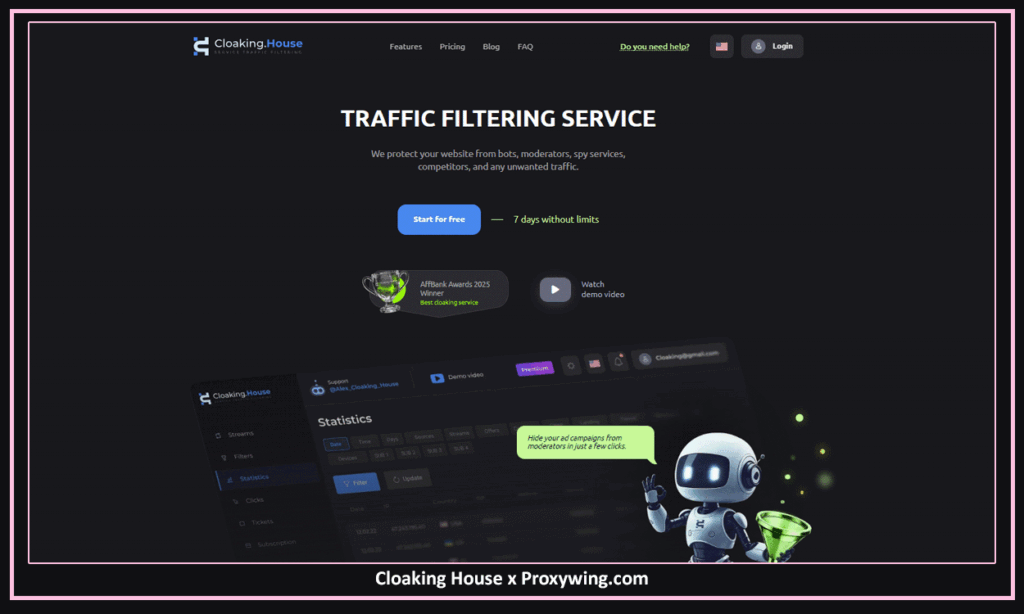
This is exactly where Cloaking House stands out as a professional solution created specifically for media buyers. Unlike primitive redirect scripts or custom-built PHP solutions that stop working after the next platform update, Cloaking House provides a constantly maintained and regularly updated cloaking engine that adapts to new detection methods in real time.
The bot detection system filters not only obvious crawlers but also data center IPs, moderator bots, and suspicious traffic patterns — as a result, the platform sees a safe white page, while the real user lands on the offer. The system is easily configurable, supports custom rules, and keeps detailed logs: you always know what is being filtered and why.
Fundamentally important: Cloaking House supports multi-accounting — you can manage dozens of campaigns in different ad accounts from a single dashboard without cross-contamination of data and detection. For those who drive large volumes, this alone is worth the investment. Neglecting cloaking is not cost-saving; it is a failure in risk management.
A scenario familiar to every media buyer: you launch a campaign from a home IP or a VPS, and within 48 hours the account gets banned. Moreover, it is unclear why: the offer is white, the creative is clean, the landing page passes moderation, yet it still gets blocked.
The culprit in most cases is the IP address reputation. Advertising platforms and traffic sources have learned to recognize multi-accounting patterns very well: shared data center IPs, proxy headers, geolocation mismatches, and suspicious browser fingerprints. Even a perfect creative and funnel will not save you if the IP is compromised — the campaign won’t even have time to gain momentum.
That is why proxy quality is not an option, but infrastructure. And it is a mistake to perceive all proxies as interchangeable commodities.
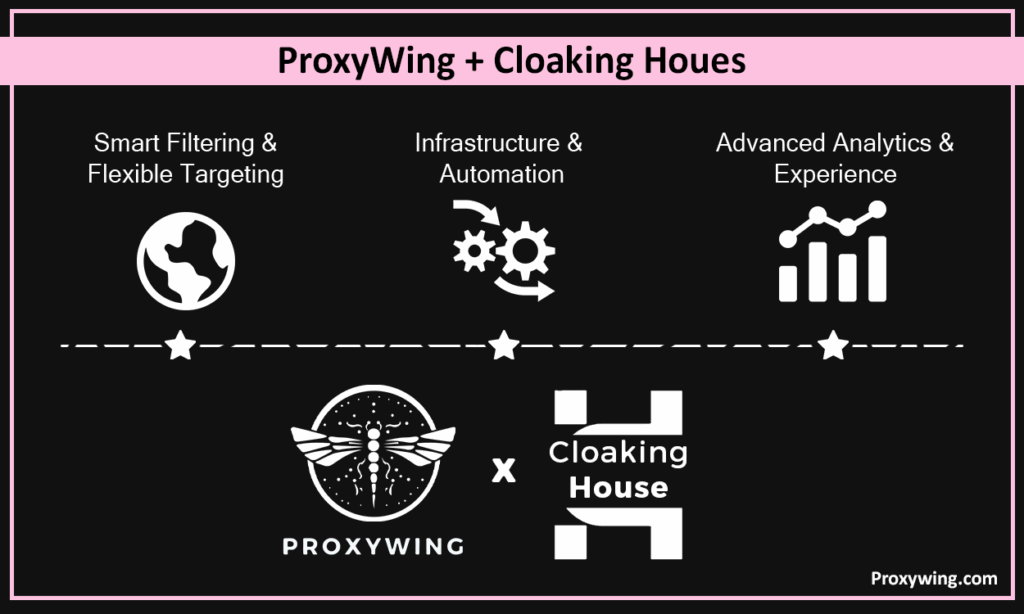
Here, the power of the Cloaking House and ProxyWing combination is particularly evident. ProxyWing provides high-quality residential and mobile proxies with a wide geography of exit nodes, a low detection rate, and stable uptime — exactly the infrastructure needed for demanding traffic arbitrage campaigns. Coupled with Cloaking House, both services create a complementary protective layer: Cloaking House handles content filtering and server-level bot detection, while ProxyWing provides a clean, trusted IP for all account management activities — from campaign creation to creative uploads and billing.
In practice, it looks like this: ProxyWing proxies are used when working inside ad accounts, and Cloaking House processes incoming traffic to the funnel on the server side. Together, they cover the two most frequent ban vectors: suspicious IP behavior during account management and bots or moderators landing on the real offer page. The synergy of these tools is not just theory: media buyers in tough verticals note a significantly longer account lifespan and higher campaign stability when they are used together.
Especially for ProxyWing users: The Cloaking.House team is giving away a promo code for a 30% discount on any Cloaking.House subscription: PROXYWING30
The tech stack in traffic arbitrage rarely consists of a single tool. A typical bundle includes a traffic source, a tracker, a cloaker, a landing page builder, a postback system, a CRM, and one or more proxy solutions. The mistake many media buyers make is choosing each tool in isolation, without thinking about how they will interact with one another.
Poor integration creates friction at every level. The tracker does not reliably receive postbacks from the CPA network. The cloaker fails to pass the necessary tokens to the tracker, leading to missed conversion attribution. The landing page builder does not support custom JS for pixel events. Every gap in the chain means lost data, and lost data means wrong decisions.
Before adopting a tool, ask yourself a few questions:
Tools created by practitioners—people who drive traffic themselves—generally integrate better: they are designed for real workflows, not imaginary feature lists. Be wary of tools that look shiny in a demo but require messy workarounds in production.
This mistake is surprisingly common among experienced media buyers who think they already know what they need. They see a recommendation in a Telegram chat, look at the pricing page, and pay for an annual plan the very same day. Six weeks later, they discover a critical limitation that is incompatible with their workflow—but they are already locked into a contract.
The “test before you scale” discipline works for tools exactly the same way it does for creatives and offers. Most decent services offer a trial, a demo account, or a limited free tier to evaluate basic capabilities. Use this to your advantage.
During the testing period, focus on the scenarios that are specifically important to your workflow:
A tool that handles edge cases correctly and has responsive, competent support is worth more than a slightly cheaper alternative that leaves you stranded with a problem at 2 a.m. when your campaign is bleeding money.
The market for traffic arbitrage tools is overcrowded, and the cost of making the wrong choice is very real—in money, time, and missed opportunities. All the mistakes described above—fixating on price, ignoring cloaking, neglecting proxy quality, using a fragmented stack, and failing to test before scaling—can be avoided with the right approach and due diligence.
The best media buyers approach the selection of tools with the same rigor as campaign optimization. They test, iterate, integrate, and constantly ask themselves: is my stack holding me back or driving me forward?If you are serious about building a sustainable traffic arbitrage business, cloaking and a clean proxy infrastructure are not optional add-ons. They are the foundation. Start with solutions tailored to the real demands of modern arbitrage traffic, and make sure they work well together. Your conversions—and your account lifespans—will show the difference.
Article written by:

Head of Partnerships
Leads partnerships at Proxywing with hands-on knowledge of residential, ISP, datacenter, and mobile proxies. Works with affiliates, bloggers, and tech communities, bridging tech and partner needs.
All articles by author (23)