



Proxy Authentication Methods Explained: Username/Password vs IP Whitelisting
06.10.2026 10 min
If you need unrestricted access to South Korean content and websites, using proxies is one of the most reliable ways to achieve that. However, the service provider you choose will have a huge impact on the overall experience. With hundreds or even thousands of vendors to choose from, it can be confusing for many users to select the right one. If you’re someone needing reliable service providers, this guide is for you.
In today’s guide, we will explore the best South Korea proxy vendors in 2026. For each provider, we will cover the key features offered, South Korea IP coverage, pricing, and the best use cases. Our goal with this guide is to provide you with all the information you need for choosing the right premium vendors that suit your exact business or individual needs. So, without further ado, let’s jump right in!
| Provider | Types | SK Targeting | Rotation Options | Starting Price | Best Use Case | Overall Value |
| ProxyWing | Residential, ISP, DC | City-level | Auto-rotate + sticky | $0.90/month | Automation & scraping | 4.9/5 |
| Oxylabs | Residential, ISP, Mobile, DC | City-level | Custom + sticky (7 days) | $1.20/IP | Enterprise scraping | 4.7/5 |
| Decodo | Residential, ISP, Mobile, DC | City-level | Auto-rotate + sticky | $0.02/IP | Developers & small teams | 4.7/5 |
| Bright Data | Residential, ISP, Mobile, DC | City-level | Flexible rotation | $1.30/IP | Advanced geo-targeting | 4.7/5 |
| SOAX | Residential, Mobile, DC | City + ASN-level | 1–60 min intervals | $0.40/GB | Flexible geo-sessions | 4.6/5 |
| Webshare | Residential, ISP, DC | Country-level | Auto-rotate | $0.23/month | Budget light tasks | 4.5/5 |
| IPRoyal | Residential, ISP, Mobile, DC | City-level | Auto-rotate + sticky | $1.39/IP | Entry-level teams | 4.6/5 |
| NetNut | Residential, ISP, Mobile, DC | City-level | Rotate + sticky (2 hrs) | $99/month | Stable sessions | 3.8/5 |
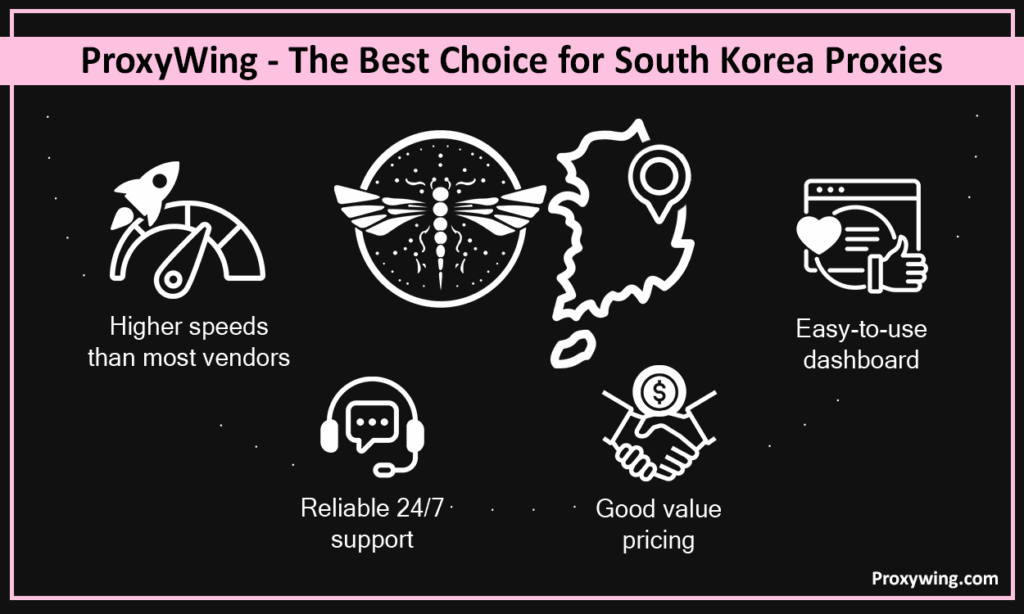

With all factors considered, ProxyWing is our top pick for South Korea proxy solutions. It offers the best residential and datacenter proxies for South Korea with a balance of all the critical elements that users care about when it comes to proxy usage. ProxyWing also has a large pool of verified South Korean IPs, city-level targeting, and the best value pricing on the list starting from $0.90/month.
Pros
Cons
Pricing

Having been around since 2014, Oxylabs is easily one of the proxy service vendors that has stood the test of time. It is mainly trusted for enterprise-grade solutions, offering a massive South Korean proxy pool, advanced tooling, and rock-solid uptime for high-concurrency operations.
Pros
Cons
Pricing

Decodo (formerly Smartproxy, rebranded in 2025) is a practical mid-range option that balances strong performance with easy setup. It is a good option for developers and smaller teams that need diverse capabilities without enterprise price tags.
Pros
Cons
Pricing

Bright Data is one of the most feature-rich platforms on our list. With over 12 years of industry experience, Bright Data meets the fundamentals users care about, including offering all major proxy types, deep geo-targeting, and built-in scraping tools.
Pros
Cons
Pricing

SOAX has been around since 2019 and is a strong pick for users who need granular location control and ASN-level targeting. It is geared towards professionals and relatively large businesses.
Pros
Cons
Pricing

Webshare is one of the most affordable options on this list. Unlike most vendors, Webshare includes a free tier. Its proxies for South Korea also go for as low as $0.23/month, making it one of the most accessible vendors in the industry.
Pros
Cons
Pricing

If you’re on a budget, IPRoyal is one of the top choices you should consider. It is a budget-friendly option built for businesses and individual users. Over the years, IPRoyal has become popular thanks to its non-expiring residential bandwidth and straightforward pricing.
Pros
Cons
Pricing
NetNut has been in business since 2017 and has become popular thanks to its ISP-direct, single-hop architecture that delivers faster and more consistent South Korea sessions. This makes it a good choice for workflows that depend on connection stability.
Pros
Cons
Pricing
Some of the key factors that you need to consider when choosing a provider include:
Confirm the provider has real South Korean IPs — ideally with a stated IP count for the region. Broad Asia-Pacific routing is not the same as dedicated in-country coverage. Besides NetNut, all the other vendors on our list offer a detailed number of IPs offered in South Korea.
Here are the key differences to keep in mind:
Look for vendors with sub-1-second latency and at least 99%+ uptime. For sustained workflows, session consistency matters as much as raw speed. When it comes to success rate, 95 to 99% success is good enough for most workflows.
Proxies with rotating IPs reduce detection risk during scraping and other similar tasks. Sticky sessions hold a fixed IP, making them better for logins and account management. Good vendors offer both options.
City-level or ASN-level targeting matters for tasks that require location precision. Such tasks include ad verification and localized testing. Not all vendors offer this depth. Confirm this before committing
Compare what each plan actually includes. Key details to look out for include traffic limits, targeting depth, and feature access. It should not only be about choosing a provider offering the lowest price.
A clean dashboard and clear documentation reduce setup time, especially for less technical users or teams managing multiple proxies for South Korea. Also look at features offered, especially if you need more flexibility with your usage.
Residential proxies redirect your traffic through South Korean household IPs, which makes them the hardest to detect. They are typically more expensive than datacenter and ISP proxy servers.
These route your traffic through IPs of servers running in data centers. Datacenter proxy servers are fast and affordable, making them practical for high-volume tasks where detection risk is lower. However, IPs from datacenters are the easiest for websites to identify and block.
Mobile proxies route your traffic through carrier-assigned South Korean mobile IPs and carry the highest trust scores. They are the ideal choice for mobile-first platforms and strict environments. However, mobile IPs are significantly more expensive than the other types.
Key steps to follow when choosing a provider include:
Article written by:

Product & Support Operations Lead
Built Proxywing's support department from scratch — documented workflows, clear escalations, consistent quality. Now bridges the CEO and engineering, keeping infrastructure projects on track.
All articles by author (68)South Korea proxies are servers that route your traffic through a Korean IP address. This makes your connection appear to originate from within the country, bypassing several geo-restrictions.
South Korea proxies work by routing your traffic through a server or network with a South Korean IP before reaching the target website. The target websites see the proxy’s IP instead of your real one.
The common types available include residential, ISP, datacenter, and mobile proxy servers. Each offers a different balance of trust score, speed, and price.
Yes, they are. Using South Korean IPs reduces geo-blocks and rate limits when scraping South Korean websites. Rotating residential or ISP proxy servers are the best fit for scraping tasks since they have a relatively high trust score and are also not as expensive as mobile proxies.
It depends on the provider you choose. Proxies from reputable premium proxy providers are safe to use and keep your traffic anonymous. Free proxies often rely on reused IPs, which are easy to detect and block. Go with a vendor that provides dedicated IPs for better security and performance.