



Best Proxies for OnlyFans in 2026
22.10.2026 12 min
With over 130 million monthly active visitors, Janitor is easily one of the most useful AI platforms in 2026. But like most online platforms, Janitor AI is not available or supported in every country, which means some users don’t get the chance to enjoy the capabilities offered by this tool. To bypass such restrictions, using a proxy is one of the best solutions.
However, the proxy vendor you choose matters just as much as using the proxy itself. In this guide, we will explore the best Janitor AI proxy vendors, key factors to consider when choosing one, the proxy setup process, and common use cases for proxies for Janitor AI.
By the end, you will have all the information you need to get started using proxies with Janitor and other similar chatbot platforms. We will kick things with a summary (table) of the best proxy for Janitor AI
| Provider | Best For | Proxy Types | Starting Price | Janitor AI Performance |
| ProxyWing | Overall best | Residential, ISP, Mobile Datacenter | $0.90/month | Excellent |
| Bright Data | Enterprise scale | Residential, ISP, Mobile, DC | $1.30/IP | Very Good |
| Oxylabs | Premium quality | Residential, ISP, Mobile, DC | $1.20/IP | Very Good |
| Decodo | Balanced option | Residential, ISP, Mobile, DC | $0.27/IP | Good |
| SOAX | Mobile coverage | Residential, Mobile, DC | $0.40/GB | Good |
| IPRoyal | Budget users | Residential, ISP, Mobile, DC | $1.39/IP | Moderate |
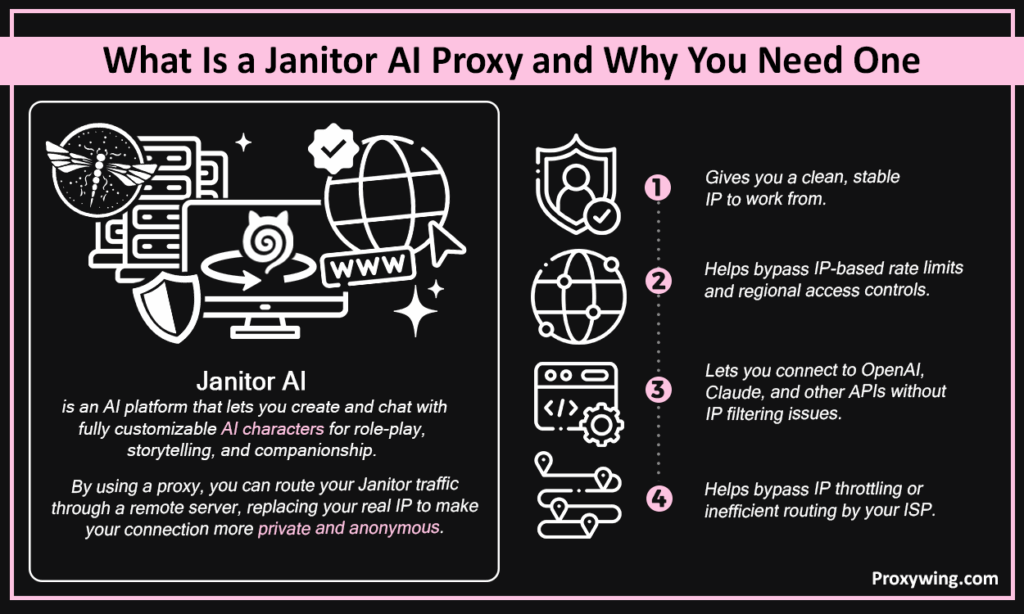
Janitor AI is an AI platform that lets you create and chat with fully customizable AI characters for role-play, storytelling, and companionship. By using a proxy, you can route your Janitor traffic through a remote server, replacing your real IP to make your connection more private and anonymous.
For Janitor users, this matters because the platform enforces IP-based rate limits, applies regional access controls, and connects to OpenAI and Claude APIs that carry their own IP filtering. A proxy gives you a clean, stable IP to work from if you ever need to. Using a proxy also allows users to bypass any IP throttling or inefficient routing implemented by their ISPs.
A reverse proxy connects janitor_ai to OpenAI and Claude, which apply their own IP-level rate limits. Heavy usage from a single IP triggers throttling or blocks to allow more users to utilize this Janitor platform at the same time.
Regional access controls also make certain models unavailable by location, and shared IPs from school or office networks face additional restrictions from flagged address ranges. Such restrictions will significantly affect your experience when using this Janitor platform.
A proxy reroutes your Janitor traffic through a clean IP in your chosen region, bypassing both Janitor’s regional restrictions and API-level rate limits. The proxy type you choose has an impact on the success rate and the overall users experience. The common available types include residential, datacenter, and ISP proxy solutions.
Residential proxies look like genuine home connections, reducing detection risk and delivering stable API access for your preferred models. When using residential IPs, Janitor will view your traffic as though it is coming from a local user in any region that you choose. This makes them the most ideal type to reliably access this Janitor chatbot service.
In this section, we will discuss the key features you need to consider to choose the best proxy for Janitor AI.
Latency directly affects the quality of roleplaying experiences — slow responses break immersion, significantly affecting your experience with such AI tools. For the best experience, always choose proxies with sub-1-second response times.
Residential proxies typically average 1–2 seconds; ISP proxies come closer to datacenter speeds (<1s response times) while maintaining higher trust scores. Different providers also guarantee different response times — know what your provider offers before committing.
A large pool reduces the chance of reusing flagged IPs since you have millions of IPs to choose from. Broad geo coverage lets you select regions where Janitor AI is fully accessible. City-level targeting gives the most control over where your Janitor traffic appears to originate. Residential proxies typically offer the largest pools. More premium providers offer 50M+ IPs in 150 to 200 countries.
Price is another crucial factor that you need to consider when choosing a proxy provider. Casual users can manage on $5–15/month with a small per-GB residential plan. Heavy daily users should look at higher-bandwidth or per-port subscriptions. Per-GB pricing scales most predictably for chatbots since bandwidth consumption is low compared to scraping. We will share the starting prices for the different providers to help you make an informed choice.
The providers below were selected based on IP quality, geo coverage, response times, and practical fit for Janitor’s API setup. ProxyWing leads the list as the strongest all-around option for stable AI platform access at an accessible price.
ProxyWing is the overall best provider when you consider all the key factors that affect proxy usage experience. It offers residential and ISP proxies across 190+ countries with sub-1-second response times and clean IPs that perform well against AI platform rate limits. Its IP pool has over 70M IPs, which significantly minimizes the chances of reusing IPs and facing IP blocks. Plans start from $1.0/GB for residential IPs, which make it one of the most accessible options on this list without sacrificing reliability.
Bright Data has the largest IP pool of any proxy provider on this list. It has a 400M+ IP pool coverage across over 195 million countries. This makes it a strong option for geo-targeting and highly reliable access, but it’s overkill for casual Janitor AI users. Best for users who need enterprise-grade consistency. Its residential IPs start at $4.0/GB, making it the most expensive vendor on our list. However, large scale users that value large pools and their faster response times can find it worth the price.
Oxylabs delivers premium residential proxy quality with strong session consistency — useful for long role-play sessions needing a stable IP. It has an IP pool with 175M+, covering over 195 countries worldwide. The starting price for their residential proxies is $2.5/GB, making it a good option for users that value its large IP size.
Decodo is another solid choice for users with a relatively small budget but need access to large IP pool size. Decodo offers 115M+ IPs in its residential pool across 195+ countries with straightforward proxy URL configuration that drops easily into Janitor’s API settings. With prices for residential IPs starting at $2.0/month, Decodo is a practical mid-tier option for most users.
SOAX covers residential and mobile proxies with flexible rotation and competitive per-GB pricing. It has an IP pool size of 55M+ IPs in more than 150 countries. It also supports several proxy types, including mobile proxies that are reliable for bypassing the strictest blocks. SOAX’s plans for residential IPs start at $3.60/GB, which is quite on the high end when compared to other providers on this list.
One of IPRoyal’s key selling points is its non-expiring bandwidth. It also offers 32M+ IPs in more than 195 countries. Even though it has the smallest IP pool size on this list, IPRoyal is mostly good enough for most Janitor AI casual users. IT offers pay-as-you-go residential proxies with non-expiring bandwidth starting from $1.75/GB.
After choosing the best Janitor AI proxy provider, you now need to configure the required settings to get started using their services. Getting a proxy running on Janitor AI takes a few minutes. Grab your credentials, navigate to API settings, paste in your configuration, and test. The steps below use ProxyWing as the working example for your setups.
Log into your ProxyWing dashboard, select your proxy type and target country, and generate your credentials. You’ll get a proxy URL, port, username, and password. Make sure to copy these details carefully to avoid facing connection issues down the road.
Once you are done copying the proxy details, go to Settings → API Settings in Janitor AI. You’ll see fields for your own OpenAI or Claude API key, plus a reverse proxy URL field — this is where your proxy endpoint goes.
In Janitor AI’s API settings, select the Proxy/Custom model option. Paste your reverse proxy endpoint URL into the designated proxy URL field. If your provider supplies an API key, enter it in the key field. Save settings once both fields are filled in. After you add configuration steps shared above, all your Janitor AI connections will now be routed through the remote server IP address.
Send a short test message to any character. If it loads without errors, your proxy is working. If you see timeouts or model errors, recheck your credentials and port settings. If you notice any performance issues, changing IP addresses or switching to a different proxy type helps. We will share more troubleshooting and performance optimization steps in the next section.
Even when you choose the best Janitor AI proxy, you can still face issues if you don’t make proper configurations. Here are some of the most common ones.
If you’re facing connection issues, check that the credentials are copied correctly, port is open, plan is active with remaining bandwidth, and IP is whitelisted if your provider requires it.
Usually caused by an overloaded shared pool. If you are experiencing this issue, switch to a less congested server location or upgrade from datacenter to residential or ISP proxy servers for more stable routing. The ISP proxy type is usually the perfect middle ground for good performance without sacrificing reliability.
A proxy-side error shows a connection timeout or 407 status. An API key error returns a 401 or model-unavailable message. Fix proxy errors at the credential level — double check every credential to make sure it is what your proxy vendor provides. Fix API errors in your OpenAI or Claude dashboard — you can reach out to their support teams to figure out how best to resolve this if you can’t handle it on your own.
Another key decision you will have to make is choosing between free and paid proxies. Free proxies are slow, heavily flagged, and often log your traffic and not suitable for a platform like Janitor AI that involves sharing your personal conversations and API keys. A paid provider like ProxyWing costs a few dollars a month and delivers clean IPs and reliable performance. We recommend sticking to premium proxies if you need a reliable and secure experience.
Article written by:

CEO
Founder of Proxywing. Drives growth across EU, US, and Asian markets, combining B2B strategy with a hands-on focus on product quality, 99% uptime, and responsive support.
All articles by author (65)Not always, but its impact might be felt more by some users when used with a proxy. A proxy becomes necessary when you’re in a restricted region, on a network that blocks AI platforms, or hitting IP-based rate limits from Janitor AI’s reverse-proxy connections. Proxies can also help improve performance if your local ISP is using inefficient routes for your Janitor traffic. In such situations, this Janitor platform works well when used alongside a proxy.
The residential proxy type is the best for most users, thanks to its low detection risk and reliable regional bypass. Use mobile proxies if you’re hitting persistent blocks since they offer the highest trust scores — but are the most costly too. Datacenter proxy services are cheap and fast but get flagged faster than any other type.
Yes, with a reputable paid provider. The risk comes from free proxies that log traffic or inject malicious content. A trusted provider routes your traffic without exposing your session data, which is especially crucial when accessing AI platforms since they involve sharing very sensitive data.
Technically yes, but not recommended. Free proxies are slow, frequently blocked, and may log your activity. This is a poor choice for a platform like Janitor that involves personal conversations and API credentials.
Some of the most likely causes include congested shared pool, server location far from Janitor AI’s infrastructure, or plan-level bandwidth throttling. Switch to residential or ISP proxies on a server closer to the US or EU.
It all depends on your usage patterns. Casual users: $5–15/month. Heavy daily users: $20–50/month. ProxyWing’s proxy plans start from $0.90/month, making it one of the most accessible entry points available. For a user that is able to limit their daily chats volume, it is possible to only spend less than $1 per month.