




Proxy Authentication Methods Explained: Username/Password vs IP Whitelisting
06.10.2026 10 min
One of the reasons developers choose Python for tasks like data scraping is because of its extensive catalog of libraries for such workflows. HTTPX, Requests, and AIOHTTP are three of the most popular libraries used in Python programming. These libraries are used to make HTTP requests, allowing your Python code to talk to websites or APIs.
In summary, Requests is simple and synchronous, HTTPX supports both sync and async with modern features, and AIOHTTP is fully async and built for high-speed concurrent tasks. In this Python Requests vs HTTPX vs AIOHTTP article, we will discuss all the crucial differences between these three to help you make a decision.
By the end you will know whether HTTPX, Requests, or AIOHTTP is the best solution for you depending on the task at hand. So, without wasting any more of your time, let’s jump right in!
We will start off this comparison by looking at the key differences between these two. Later in the next section, we will then bring in AIOHTTP to give you a more comprehensive comparison of the three.
Python Requests is the most popular of the two and this is mainly due to its simplicity. However, one of the drawbacks of Requests is that it works only in synchronous mode, which means each request must finish before the next begins. This is okay when handling simple tasks that don’t involve making dozens of thousands of HTTP actions. But as you scale up, it may not be ideal.
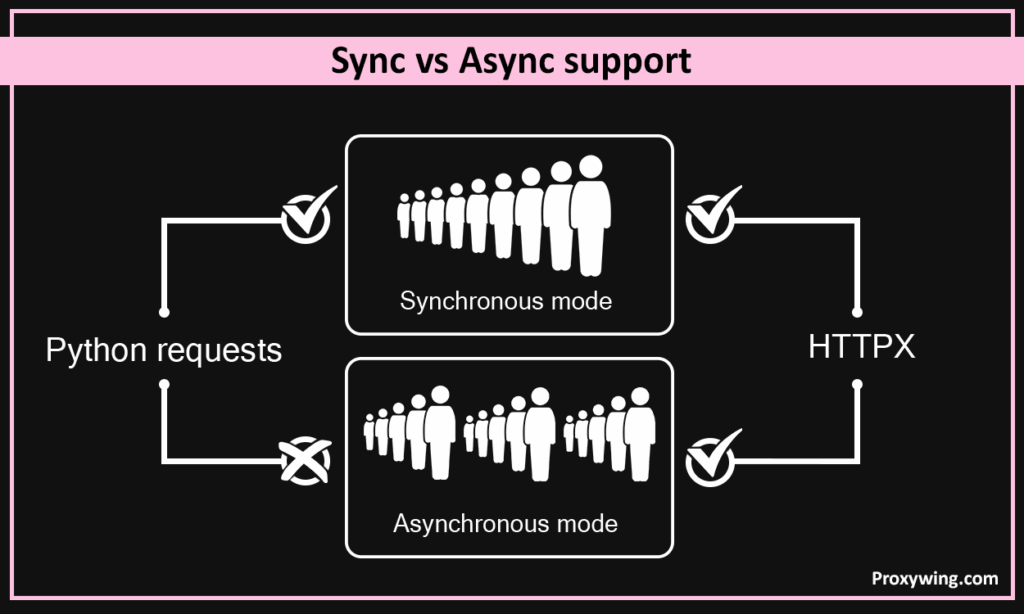
On the other hand, HTTPX supports both sync and async, which means several HTTP calls can be sent all at once without waiting for one to finish before triggering the next. This makes it far better for handling many HTTP calls at the same time. If you are handling complex projects that involve making several requests, HTTPX is the clear choice.
Compatibility with HTTP/2 & HTTP/1.1 protocols is crucial as it affects the overall performance of sending HTTP calls and getting responses from APIs and websites.
HTTPX includes native support for HTTP/2. One of the benefits of HTTP/2 (supported by HTTPX) is that it speeds up HTTP calls by allowing several parallel requests over one connection with lower latency, header compression, and better performance for repeated or small API calls.
On the other hand, Requests only uses the older HTTP/1.1 protocol. HTTP/1.1 allows only one request per connection at a time, which is a huge performance limitation for more complex tasks as you saw earlier. So, if your application needs support for new standards like HTTP/2 for better performance, go for HTTPX.
Both libraries reuse connections to reduce latency. However, their approaches are different:
HTTPX offers more modern and efficient connection pooling, especially when working with async clients. That means it can hold several open connections and reuse them without blocking.
With Requests, a new connection is created when switching domains or when the pool is full. Even though Request supports pooling, it is not as robust as with HTTPX—it is more basic and not ideal for high levels of concurrency.
When streaming, files are not downloaded to memory, they are simply read and sent in small chunks. Requests handles streaming uploads and downloads well, but only does it synchronously. Below is a code example for using Requests for streaming upload/download:
import requests

with requests.get("https://example.com/large.zip", stream=True) as r:
    r.raise_for_status()
    with open("large.zip", "wb") as f:
        for chunk in r.iter_content(chunk_size=8192):
            if chunk:
                f.write(chunk)
HTTPX on the other hand adds more flexible streaming controls and async streaming. This helps when dealing with large files or chunked transfers, which are common for tasks like complex web scraping. The code below shows this library’s streaming upload/download capabilities in action:
import httpx
import asyncio
import aiofiles  # for async file I/O

async def download():
    async with httpx.AsyncClient() as client:
        async with client.stream(
            "GET",
            "https://example.com/large.zip"
        ) as r:
            r.raise_for_status()
            async with aiofiles.open("large.zip", "wb") as f:
                async for chunk in r.aiter_bytes():
                    await f.write(chunk)

asyncio.run(download())The process of sending HTTP calls and receiving responses will sometimes encounter some errors and the way HTTPX and Request handle this is quite different as well.
It is important to note that both have clear exception models. However, HTTPX provides more structured timeout settings. It also integrates cleanly with external retry logic, making it more effective if your program encounters errors when sending HTTP calls. The code example below shows custom retry pattern with HTTPX:
import httpx
import time

def get_with_retries(url, attempts=3, backoff=0.5):
    for i in range(attempts):
        try:
            r = httpx.get(url, timeout=10.0)
            r.raise_for_status()
            return r
        except (httpx.RequestError, httpx.HTTPStatusError) as e:
            if i == attempts - 1:
                raise
            time.sleep(backoff * (2 ** i))
On the other hand, Requests keeps things simple but requires add-ons for advanced retry behavior. Since it doesn’t support any advanced retry capabilities, it relies on add-ons like urllib3 Retry, tenacity, or backoff to get the same level of control that modern libraries like HTTPX offer. Below is some sample code illustrating how Request with urllib3 retry to enhance its retry capabilities:
import requests
from requests.adapters import HTTPAdapter
from urllib3.util.retry import Retry

retry = Retry(total=5, backoff_factor=0.5,
              status_forcelist=[429, 500, 502, 503, 504])

adapter = HTTPAdapter(max_retries=retry)
s = requests.Session()
s.mount("https://", adapter)
s.mount("http://", adapter)

resp = s.get("https://example.com")When it comes to ease of use and API design, Requests is the winner here. It is known for its simple and very readable API, making it beginner-friendly and ideal for simpler projects that may not need advanced complex features offered by HTTPX.
On the other hand, HTTPX feels similar but adds extra options and a slightly steeper learning curve due to async features. This makes it great for complex tasks, but its steeper learning curve makes it less ideal for beginners.
As covered earlier, Requests offers great performance for basic scripts, but it only handles synchronous requests and lacks HTTP/2 support. HTTPX on the other hand wins performance-wise because of its high-concurrency or async environments since it can send and manage many HTTP calls at once without blocking. This makes HTTPX the more ideal choice if performance is one of the key priorities when choosing between these two libraries.
Requests was created around 2010 and then released for public use in 2011. This makes Requests an extremely popular library with a massive user base. In contrast, HTTPX is newer (released in 2019) but growing fast with active development and modern features. But overall, the community support experience is still better with Requests.
However, HTTPX is getting lots of previous Request users, so you will also likely get good enough help from the community whenever needed.
Requests integrate smoothly with most synchronous tools. Since it is built for synchronous code, it naturally integrates with tools like BeautifulSoup ( for web scraping), Pandas (for data processing), and several CLI tools.
On the contrary, HTTPX works well with both sync workflows and async frameworks. This makes it more flexible as it can integrate with tools like FastAPI / Starlette, Scrapy (through third-party plugins), Async web servers and microservices, Async data pipelines and workers, and Any asyncio-based application
The choice between Requests and HTTPX largely depends on your performance needs, ease of use, integration options, and community support.
Unlike Requests (sync only) and HTTPX (sync + async), AIOHTTP is an async-only HTTP client and server framework. It is primarily designed to run on top of Python’s asyncio. With this library, every operation is non-blocking and built for high concurrency, making it ideal for complex tasks that require this level of concurrency and performance.
If you are building applications that need to handle thousands of simultaneous HTTP calls, AIOHTTP is the most ideal choice. It is architected around event loops, co-routines, and connection reuse that never blocks the thread. This library also comes with a built-in web server, WebSocket support, middleware hooks, and session handling.
That means AIOHTTP can be used for both sending HTTP requests and building full async web applications. This makes it superior to Request and HTTPX in this regard since it offers better performance than the two.
In the previous section we compared Request and HTTPX, and their main difference was that one handles only synchronous HTTP actions while the other can handle both synchronous and asynchronous requests. Now let’s see how HTTPX compares with AIOHTTP using four major factors.
As stated earlier, HTTPX supports both synchronous and asynchronous usage. This makes HTTPX ideal for both simple scripts and fully async services. On the other hand, AIOHTTP works only in async mode and cannot be used in synchronous code without restructuring or using it along with other add-on tools. So, as far as flexibility is concerned, HTTPX wins.
HTTPX can be used in mixed environments, including traditional scripts, FastAPI services, testing tools, or libraries that may require either sync or async. On the other hand, AIOHTTP is best for pure async systems, large-scale scrapers, long-lived client sessions, and applications that also need an async web server. So, the choice here will depend on your exact use case.
HTTPX is known for offering a familiar Requests-style API with modern features like HTTP/2 and easy switching between sync and async clients. AIOHTTP on the other hand uses more low-level async patterns, including sessions, connectors, and coroutines. It also gives deeper control over connection behavior, which can be powerful and robust but less ideal for beginners due to the steep learning curve.
When it comes to their fundamental architectural design, HTTPX focuses mainly on being a universal HTTP client. On the contrary, AIOHTTP is a full async web framework with routing, middleware, and WebSocket support. This makes AIOHTTP suited for both clients and servers in asynchronous applications.
In this section, we will look at the average performance numbers for HTTPX, Requests, and AIOHTTP when making different sizes of HTTP actions. Since HTTPX supports both synchronous and asynchronous requests, it will appear in all the comparisons. On the other hand, Requests and AIOHTTP will only appear in synchronous and asynchronous comparisons respectively.
For Synchronous GET (50 requests):
Even though Requests is designed to primarily handle synchronous requests, it still trails, which is much faster HTTPX when it comes to performance.
For Asynchronous GET (100 requests):
Here AIOHTTP offers better performance, even though it is not as significant.
Asynchronous GET (1000 requests):
Unlike the previous test, when handling larger numbers of asynchronous requests, the difference in performance between AIOHTTP and HTTPX becomes wider.
For Sync POST (50 requests):
Just like with GET requests, HTTPX still has a clear advantage over Request.
Async POST (1000 requests):
In this test, AIOHTTP got over two times faster than HTTPX since it is primarily optimized for Asynchronous requests.
When using HTTPX with HTTP/2, the completion time for 1000 requests is 8.5 seconds compared to 10.22 seconds when using HTTPX with HTTP/1.1. This is a clear sign that using the newer HTTP/2 has a noticeable (about 17% better) impact in performance for a multiplexing and header compression task.
500 Concurrent Requests:
HTTPX was faster in the benchmark, thanks to its more advanced connection management system.
For 1000 Concurrent Requests:
For 5000 Concurrent Requests:
AIOHTTP was significantly more superior in this stress loading test. It also scales better than HTTPX and Requests.
For Bandwidth usage (1000 requests):
Despite higher bandwidth, HTTPX still delivers lower latency and higher throughput mainly due to HTTP/2 framing.
For 1000 requests with 10% failure rate:
Since HTTPX’s internal retry behaviour made it recover faster, it was still trailing Python AIOHTTP by a significant margin.
| Test / Metric | Requests | HTTPX | AIOHTTP |
| 1000 Concurrent Requests | 15.4 s | 10.22 s | 3.79 s |
| 5000 Concurrent Requests | 78.3 s | 50.5 s | 18.7 s |
| 1000 async GET Requests | N/A | 10.22 s | 3.79 s |
| 50 Sync GET Requests | 1.50 s | 1.22 s | N/A |
| 50 Sync POST Requests | 1.60 s | 1.30 s | N/A |
| 1000 async POST Requests | N/A | 11.5 s | 4.3 s |
| Bandwidth (1000 requests) | 1.2 GB | 1.5 GB | 1.25 GB |
| 1000 Requests w/ 10% Failure Rate | 15.8 s | 12.5 s | 4.6 s |
| Failure Rate Behavior | Higher | Medium | Lower |
| Category | Requests | HTTPX | AIOHTTP |
| Async Support | No async support (sync-only) | Supports both sync and async | Async-only (built for asyncio) |
| HTTP/2 Support | No | Yes (optional) | No |
| Speed (Low Concurrency) | Good | Very good | Very good |
| Speed (High Concurrency) | Weak (thread-bound) | Strong (async mode) | Strongest (async-native) |
| Error Handling | Clear but sync-blocking | Structured errors (HTTPStatusError, etc.) | Fast async errors, broader types |
| Retry Support | No built-in (needs urllib3 Retry or custom) | No full retry system (works well with Tenacity) | No retry system (can be implemented manually) |
| Connection Pooling | Basic keep-alive | Modern pooling (sync + async) | Highly efficient async pooling |
| Streaming Support | Yes (sync streaming) | Yes (sync + async streaming) | Yes (async streaming) |
| Memory Efficiency | Highest usage (threads) | Medium | Best (async tasks use tiny memory) |
| Ease of Use | Easiest | Easy, but more options | Requires async knowledge |
| Ecosystem Integration | Works everywhere | Works everywhere (sync & async) | Best for modern async frameworks (FastAPI, aiojobs, aiomonitor) |
| Learning Curve | Easiest | Easy–moderate | Moderate–advanced |
| Best Use Cases | Simple scripts, CLI tools, low concurrency tasks | Apps needing both sync + async, high concurrency APIs, modern projects | Maximum-throughput scraping, large async pipelines, real-time async systems |
| Main Strength | Simplicity | Flexibility + modern features | Raw async performance |
| Main Weakness | Slow at scale | Slightly slower than AIOHTTP in heavy async workloads | No sync support, must use async everywhere |
As covered throughout this article, Python HTTPX, Requests, and AIOHTTP each excel in different situations, so the choice between the three will largely depend on your use case. Requests is the easiest library of the three, easier to learn and best for simple tasks, synchronous workflows, quick prototypes, and low-concurrency tasks.
HTTPX offers a more modern and flexible middle group of the three since it supports both synchronous and asynchronous workflows. Finally, AIOHTTP is the best library if you are looking for high performance when dealing with fully asynchronous applications. So, take time to analyze your workflow before you can choose which one of Requests, HTTPX, and AIOHTTP is best for you.
Article written by:

Full Stack AI Engineer
Full-stack engineer at Proxywing working across backend architecture, performance optimization, and AI-driven workflows. Node.js, React, cloud infrastructure, and RAG pipelines.
All articles by author (61)The fundamental difference between HTTPX and Requests is that HTTPX supports both synchronous and asynchronous requests where Requests only supports synchronous requests only. HTTPX also supports HTTP/2 and is better at connection pooling and async pooling. These features make HTTPX the best choice for high-concurrency workloads.
Yes, HTTPX offers much better performance than Requests for POST requests. In some scenarios, HTTPX can be up to 50% faster. The main reasons behind this performance difference is that HTTPX uses a more efficient connection management system and supports modern protocols like HTTP/2.
Unlike what many may assume HTTPX and HTTPS are two different things. HTTPS stands for a secure HTTP protocol whereas HTTPX is a python library used to make HTTP requests.
Yes, for most high-concurrency async workloads, AIOHTTP offers better performance than Python HTTPX. This performance difference is because AIOHTTP is fully async by design and uses event-loop-optimized I/O that gives it a significant advantage when running workloads that involve thousands of requests. However, HTTPX supports both sync and async, so it would still be the best choice for async workloads despite AIOHTTP offering better async performance.