



Proxy Authentication Methods Explained: Username/Password vs IP Whitelisting
06.10.2026 10 min
If you’re searching for mobile and residential proxies on the web, you probably need them for web automation, web scraping, or some other tasks that are based on online accounts. Well, both solutions are pretty helpful in sending your internet traffic via multiple IP addresses. But they do it in very different ways. Many individuals also begin with an ISP proxy or even datacenter IPs, but later shift to these advanced solutions.
This article makes it easy to understand everything related to mobile proxies vs residential proxies. Here, you will discover how each sort of proxy actually operates, where they fit, and which one you should pick. These are among the most renowned other types of proxy options today. Read the article to the end in case you want to have fewer blockages as well as more successful attempts.
Here are key takeaways:
If you need help, this guide helps simplify your decision.
| S.No | Feature | Residential Proxies | Mobile Proxies |
| 1 | Trust | High | Very High |
| 2 | Scale | Excellent | Limited |
| 3 | Cost | Moderate | High |
| 4 | Geo Control | Strong | Limited |
| 5 | Speed | Stable | Variable |
| 6 | Best For | Scraping, SEO | Accounts, strict platforms |
| 7 | Worst For | Strict anti-bot sites | Large-scale scraping |
This simple comparison aids you pick between residential vs mobile proxies. It also allows for a bit easier decision-making when comparing a myriad of proxy choices.
A residential proxy sends your internet traffic via a genuine device in homes. These are usually linked to the internet through an ISP. Moreover, these IP addresses are sourced from genuine residences, not directly from data centers, unlike datacenter options.
This outstanding arrangement makes residential proxy solutions appear like regular users using the web. Most websites contemplate them as real links, since the addresses assigned belong to a genuine household as well as often the same ISP.
A normal residential proxy might be in the form of– IP address and port number or a username and password. A substantial number of providers also include dashboards that let you manage connections as well as rotating IPs.
Residential proxies functioning relies on massive networks of real devices. These electronic devices typically use genuine internet services to connect, and servers route requests through them.
This is how the system works:
The majority of residential-based proxies support these :
These choices make web-scraping as well as session-based tasks pretty easy.
Strengths:
Limitations:
You can use residential-based proxies to scrape big websites without any apparent issues. They are pretty helpful in gathering large amounts of precise data for ongoing activities.
These solutions enable you to get accurate SEO data from search engines. They assist with repetitive tasks as well as keeping track of rankings in targeted locations.
Individuals can use them to keep an eye on the cost of goods in different regions of the globe from their own country. They let you visit websites reliably for accessing current info and new updates.
You can also use these to check content from various places. They help to verify how websites show content to different types of online users.
You can use these options to see adverts in several different places. The routes traffic is correctly between platforms.
These use cases explain how the above type of proxies may assist with tasks that need to be scalable.
You need to always utilise these proxies in a responsible manner. Follow the rules of the websites and the legislation in your area. Apart from this, pick suppliers who are open about where they get their goods. User consent is what makes ethical networks work. This keeps people safe, protects their rights as well as makes sure that everyone uses the internet fairly.
A mobile proxy sends your internet traffic via genuine movable devices that are linked to mobile networks. These IPs originate from mobile carriers, not from home ISPs or data centers.
This is why these solutions seem like genuine mobile users are working on the web. Many providers now even offer 4G mobile proxy solutions for better trust.
Carrier networks and a mechanism called CGNAT are typically used by mobile proxy solutions to operate. This signifies that a lot of users share the same IP.
To put it simply:
This technique of sharing IPs impacts how websites use blocking, often allowing access in stricter environments.
These solutions are generally suited to be used on strict platforms. This is because of how mobile carriers tackle internet traffic, and how trust has gotten better for these networks over time.
Blocking one mobile proxy IP may hurt a lot of real users. This means that websites stay very careful when blocking anyone aggressively.
Traffic from carrier networks sends trust signals. These entail ASN statistics along with real mobile usage patterns.
Mobile traffic is not stagnant; it varies a lot. IP rotation occurs on mobile devices all the time without any pause. Because of this, web servers think this to be more organic.
Strengths:
Limitations:
Both sorts of proxies meet distinct purposes. This part will discuss the main differences between them and how demand is coming from different types of industries.
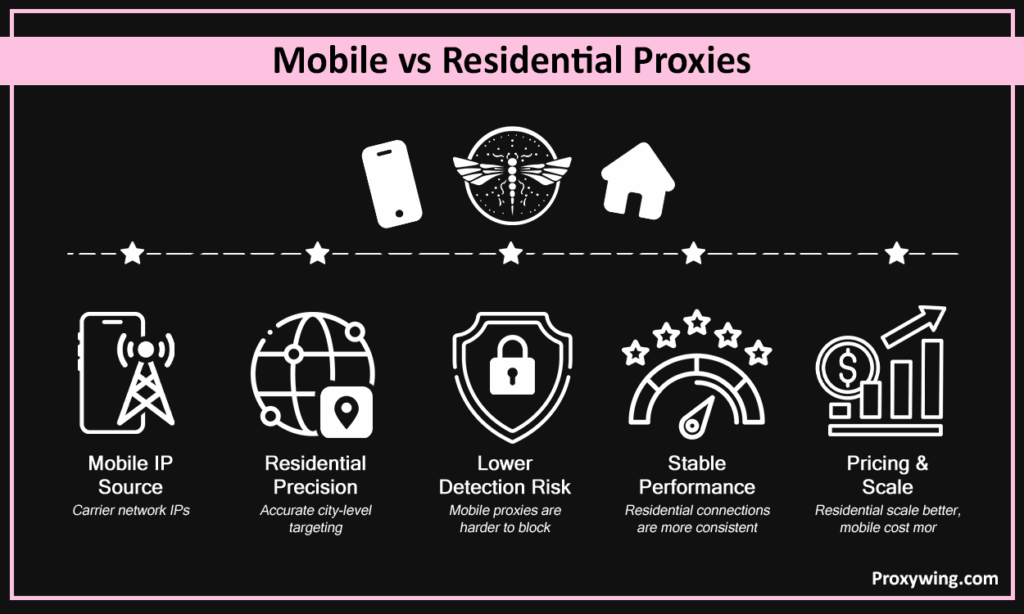
Home network proxies employ static IPs from home Internet Service Providers (ISPs). On the other side, Mobile proxy solutions employ IPs from mobile phone carriers. This distinction affects how websites assess threats. Carrier IPs are frequently seen as more trustworthy when compared to residential ones.
These solutions are pretty prone to blocks. Residential-proxies still work successfully, but they could be blocked more often than mobile ones. But the outcomes rely on the specific tasks, the vendors, and the behaviour.
Residential proxies make internet connections more stable. They typically offer higher speeds for lengthy periods of time. The speed of carrier-based proxies may change depending on how busy the network is. They still do a good job for a plethora of tasks, while some users may prefer it because of personal liking.
Both kinds of proxies can use rotating IPs. Residential-proxies let you easily control your sessions manually, while carrier networks inherently rotate mobile proxies.
Both proxy types effectively support rotating IPs.
Sticky sessions are quite helpful when you need the same IP for smooth login flows.
Home-based proxies offer you very accurate locations, like targeting at the city level or the pin code of specific regions. Mobile proxies rely on carrier networks, therefore their accuracy may not be high.
Residential proxies are better at scale. They aid with large amounts of data operations. On the other hand, carrier proxies are limited. These rely on the movable devices as well as carriers that are available.
Most of the time, residential-proxies use GB-based prices, however because of limited availability, carrier-based proxies are much more expensive. It is imperative to note that low-cost proxy solutions could impact the quality of the connection. So, it is advised to always look at what the plan includes.
Use residential-proxies when you need both scale as well as efficiency.
Best scenarios:
These residential proxies setups are pretty helpful in handling high-volume tasks at a better costs.
When trust is your priority, we recommend using mobile proxies.
Best cases to use these solutions:
In situations where other types of proxies don’t work, a mobile proxy may assist.
Don’t only look at the price, pay attention to the outcomes also.
Getting the best results relies on the following factors:
Remember, a bad configuration may even lead to the failure of the most reliableproxy.
Plans that are pretty cheap may appear good at first. But they might cause additional blocks.
This is how to measure value:
Mobile proxies might sometimes be worth the extra costs since they work better.
There are three things to think about while picking one:
Choose residential proxies if you want to save money and get more done. Pick mobile proxies if you want the most trust and the fewest blockages.
This last comparison should help you make your choice.
In current online processes, both residential proxies and mobile proxies are quite important. Choosing one of the best proxy for your requirements is the key to your success.
If you’re still comparing, start with residential-proxies, in case your preference is scalability. When you run across stringent blocks, switch to carrier-based solutions. Remember, the ideal proxy setup always finds the appropriate mix between trust, cost, and speed, while also providing flexibility that several others may not match.
Article written by:

CEO
Founder of Proxywing. Drives growth across EU, US, and Asian markets, combining B2B strategy with a hands-on focus on product quality, 99% uptime, and responsive support.
All articles by author (64)Not always. Mobile proxies are more trustworthy, while static residential proxies are better for scaling and price.
Accounts are safer with carrier-based proxies. They employ genuine mobile networks as well as IP addresses from shared real carriers.
For web scraping, residential proxies work well. They help in collecting vast amounts of data and making things function better.
You can, yes. However, stringent platforms may still be able to find patterns. Use solutions from trusted vendors and make proper rotation.
There aren’t a large number of mobile proxies, hence they cost extra. They use genuine mobile devices as well as carrier networks, which are tougher to grow.