The ads.txt Delivery Map: 15 publisher sites pointed to 9 other hosts
In a panel of 150 publisher sites, 15 ads.txt responses redirected to nine other hosts. Four hosts accounted for 10 of those routes.
Published: Reading time: 6 min
Table of contents
Result
15 sites / 9 hosts
Observed cross-host ads.txt redirects in a 150-site panel
15 publisher sites pointed to 9 other hosts
In a fixed panel of 150 publisher candidates, ProxyWing recorded 15 sites whose ads.txt response directed the collector to a different host. Those redirects named nine distinct destination hosts. Four destinations appeared more than once and together accounted for 10 of the 15 publisher routes.
This is a count of observed routes, not the share of all US publishers that outsource ads.txt. Collection was incomplete for part of the panel. A cross-host redirect also does not establish that the destination belongs to an independent company.
Key findings
- 15 publisher origins returned a cross-host ads.txt redirect, pointing to nine destination hosts.
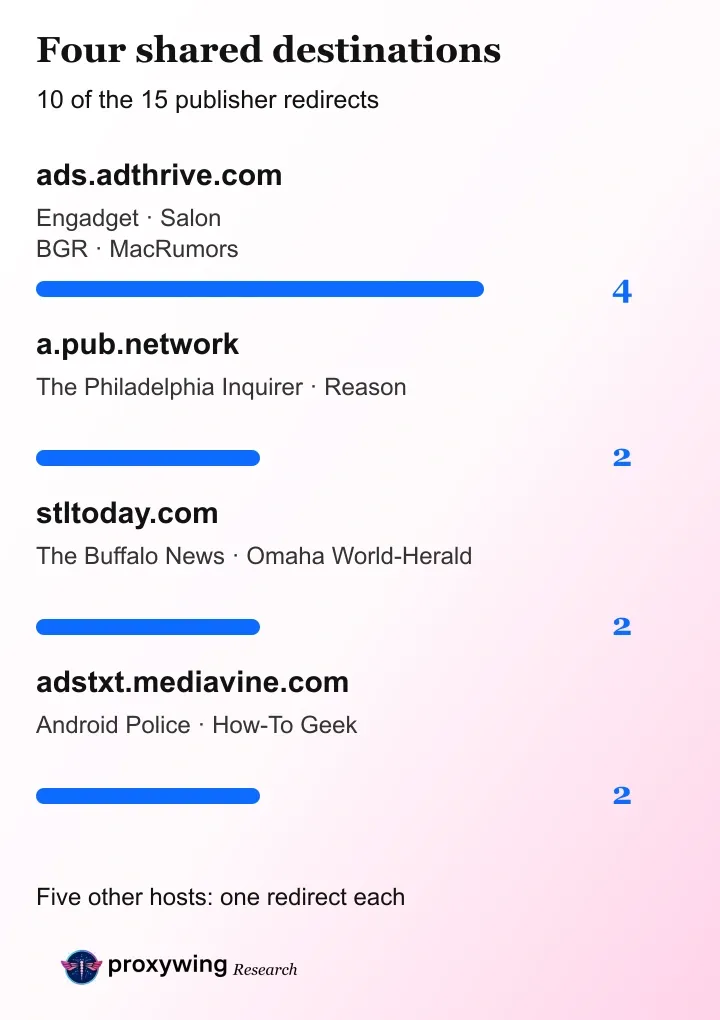
- Four shared hosts accounted for 10 publisher routes. The most frequent host, ads.adthrive.com, appeared for four sites.
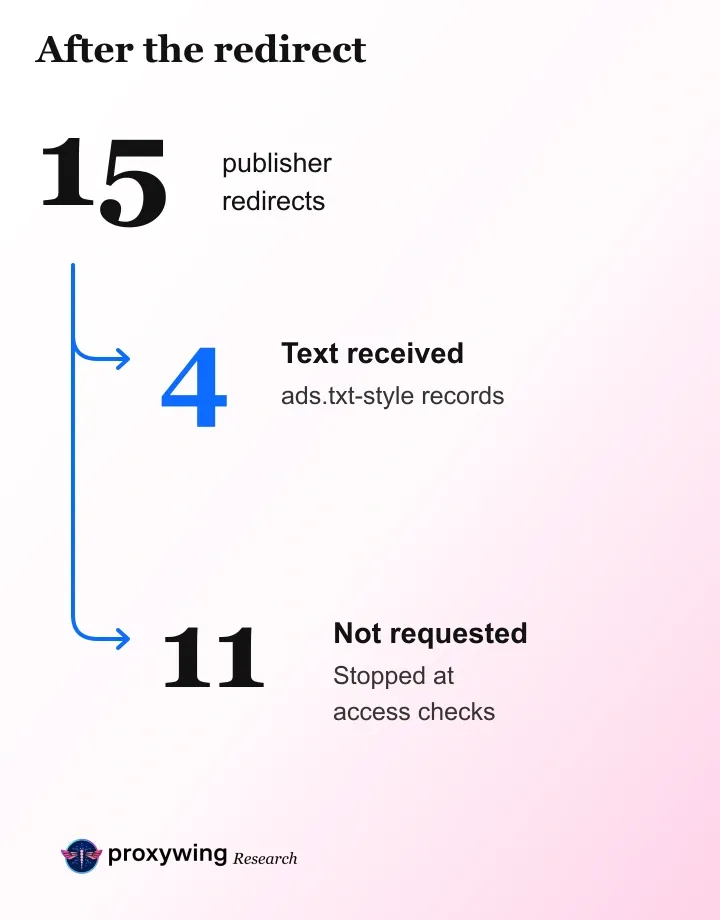
- Four redirect chains ended in a captured text response containing ads.txt-style records. The other 11 destinations were not requested under the collection rules.
- Across the full panel, 69 first-pass observations returned text containing ads.txt-style records. This was a content screen, not a full validation of the standard or the listed sellers.
- A separate follow-up completed 11 previously outstanding checks. Digital Trends returned record-like text after an earlier network error, but the later check used a different execution environment.
Following the ads.txt delivery route
Ads.txt lets a publisher declare companies authorized to sell its digital advertising inventory. The file can redirect a client to a URL on another host, including a shared service or another publisher's domain. IAB Tech Lab Authorized Digital Sellers with ads.txt and app-ads.txt
An ad-verification crawler needs both addresses: the publisher that starts the request and the host asked to supply the file. Keeping only one loses part of the delivery route.
We mapped those visible HTTP handoffs. We did not test advertising transactions, calculate revenue exposure or measure how quickly buyers refresh cached authorization files.
Four shared hosts accounted for 10 publisher routes
The largest observed group contained Engadget, Salon, BGR and MacRumors. Each pointed to ads.adthrive.com. The Philadelphia Inquirer and Reason pointed to a.pub.network. The Buffalo News and Omaha World-Herald pointed to stltoday.com. Android Police and How-To Geek pointed to adstxt.mediavine.com.
The table groups routes by hostname. Publishers in one group may share an owner, and a hosting service may serve unrelated clients. Corporate ownership requires separate evidence.
Destination host | Sites | Publisher sites |
|---|---|---|
ads.adthrive.com | 4 | Engadget, Salon.com, BGR, MacRumors |
a.pub.network | 2 | The Philadelphia Inquirer, Reason Magazine |
stltoday.com | 2 | The Buffalo News, Omaha World-Herald |
adstxt.mediavine.com | 2 | Android Police, How-To Geek |
adstxt.dsc-ato.com | 1 | CNN |
www.paramount.com | 1 | CBS News |
htlbid.com | 1 | The Sacramento Bee |
adstxt.publisherdesk.com | 1 | TribLIVE.com |
config.playwire.com | 1 | Android Authority |
Four routes completed a text delivery
Four of the 15 routes completed a first-pass delivery with ads.txt-style records: CBS News, TribLIVE, The Buffalo News and Android Authority. The other 11 destination requests were withheld by the collector's access rules. The origin response still established where the client had been told to go.
For the 11 unrequested destinations, availability remains unknown. The dataset keeps the origin response, Location value, decision to continue and terminal result in separate fields.
An automated research agent should retain the same distinction. Receiving a redirect establishes the next URL, but the destination document still needs to be fetched and checked.
Coverage of the 150-site panel
The list contained 50 national, 50 regional and 50 specialist publisher candidates. It was selected deliberately, not sampled randomly or drawn as a ranking of the largest US publishers. Explicit US-audience or US-edition support was retained for 52 candidates; the remaining 98 were left geographically unconfirmed under the documentary criteria. We therefore report a publisher-panel study rather than a US-market prevalence estimate.
The table records what happened during collection, including decisions not to continue. It should be read alongside the access rules in the methodology.
Recorded first pass state | Candidates |
|---|---|
Text containing seller-like records | 69 |
Robots policy disallowed the request | 3 |
Robots policy unresolved | 19 |
Blocked workflow outcome | 8 |
Environment block before measurement | 1 |
HTTP error | 8 |
Response failed the text screen | 1 |
Current homepage host unresolved | 39 |
Redirect failed a safety prerequisite | 1 |
Network error | 1 |
Total | 150 |
The 69 text observations included four of the 15 redirect cases. The other 11 redirect cases sit among the stopped workflows. Adding 69 and 15 would therefore double-count completed redirect deliveries.
The text screen required ads.txt-like seller records in the captured body. It did not confirm every record's syntax, validate seller accounts or establish that any listed company was currently authorized. A body passing this screen should not be called a fully validated ads.txt file.
What changed in the follow-up
We completed the 11 follow-up checks that remained outstanding after the expansion collection. Eight returned record-like text and three returned HTTP errors. Ten retained the same broad outcome class. Digital Trends changed from a network error to a text response.
The follow-up used a separate local execution environment with no verified US network location. Because the time and client environment differed, the change does not isolate the cause of Digital Trends' earlier error. Both observations remain in the dataset.
ESPN's first ads.txt observation was completed separately during the same-day closing pass. It returned text containing seller-like records and increased the primary text count from 68 to 69. Its collection wave is identified in the data.
Some hosted files leave no visible redirect
A redirect map captures only one form of delegation. HTL BID's own documentation describes both a redirect method and a proxy method. In the proxy method, the publisher's server fetches the hosted file on the client's behalf. The external client need not see a move to the hosting service. HTL BID Ads.txt Delegation
A same-host response can therefore conceal a hosted source. The nine destinations in this study cover visible redirects only. They do not identify every service behind the panel.
A 2019 IMC paper, A Longitudinal Analysis of the ads.txt Standard, documented file-sharing and redirect arrangements involving AdThrive and MediaVine. This study adds a current publisher-by-publisher map, with separate records for redirects, completed deliveries and collection stops. A Longitudinal Analysis of the ads.txt Standard
What an ad verification monitor should retain
Keep the publisher's requested URL, every HTTP redirect, the destination hostname, the collection time and the terminal content check in one record. Record an access-policy stop as a stop, rather than manufacturing a destination response.
Track repeated destination hosts alongside the publishers that point to them. If several checks change together, the shared destination is a useful starting point for investigation. The map itself does not establish an outage.
Keep ownership evidence separate from delivery records. A shared hostname, identical file content and a common parent company describe different relationships.
Methodology
The collection used a fixed panel of 150 candidate sites and public, unauthenticated pages on October 16, 2026. The initial wave covered 60 candidates; the extension added 90. Their national, regional and specialist labels describe editorial strata, not statistically weighted market segments.
The workflow sought a current homepage host, evaluated access prerequisites and recorded ads.txt requests where permitted. Redirect destinations were evaluated separately before another request. Access rules were conservative, and the two supplied collection waves differed in how some unavailable robots.txt outcomes were handled. The data retain these collection states rather than treating the waves as an identically administered experiment.
Cross-host routes in the reported set move from a publisher hostname to a distinct destination domain. Routine HTTP-to-HTTPS and www canonicalization alone are not included. Each of the 15 reported Location values was checked against its retained response-header evidence. All 91 first-pass body records were hash-checked, and the 69 text-positive bodies were independently screened for record-like lines.
The closing pass completed ESPN's first observation and 11 follow-ups without replacing earlier results. The original collectors used a shared execution environment with an opaque upstream proxy; the closing pass used a separate local environment. Neither provides a verified US-origin vantage, and we do not attribute these captures to ProxyWing's commercial proxy network.
This is descriptive accounting of a purposive panel. We publish counts and the complete candidate table, not a probability-sample estimate or a confidence interval for the US publishing market. No login, paid API, advertising transaction, CAPTCHA solving or access-control bypass was part of this study.
Sources
- IAB Tech Lab Authorized Digital Sellers with ads.txt and app-ads.txt. Definition and current entry point to the official specification.
- HTL BID Ads.txt Delegation. Official documentation of proxy and redirect delivery methods.
- A Longitudinal Analysis of the ads.txt Standard. Prior research, IMC 2019, section 4.1.2 and Table 1; not a source of the 2026 counts.
Data and reproducibility
The download includes the 150-site panel, all 15 redirect routes, nine destination-host summaries, the 11 closing checks, reduced header evidence, body hashes, calculation code and source provenance. The calculations can be rerun from the included normalized observations without making new website requests.
ProxyWing-derived tables, aggregate results and original figures are available under CC BY 4.0. Third-party pages and original input archives retain their own terms and are not relicensed by this release. A live repeat may return different content because this is a dated snapshot.
Cite this research
ProxyWing Research. The ads.txt Delivery Map: 15 publisher sites pointed to 9 other hosts. Observation date October 16, 2026. https://proxywing.com/research/ads-txt-delivery-map-2026
Frequently asked questions
It establishes a visible move to another host. It does not establish independent ownership, the commercial arrangement or whether the destination was successfully fetched.
No. For 11 observed redirects, the destination request was not made under the collection rules. Its availability was not measured.
No. It maps delivery routes for an authorization file. It does not measure invalid traffic, fraudulent inventory, seller-account validity or financial losses.
No. The 150 candidates form a deliberate editorial panel. US status and collection coverage are recorded separately; neither supports a market-wide estimate.
Proxy infrastructure for research and web workflows
Choose the ProxyWing network that fits your collection, monitoring, verification, or automation workflow.