The Static IP Gap in AI and Automation
A static IP for tool calls can leave authentication, browsing or storage on a different route. We reviewed 16 platforms to compare coverage, address sharing and pricing.
Published: Reading time: 9 min
Table of contents
Result
16 platforms
Public documentation reviewed for AI and automation workflows
Static IP coverage depends on the operation
We reviewed the public documentation of 16 AI and automation platforms. Authentication, tool calls, browsing and storage can use different routes; a static address assigned to one operation may not apply to the others.
The review compares published routing rules, address sharing, plan requirements and retention conditions. It does not measure runtime traffic or service reliability.
Key findings
- We reviewed 16 platforms from an initial list of 60, using public documentation collected on October 16 and 17, 2026.
- Pipedream Connect sends VPC tool calls through a dedicated address, while API Proxy and account connections use a shared static range.
- Render's dedicated IP set covers most build traffic, but Docker image pulls use shared ranges. Vercel requires a separate opt-in for build traffic.
- Steel's USD 5 monthly IP fee requires the USD 250-per-month Scale plan. The IP add-on and the subscription needed to access it are separate costs.
Where a static IP applies
An AI workflow may call a model, invoke a tool, open a remote browser and write to storage. These steps can run in separate services or containers. At the destination, an IP allowlist checks the source of each connection.
We examined egress: traffic leaving a platform for another system. A fixed address used to reach an application from outside is an inbound feature and falls outside this comparison.
Documented model | What it establishes | Example or scope |
|---|---|---|
Shared static range | A known address or pool used by multiple customers | Dust and Vercel shared Static IPs |
Exclusive assignment | An address or set reserved to a stated customer resource | Render workspace; Anchor profile |
Published changeable list | Documented outbound addresses without a permanent allocation promise | n8n Cloud; Make zone lists |
External proxy configuration | A component sends traffic through a supplied proxy | Browserbase; HTTP nodes |
Customer-managed network | The customer controls egress in their own hosting or network | Separate from the vendor-managed offers in this comparison |
A platform can offer several of these models. Shared static ranges may be sufficient for an allowlist, but they cannot identify an individual customer. n8n explicitly warns that its shared Cloud IPs do not prove which instance sent a request. n8n Cloud IP addresses
Six places where the route changes
These six examples show where a request uses a different route or needs a separate setting.
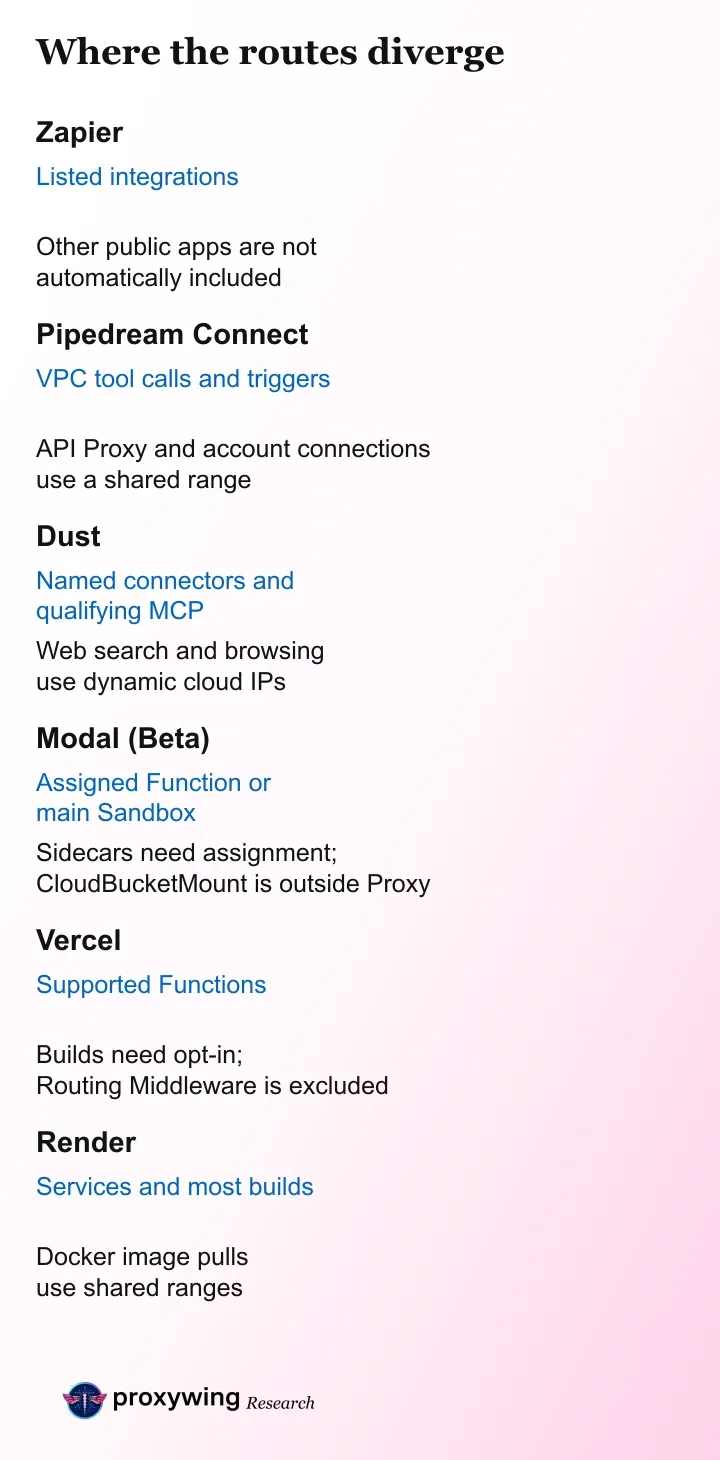
Integration coverage in Zapier
Zapier names the public integrations covered by static IP. Professional, Team and Enterprise are eligible; Free is not. The list includes AI integrations and MCP Client by Zapier, but the feature is not available for every public app. Adding an uncovered app to the same workflow does not extend the static-IP rule to it. Zapier static IP scope
Authentication routes in Pipedream Connect
In Pipedream Connect, assigned-project tool calls and triggers use the dedicated VPC address. API Proxy requests and account connections use a separate, shared static range. An allowlist built only around the VPC address can therefore miss a route needed by the application. Pipedream Connect VPC
Browsing and MCP in Dust
Dust uses shared static egress for Snowflake, BigQuery and qualifying remote MCP connections. Remote MCP normally requires a workspace-verified domain, with an exception for the official BigQuery MCP server. Web search and browsing use dynamic cloud IPs. Configuring access for a database tool does not settle the browsing route. Dust static egress IPs
Storage and additional containers in Modal
Modal's Beta Proxy covers the Function or main Sandbox container to which it is assigned. Sandbox Sidecars need their own assignment. CloudBucketMount traffic does not use the Proxy for either Functions or Sandboxes, so storage needs a separate network check. Modal Proxy IPs
Build configuration in Vercel
Vercel's shared Static IPs cover supported Functions. Build traffic has a separate switch, disabled by default; Routing Middleware is excluded. Secure Compute is a distinct Enterprise option with its own network setup and pricing. Vercel shared Static IPs
Image downloads in Render
Render routes build requests such as package downloads through the dedicated IP set. Docker image pulls are an explicit exception and use shared outbound ranges. A build can therefore require more than one set of allowlist entries. Render dedicated IPs
A fixed address can still be shared, pooled or reassigned
Render reserves three regional addresses exclusively for a workspace. A request may use any of them. Modal can also assign several addresses to a Proxy and select among them. Allowlisting only the last address seen in a log can leave valid requests blocked. Render dedicated IPs Modal Proxy IPs
GitHub Actions allocates a static range to an eligible larger-runner pool. Jobs share that range, and the reservation has a clear inactivity limit: after more than 90 days without use, the range is removed and cannot be recovered. A dormant workflow may need an allowlist update when it returns. GitHub larger-runner networking
Anchor Browser reserves a sticky IP for a profile and reuses it across that profile's sessions. A session-level proxy can override it. The reviewed pages do not state how long the reservation lasts. Anchor Dedicated Sticky IP
The unit of allocation matters. A workspace, runner pool and browser profile have different lifecycles. Record the full assigned set and its retention conditions alongside the destination's allowlist.
What sits behind the IP price
The four offers below illustrate different ways of charging for network access. We retained the published USD amounts and billing units as captured on October 17, 2026.
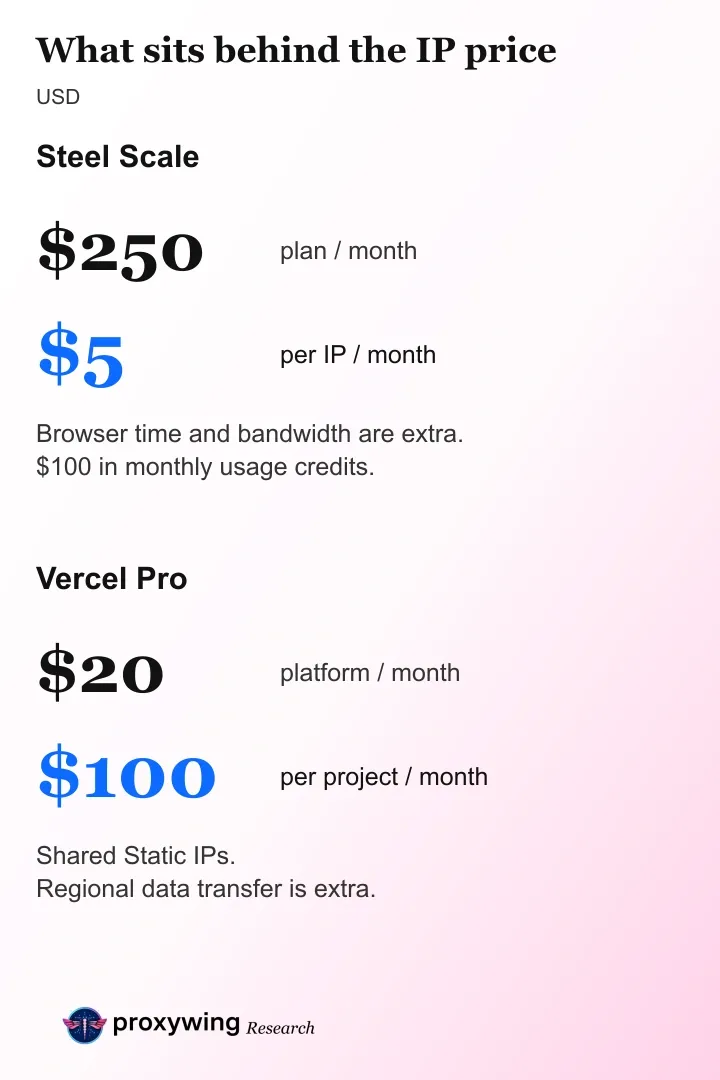
Steel charges USD 5 per IP per month on its USD 250-per-month Scale plan. Scale includes USD 100 in monthly usage credits; the captured terms do not say whether those credits cover the IP subscription. Browser time and proxy bandwidth are metered separately. Steel pricing Steel dedicated IP configuration
Vercel's shared Static IPs cost USD 100 per project per month, in addition to the Pro platform fee and regional transfer charges. Project count is therefore a cost input even for an application that sends little traffic. Vercel shared Static IPs Vercel Pro plan
Zapier Professional starts at USD 19.99 per month when billed annually. Browserbase's USD 20-per-month Developer plan permits a custom proxy, which must be supplied separately. These prices buy different things: access to a shared range, permission to connect a proxy, or a leased address. Zapier pricing Browserbase proxy scope and rules Browserbase pricing
A proxy setting belongs to the client that uses it
Browserbase accepts a proxy when a browser session is created. It evaluates domain rules in order; excluded domains, or unmatched domains without a fallback, can go direct. Agent code hosted elsewhere has its own network configuration. Browserbase proxy scope and rules
Make's HTTP V4 module and n8n's HTTP Request node also expose proxy controls. Those settings apply to requests made by the configured component. Their presence alone does not establish proxy coverage for other app connectors in the workflow. Make HTTP app n8n HTTP Request node
Start with the calls that need a stable address. Identify the client making each request, then check whether it accepts the required proxy protocol and credentials. Where the native static route already covers the operation, an external proxy may be unnecessary.
Conflicting documentation and preview limits
Vellum's Workflows page describes four outbound IP addresses but lists five, including in its configuration example. Its separate personal-assistant pricing also mentions static IP. We kept the two products separate and did not use the assistant price as a Workflow quote. Vellum Workflows static IPs Vellum assistant pricing
Anchor's homepage lists Custom proxy under Team. Its documentation pricing matrix places Bring your own proxy under Growth and Enterprise. The public pages disagree on the lowest qualifying plan, so the dataset leaves that field unresolved. Anchor homepage plan cards Anchor documentation pricing
LangSmith gives a broad NAT rule for Cloud deployments created after January 6, 2025. We retain that rule as written, without treating the lack of a separate statement for each worker operation as an exclusion. Other LangSmith products have a separate IP list. LangSmith Cloud platform features
Blaxel labels dedicated egress gateways private preview, limited to sandboxes and not intended for production. Those conditions take precedence over the broader introductory description of the feature. Blaxel dedicated egress gateways
The 16-platform panel
The download includes each platform's scope, routing boundaries and supporting source IDs. This table identifies the network option reviewed and its availability.
Platform | Network option reviewed | Availability or qualification |
|---|---|---|
Zapier | Shared static ranges | Professional, Team and Enterprise |
Make | Published outbound lists and BYO proxy | HTTP V4 release available to all customers |
n8n Cloud | Shared addresses and request-level proxy | Cloud; HTTP Request node option |
Pipedream Connect | Dedicated VPC and separate shared range | Business VPC offer with custom pricing |
Trigger.dev | Paid Cloud static IPs | Paid plans in the official announcement; current product page retains feature |
Vellum | Workflow static set and Enterprise VPC | Current Workflow commercial entitlement unresolved |
Dust | Shared regional static egress | Feature documented; minimum plan not established |
LangSmith Deployment | Regional static NAT | Managed Cloud on Plus or above |
Browserbase | Custom browser-session proxy | Developer or above |
Steel | Leased dedicated IP and BYO proxy | Dedicated IPs on Scale; Enterprise custom |
Anchor Browser | Profile-reserved sticky IP | Documented feature; entitlement unresolved |
Modal | Workspace-unique Proxy | Beta; Team and Enterprise |
Blaxel | Dedicated sandbox gateway | Private preview |
Vercel | Shared Static IPs or dedicated Secure Compute | Shared Static IPs on Pro and Enterprise |
Render | Exclusive regional three-IP set | Pro or higher |
GitHub Actions | Static range for a larger-runner pool | Enterprise Cloud and compatible larger runners |
Trigger.dev announced paid-plan static IPs in August 2025 and still advertises them on its product page. Make publishes outbound addresses by zone. Neither page establishes exclusive ownership or an unlimited retention term. Trigger.dev static IP announcement Trigger.dev product features Make outbound IP addresses
Methodology
We began with a fixed discovery list of 60 workflow, agent-runtime and developer products. The initial review on October 16, 2026 identified questions about routing, pricing and feature identity. We selected 16 products for follow-up on October 17 because their documented network options and unresolved questions were relevant to this study. The panel is a purposive sample, not a usage ranking or a representative sample of the market.
The follow-up contains 127 source records: 115 captured URLs, 10 blocked retrievals and two unavailable retrievals. Blocked pages were not treated as evidence that a feature was absent. Source records preserve the capture date separately from the original publication or update date.
For each profile we recorded the address model, operation covered, configuration requirements, plan and preview status. We kept shared ranges separate from exclusive assignments and customer-configured proxies. Conflicting or unestablished details remain unresolved. Prices retain their original units and billing conditions; we did not estimate an all-in workload bill.
The six routing cases and four commercial examples were selected to explain distinct arrangements. They are not the results of a uniform pass-or-fail test, and their counts cannot be used to calculate a market failure rate or a US adoption estimate.
This is a public-documentation study. We did not create accounts, buy plans, run workloads or measure packets. The results describe published scope and terms, not observed leaks or service reliability. The public release contains derived tables and source references; it does not republish full vendor documentation.
Sources
Official pages captured October 17, 2026. Original publication dates may be earlier.
- Zapier static IP scope
- Zapier pricing
- Make outbound IP addresses
- Make HTTP app
- n8n Cloud IP addresses
- n8n HTTP Request node
- Pipedream Connect VPC
- Trigger.dev static IP announcement
- Trigger.dev product features
- Vellum Workflows static IPs
- Vellum assistant pricing
- Dust static egress IPs
- LangSmith Cloud platform features
- Browserbase proxy scope and rules
- Browserbase pricing
- Steel dedicated IP configuration
- Steel pricing
- Anchor Dedicated Sticky IP
- Anchor homepage plan cards
- Anchor documentation pricing
- Modal Proxy IPs
- Blaxel dedicated egress gateways
- Vercel shared Static IPs
- Vercel Pro plan
- Render dedicated IPs
- GitHub larger-runner networking
Data and reproducibility
The data package contains 16 platform profiles, six routing cases, four price examples, the source register and the 60-product discovery list. A Python script checks references, file integrity and the published counts.
Cite this research
ProxyWing Research. The Static IP Gap in AI and Automation. Public documentation reviewed October 16 and 17, 2026. https://proxywing.com/research/static-ip-gap-ai-automation-2026
Frequently asked questions
A service may allocate a fixed set. Render reserves three addresses, and requests can use any of them. Use the full documented set when configuring an allowlist.
No. Other customers can use the same range. Keep application authentication in place even when the source IP is allowed.
Only where the platform supports that scope. Browser sessions, HTTP nodes and separately hosted agent code can be independent network clients.
Retention depends on the product. GitHub removes an eligible larger-runner pool's static range after more than 90 unused days; the old range cannot be recovered.
Proxy infrastructure for research and web workflows
Choose the ProxyWing network that fits your collection, monitoring, verification, or automation workflow.