


Proxy Authentication Methods Explained: Username/Password vs IP Whitelisting
06.10.2026 10 min
Datacenter proxies are one of the most popular proxy types that most providers offer in 2026. These proxies rely on IP addresses of servers running in traditional data centers, making them cheap to acquire. They also offer the fastest speeds when compared to other types, making them a great option for use cases like web scraping that require the fastest possible speeds.
When choosing datacenter proxies, one of the most important decisions you need to make is the right provider to go with. In today’s guide, we will discuss the best datacenter proxies for web scraping in 2026. We will compare the differences between providers, allowing you to choose one that offers the features that matter for your next web scraping project. Let’s dive in!
| Provider | Best For | Proxy Types | Starting Price | Web Scraping Performance |
| ProxyWing | Automation & web scraping | Datacenter, ISP, Residential, Mobile, Dedicated | $0.90/month | 99.99% uptime, <1s response time, 1Gbps bandwidth |
| IPRoyal | Budget web scraping, small teams | Shared & dedicated DC, ISP, Residential | $1.39/IP | 99.9% uptime, <0.2s response time |
| Bright Data | Large-scale enterprise web scraping | DC, ISP, Residential, Mobile | $1.20/IP | 99.99% uptime, 0.9–2.0s response time |
| Oxylabs | Mid-to-large data collection projects | DC, ISP, Residential, Mobile | $1.20/IP | 99.9% uptime, <0.5s response time |
| Smartproxy (Decodo) | Teams scaling from free tools | Shared DC, Residential, ISP | $0.02/IP | 99.99% uptime, <0.3s response time |
| Webshare | Hobby scrapers & developers | Shared DC, Static Residential | $2.99/month | 99.97% uptime, <100ms response time |
| Razorproxy | High-frequency data collection | Shared & dedicated DC | $2.80/month | Unlimited bandwidth, up to 3,000 threads |
| Rayobyte | Predictable per-IP cost | Dedicated DC, ISP, Residential | $1.00/IP | 99.7% uptime, ~0.75s response time |
Datacenter proxies are a proxy type that routes traffic through server-hosted IPs from cloud and hosting infrastructure before forwarding it to the targets. Unlike residential proxy services that use ISP-assigned or mobile proxies that use IPs on mobile networks, these rely on server IPs, which makes them faster, but also much easier to detect. Web scrapers benefit from using datacenter proxies for their speed, low cost, and predictable performance.
Shared proxies pool IPs across multiple users, which makes them cheaper, but also increases their block risk if the pool’s reputation is poor. Dedicated proxies on the other hand assign an IP exclusively to one user, offering a cleaner history and more consistent success rates at a higher per-IP cost. As a result, dedicated datacenter proxies offer better performance as well.
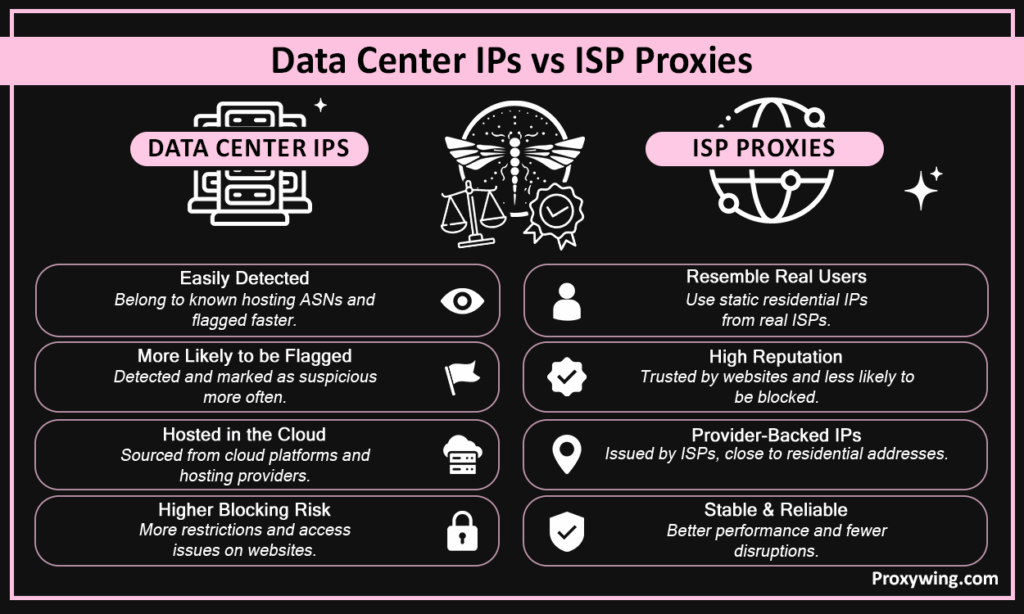
Pure datacenter IPs sit in recognizable hosting ASN ranges, making them easier for anti-bot systems to flag. These IPs are typically sourced from hosting and cloud service providers. ISP proxies on other hand use static IPs registered to ISPs but hosted in data centers, which gives them residential-like legitimacy at datacenter speeds. ISP proxies are the perfect middle ground if you need performance without sacrificing reliability.
Providers offering different configurations for datacenter proxies should be your target.
Speed, low cost, near-unlimited bandwidth, and easy bulk scaling make datacenter proxies the default starting point for most scraping operations. ProxyWing offers datacenter proxies with dedicated IP in several regions. Let’s explore the benefits of these proxies in more detail:
Datacenter proxy servers connect via direct fibre uplinks with no last-mile bottleneck. For high-volume projects, that speed advantage compounds across thousands of requests and directly improves pipeline throughput. They are also highly available since they depend on cloud infrastructure that typically has higher uptime compared to residential devices.
Datacenter proxies typically cost $0.50–$2/IP versus $3–$15/GB for residential and rotating mobile IPs. At scale, a datacenter-first approach can reduce proxy spend by 10–30x for targets where detection isn’t a major concern. So, if you’re on a tight budget or testing out proxies for the first time, datacenter proxies are usually a good place to start.
Despite the benefits we’ve shared in the previous section, there are still certain circumstances where using datacenter IPs is not ideal. For example, when dealing with targets running Cloudflare Bot Fight Mode, DataDome, or Akamai actively fingerprint datacenter ASN ranges. For such scenarios, rotating residential proxies are the step up with mobile proxy services being the most reliable choice.
Providers were evaluated on the key factors:
The providers below offer the best balance of price, performance, and pool quality for web scraping in 2026. Each was chosed based on real data collection use cases, from bulk open-data collection to moderately protected e-commerce targets.
ProxyWing leads the list with datacenterIPs. Its datacenter proxies offer sub-1s latency, 99.9% uptime, and city-level targeting across many countries around the world. ProxyWing also guarantees strong success rates on e-commerce, SERP, and classified targets with prices starting from as low as $0.90/month.
Key Features
Ideal For: E-commerce data collection, SERP monitoring, and automation
Pricing: From $0.90/month
Founded in 2020, IPRoyal has gradually become one of the most popular providers, mainly due to its non-expiring traffic offering. IPRoyal also offers affordable shared and dedicated datacenter plans with a beginner-friendly dashboard and flexible PAYG pricing. With its coverage for datacenter IPs I 60+ countries, it is a solid entry point for small teams and budget scraping tasks.
Ideal For: Small teams, budget data collection
Pricing: From $1.39/IP
Bright Data has been in the industry since 2014 and is now easily one of the leading providers mainly due to its massive IP pool. It has one of the largest IP pools in the market with full API control, flexible rotation, and audited infrastructure. It also has datacenter IPs in 90+ countries, making it one with the widest coverage. Bright Data is built for large-scale web scraping services that need reliability and compliance.
Ideal For: Enterprise-scale data collection, data pipelines
Pricing: From $1.20/IP
Since getting into the market in 2015, Oxylabs has gradually become a top provider for large businesses by focusing more on the needs of enterprise customers. It offers strong success rates on e-commerce and SERP targets, with shared and dedicated IP options plus a scraper API. Reliable for mid-to-large data collection projects needing consistent performance.
Ideal For: Mid-to-large data collection projects, e-commerce, and SERP
Pricing: From $1.20/IP
Smartproxy was founded in 2018, but later rebranded into Decodo with the goal of optimizing its offerings for AI-first workflows. It offers reliable shared datacenter IPs with PAYG pricing, city-level targeting, and a clean interface. Considering its significantly low prices, Decodo is a good option for teams scaling up from free scraping management tools.
Ideal For: Teams scaling up, PAYG data collection
Pricing: From $0.02/IP
It has been in the game since 2015 and now offers its datacenter proxies in 45+ counters worldwide. Webshare has shared datacenter proxies with a permanent free 10-proxy tier with no credit card required, making it a great choice for users trying out proxies for the first time. It is best for developers testing scraping tools and hobby-scale projects.
Ideal For: Developer testing, hobby data collection
Pricing: From $2.99/month (free tier available)
It is another reliable option for datacenter IPs with coverage in the US, UK, and Germany. It provides high-speed shared and dedicated datacenter proxies with unlimited bandwidth and up to 3,000 threads. It has US, EU, and UK IP pools for its datacenter IPs with customizable plans.
Ideal For: High-frequency data collection, e-commerce automation
Pricing: From $2.80/month
Rayobyte is one of the most affordable options on the list. It was founded in 2015 and has gradually improved its coverage with datacenter IPs now in 27+ countries. It offers dedicated datacenter proxies with unlimited bandwidth, unlimited threads, and predictable per-IP pricing. Rayobyte also has a reliable infrastructure with strong support.
Best For: Predictable per-IP scaling, high-frequency data collection
Pricing: From $1.00/IP
Shared IPs work well for bulk open-data data collection and price monitoring on basic websites — pool size dilutes block risk and keeps cost per request low. Dedicated IPs are worth the premium for login-gated targets, account creation workflows, and sustained sessions where a shared pool’s reputation history would be a liability.
| Proxy Type | Speed | Cost | Trust Score | Best For |
| Datacenter | Fastest | Cheapest | Low | Bulk data collection, open data, basic SERPs |
| Residential | Medium | Mid-range | High | Protected websites, e-commerce, social media |
| Mobile | Medium | Most expensive | Highest | Ad verification, mobile-first platforms |
Your choice largely depends on your goals and budget. Use datacenter proxies for speed-first, high-volume workflows on unprotected targets. Upgrade to residential IPs for protected sites, and mobile for platforms that scrutinize device type.
Start by getting your credentials (host (server IP address), port number, username, and password) from your provider dashboard. Choose rotation mode per-request or sticky and then pass the proxy into your HTTP client:
| import requests proxies = { “http”: “http://user:pass@proxy.provider.com:8080”, “https”: “http://user:pass@proxy.provider.com:8080”, } response = requests.get(“https://target-site.com”, proxies=proxies) print(response.text) |
On a 403 or 429, rotate to a fresh IP and retry with a short random delay. Add retry middleware in Scrapy or Playwright to handle this automatically.
Most providers handle both via a single gateway endpoint with a session ID parameter.
Raw datacenter proxies give full control but require you to handle JavaScript rendering, CAPTCHAs, and retries yourself. Web scraping APIs handle those challenges automatically at a higher per-request cost. Use raw proxies for straightforward targets and upgrade to a web data collection API when bot protection consistently defeats your rotations. Yes, there is an extra cost, but the reliability it gives you makes it worth it.
Article written by:

Product & Support Operations Lead
Built Proxywing's support department from scratch — documented workflows, clear escalations, consistent quality. Now bridges the CEO and engineering, keeping infrastructure projects on track.
All articles by author (68)Yes, for the right targets, they do a good job at a fraction of the price you would pay for residential IPs. Ideal use cases include open data scraping, basic SERPs, and data collection on sites without advanced bot detection. For targets running Cloudflare, DataDome, or Akamai, residential proxies are the better choice.
Webshare supports a free 10-proxy tier with no credit card required. For premium plans, ProxyWing has a starting price of $0.9/month, which doesn’t require bundling more than one IP.
A common rule: one IP per concurrent thread. Providers with unlimited threads on per-GB plans let pipeline design drive scale rather than IP count.
Yes, they do. Datacenter ASN ranges are easier for anti-bot systems to identify and flag. Residential and ISP proxy services have meaningfully lower block rates on protected targets.
Free proxies from unverified sources are unreliable and often already banned. A low-cost paid plan is almost always the better option. You can also take advantage of the trial versions offered by premium providers.