


Proxy Authentication Methods Explained: Username/Password vs IP Whitelisting
06.10.2026 10 min
Online gaming is a multi-billion dollar industry with billions of active users every month that spend several hours daily playing their favorite games. Gaming online is an incredible experience, especially if you can access all the games and features you need with no restrictions. However, this is usually not the case. Several online games and features are not available or completely banned in certain countries.
To bypass these restrictions, using proxies is one of the most reliable solutions many gamers opt for. Whether you’re a console, mobile, or PC gamer, proxies will allow you to access games with servers based in any region without restrictions. But which providers offer the best proxy servers for gaming? That’s the question this guide intends to answer.
This guide will explore the best proxy servers for online gaming, including their key features, pricing, and a lot more. By the end, you will have all the information you need to choose a provider that suits your gaming needs and budget.
| Provider | Proxy Type | Best For | Static IP | Avg. Latency | Protocols | Geo Locations | Bandwidth Limits | Starting Price | Gaming Rating |
|---|---|---|---|---|---|---|---|---|---|
| ProxyWing | ISP, Residential, Mobile, and datacenter | Reliability & Price | Yes | < 1s | SOCKS5, HTTP/S | 190+ Countries | Unlimited (ISP) | $0.90/mo | 9.8/10 |
| Bright Data | ISP, mobile, Residential, and datacenter | Global Coverage | Yes | 0.6s | SOCKS5, HTTP/S | 195+ Countries | Capped (Resi) | $1.30/IP | 9.2/10 |
| Oxylabs | ISP, mobile, Residential, and datacenter | High-Concurrency | Yes | Ultra-Low | SOCKS5, HTTP/S | 195+ Countries | Unlimited (ISP) | $1.60/IP | 9.5/10 |
| Decodo | ISP, mobile, Residential, and datacenter | Speed & Low Latency | Yes | < 0.2s | SOCKS5, UDP | 195+ Countries | Unlimited (Some) | $0.27/IP | 9.4/10 |
| IPRoyal | ISP, mobile, Residential, and datacenter | Occasional Gaming | Yes | < 0.2s | SOCKS5, HTTP/S | 195+ Countries | Non-Expiring | $1.75/GB | 8.9/10 |
Proxies for gaming work by routing your traffic through a remote server before being sent to the game’s server you intend to access. Here is why this is crucial for playing games.
One of the challenges of the online gaming industry is navigating regulations in different countries. Because of these regulations, some games are either delayed or completely restricted in certain regions. With proxies, gamers can bypass the geo-restrictions by choosing an IP based in one of the supported regions.
This enables access to early game releases, region-specific DLC, or less-congested servers in different time zones. Before choosing an IP address, first research the exact regions the game you intend to play is supported. You can then choose an IP address in one of those regions.
Proxies secure connections by ensuring your IP address is hidden for the destination website. This attribute is what makes them a good option for managing multiple accounts, especially on gaming platforms that have strict rules when it comes to creating more than one account.
On such platforms, running multiple accounts from one IP often triggers bot or multi-accounting bans. Proxies give you access to high-trust IPs that allow you to manage several profiles simultaneously without linking them to a single household connection. You need to ensure that each account uses a different IP address to avoid account linking and detection.
DDoS attacks have become a common trend especially when playing competitive games. These attacks specifically target your IP address, which effectively slows down your connection. With slow connection speeds or unreliable connections, no gamer will have a chance at winning a competition.
Using proxies allows you to deal with these attacks, especially in high-stakes tournaments. A proxy absorbs the malicious traffic from DDoS bots since it keeps your home network online and your real IP hidden. Overall, using a proxy significantly helps reduce any possibilities of network slow downs that could affect your streaming performance when playing competitively.
In some regions, it is pretty common for ISPs to throttle gaming traffic or use inefficient routing. Most ISPs know that gamers take up a lot of bandwidth, so they tend to resort to throttling their bandwidth to reduce congestion on their networks. Using proxies is one of the most effective ways to overcome these limitations.
Proxies on optimized backbones can provide a more direct path to gaming web servers, stabilizing jitter and reducing lag. For the best experience, we recommend choosing IP addresses that are closer to the game’s server. For instance, if the server for the game you intend to play in the USA, using dedicated residential IPs within the US will give you the best speeds.
Sometimes, but not by default. A proxy adds one more hop between you and the game server, and every hop costs a few milliseconds. Whether you end up faster or slower depends entirely on how bad your ISP’s route was in the first place.
The gain comes from routing, not from the proxy itself. If your ISP sends your traffic through a congested peering point or takes a detour across the country, a proxy sitting on a well-peered backbone can hand your packets a shorter path. Players on rural ISPs, on mobile carriers, and in regions with poor international peering see the biggest improvement.
The same applies when you play on a foreign server. Connecting to an EU server from the US through a proxy hosted near that server is often more stable than going direct, because the long leg of the trip runs on premium transit instead of public routing.
If your ISP already has a clean route to the game server, adding a proxy can only make it longer. The further your proxy sits from either you or the game server, the worse it gets. Routing through Singapore to reach a Chicago server will cost you [XX] ms and nothing else.
Free and shared proxies are a separate case. They are oversubscribed by design, so latency spikes under load are constant and packet loss is common. That is felt as rubber-banding rather than as a higher ping number.
Run a ping and traceroute to the game server both with and without the proxy before you buy a long plan. Our proxy tester and IP tracing tool show the hop-by-hop path so you can see exactly where the delay comes from. If the proxy route has more hops and a worse total, that provider is not for your connection.
Changing your IP address does not necessarily lead to security flags. Security systems for most online gaming platforms analyze several factors before flagging your traffic or restricting your account. Let’s explore this in detail below.
Using a static IP from a consistent geographic location mimics a standard user, making it the safest method for long-term account stability. Sticking to one IP is also a good solution since it doesn’t lead to frequent re-authentication triggers. When you randomly change your IP from two distant locations, most platforms detect impossible travel, triggering re-authenticate to maintain access.
Many providers offering proxies allow users to rotate IPs automatically. Even though this approach may work for tasks like data scraping, it is not ideal for online game streaming. Rapid IP rotation, mismatched locations (such as logging in from New York then London minutes later), or using blacklisted datacenter IPs often leads to account locks or verification loops. To avoid these inconveniences, it is best to stick to the same IP address for your entire session.
Anti-cheat software does not ban you for using a proxy. Systems like Easy Anti-Cheat, BattlEye and Vanguard look at what runs on your machine, not at how your packets get to the server. Bans tied to proxies come from a different place: the platform’s account security layer, which scores your IP and your login pattern.
The three reliable triggers are a low-trust IP, an impossible-travel login, and many accounts sharing one address. Recycled datacenter ranges are already on public blocklists, so a login from one looks like a bot before you have done anything. Logging in from Texas and then from Frankfurt twenty minutes later triggers a verification loop on almost every platform.
Sharing a single IP across five accounts is the fastest way to get them linked. If you run multiple profiles, each one needs its own dedicated IP and each one should keep that IP permanently.
Use a static ISP proxy and treat it as your permanent address for that account. Keep the proxy region consistent with the region you normally play from, or change it once and stay there. Do not enable rotation on a gaming account, and do not share the IP with automation, scraping, or anything that could get the address flagged for reasons unrelated to your game.
Check the IP before your first login. Our IP checker and connection checker show the address type, the ASN and whether it is already on a blacklist. It takes thirty seconds and it is the difference between a clean account and a verification loop.
Most platforms do not prohibit proxies outright, but many prohibit using them to bypass regional pricing, to access a version of the game not licensed in your country, or to evade a previous ban. Those are account-level violations regardless of the tool. Read the rules of the platform you play on — a proxy changes your route, not your obligations.
ProxyWing offers different types of proxies that you can choose from based on your needs. Let’s explore them in detail.
Datacenter proxies route your traffic through IP addresses of remote servers in a given datacenter, masking your real IP address in the process. They offer faster connections and are cheaper than other proxy types. However, they are easily detected by anti-cheat systems due to their non-residential origin. This makes them only effective for accessing gaming platforms with less strict anti-bot policies.
These are the go to solutions for most gamers. ISP proxies route your traffic through IPs assigned by ISPs. Even though IP addresses are for servers in a datacenter, they are ISP-assigned, making them more trustworthy than IPs in a random datacenter. ISP proxies provide the speed of a datacenter IPs with the legitimacy of a residential IP, making them a great choice for accessing most gaming websites.
These route your traffic through IP addresses of real home devices. Residential proxies are mainly designed to rotate your IPs randomly or after a given time internally. This makes them a good option for web scraping but poor for playing games, as frequent IP swaps will disconnect your session. Most platforms will flag your traffic if they detect IP changes every after a few minutes.
Mobile proxies redirects your traffic through IPs running on 4G/5G mobile networks. They have the highest trust scores, especially when accessing mobile-first platforms. However, they are usually more expensive for high-bandwidth games and have slower speeds than datacenter and ISP proxies. If you’re playing games that need faster speeds, ISP proxies are a better choice. Mobile proxies are a good option for mobile-first gaming platforms.
There is a second meaning of “game proxy” worth clearing up. Sites that let you open a browser game through a web page, the ones people look for on school or office networks, are web proxies, not gaming proxies. They render a page through their own server, so they work only for browser games and only until the network blocks the site itself.
They cannot help with a game client, a console or a launcher, and they add too much delay for anything real-time. If that is what you came for, a browser proxy extension with a real proxy behind it is the stable version of the same idea. Everything else on this page is about proxies for game clients.
Consider these key factors:
Prioritize ping over raw download speed since latency determines your reaction time. We recommend choosing providers that guarantee <1s latency. So, don’t just look at the bandwidth the provider offers, but the ping too as it has a significant impact on your experience, especially when playing fast-paced multiplayer games like Call of Duty, Valorant, or Fortnite where every millisecond counts.
You need to confirm that your provider offers ISP proxies. These proxies ensure your IP remains the same throughout your session to prevent bans. This is crucial to prevent your gaming session from being interrupted by re-captchas or re-authentication requests that might be triggered to maintain access.
You need a provider with IPs in many countries. This allows you to choose a proxy physically close to the game’s data center to minimize travel time for data packets. Some of the server locations to look our for include, Ashburn (VA), Los Angeles, and Chicago for North America; London, Frankfurt, and Amsterdam for Europe; and Singapore, Tokyo, and Seoul for the Asian market,
Gaming requires high and stable bandwidth for the best experience. When choosing your provider, you need to make sure they offer unmetered bandwidth to avoid mid-game disconnects. You should also carefully consider the proxy types since most service providers limit bandwidth for some types while maintaining unlimited speeds for others.
The proxy protocols your provider supports matter since they do affect the overall speeds of your connection. SOCKS5 proxies support the UDP protocol, which enables fast internet connection and lower latency than standard HTTP proxies. This combination of low latency and fast speeds make this protocol the ideal choice for playing online games.
You need to choose a provider that offers most of the stand proxy types. This gives freedom of choice whether you need a datacenter proxy, ISP proxy, mobile proxy, or residential proxy. For most gamers, ISP proxies are usually the best choice, but other factors like location and budget could make you choose another type instead. So, having the option always comes in handy.
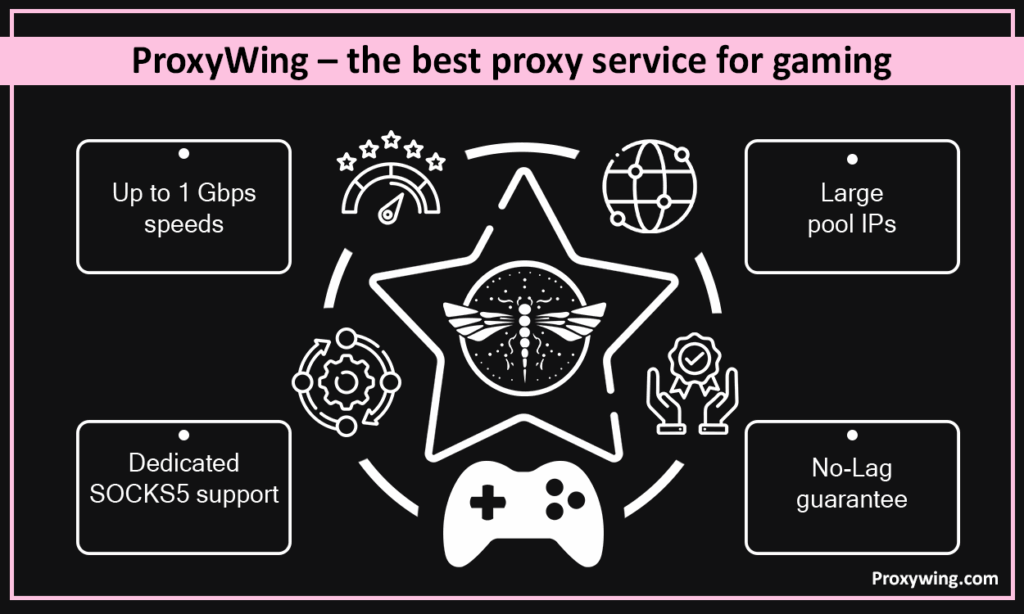

In 2026, ProxyWing is one of the most reliable proxy providers in the business. Yes, it may not have the largest IP pool or the fastest internet speeds, but it offers the perfect balance of price, performance, and reliability. It balances high-speed backbone connections with residential legitimacy, making their IPs nearly invisible to anti-bot systems.
ProxyWing is also known for its reliable residential and ISP IPs that gamers can rely on to access content on their favorite platforms. And most importantly, ProxyWing’s proxy plans start at $0.9/month—one of the lowest starting prices in the industry considering the features you get.

Bright Data has been in the proxy business since 2014, making it the oldest provider on this list. Over the years, it has stood the test of time, thanks to its focus on offering features that everyday users such as gamers care about. It also has one of the largest IP pools and proxy lists. In 2026, Bright Data is known for its advanced “Super Proxy” servers that automatically route your traffic through the fastest available path.

Oxylabs has also been in the proxy business for more than ten years, so it has stood the test of time and is easily one of the most trusted providers in 2026. It excels at all the basics that any online gamer would expect a modern proxy to offer.
Whether you need to get access to games restricted in your region or achieve faster speeds when playing online, Oxylabs is one of the best choices. Their 2026 infrastructure is optimized for ultra-low response times and high bandwidth — a combination that is needed for seamless game streaming.

Smartproxy has been around since 2018, so it has also stood the test of time and has garnered a large user base over the years. It was rebranded as Decodo in late 2025 with the goal of moving from a pure proxy infrastructure provider to a more comprehensive data access and automation platform. And this is reflected in their services.
Decodo is known for offering one of the best user interfaces for beginners. It has a large network of IPs around the world, allowing gamers to choose one based on their location and performance needs. The platform is also known for providing 100% dedicated IPs, so you won’t be sharing your IP address with any other users.

IPRoyal has been in the proxy space for more than five years. It started as an IPv4/IPv6 address leasing business before pivoting to offer a wide range of residential, mobile, and ISP proxy solutions.
Today, it is known as one of the most budget-friendly providers in the industry. One of IPRoyal’s selling points is its non-expiring traffic. This allows occasional gamers to buy data once and use it whenever they play, without worrying about expiry.
The right proxy type changes with what you play on. Below are the setups that work for the platforms our users ask about most.
Consoles accept only a manual IP and port, so you need a static address with IP whitelisting: PlayStation has no place to enter a proxy username and password. Use an ISP proxy in the region of the store or server you want, and keep it for the whole account.
On console a proxy is mainly a region tool. It gets you into a foreign PlayStation Store, an early release or a less crowded server, and it will not improve your frame-to-server latency in a match. If you specifically need PS5 IPs, see our PS5 proxy setup guide.
Xbox handles manual proxy entry the same way and has the same whitelisting requirement. For Xbox Cloud Gaming the proxy has to sit on the device running the stream, not on the console, if you play in a browser, a proxy extension is the simplest route. Details are in our Xbox proxy guide.
The Switch has a proxy field in Internet Settings and accepts host and port only. It works for eShop region access and for downloading titles released earlier in other regions. Avoid free proxy lists here: the Switch gives you almost no feedback when a connection fails, so debugging a dead public IP wastes more time than the proxy saves.
Launchers can be routed independently of the rest of your system, which is usually what you want, you keep your normal connection for everything else and send only the client through the proxy. This is the setup for accessing a regional storefront or a launcher that is unavailable in your country. Our Epic Games proxy page covers the launcher-level configuration.
Mobile titles are stricter about IP trust than PC games, because most of their fraud pressure comes from emulator farms. That makes mobile 4G/5G IPs the safest option for mobile-first platforms, with ISP proxies as the cheaper alternative for casual region switching. If you play through BlueStacks or LDPlayer, set the proxy inside the emulator’s Android settings rather than system-wide, so only the game traffic is routed.
For anything where a disconnect costs you a match, the requirements narrow to two: a static IP and a location close to the game server. Rotation, mobile IPs with carrier-level NAT, and long-distance routes all introduce the kind of instability that ends a ranked game. Pick the ISP proxy in the closest available city and test it before a session, not during one.
Free proxy lists are the first thing most people try, and they are the reason most people conclude that proxies do not work for gaming. It is worth understanding what you are getting before you spend an evening on one.
A public proxy is shared by everyone who found the same list, which means the bandwidth is divided and the address is already known to every platform’s security vendor. In practice you get high jitter, packet loss under load, and an IP that is likely to be blocked at the login screen rather than in the match.
There is also a real security cost. An unencrypted public proxy sees everything you send through it, and a game login is exactly the kind of traffic you do not want passing through an unknown operator.
Two cases only. The first is checking whether a game or store page is available in another region before you decide to buy anything. The second is a one-off download that does not involve logging in.
For both, treat the IP as disposable and never authenticate through it. If it works, you have your answer, and you can then buy an IP in that region for actual play.
Run it through a checker first. Our proxy tester shows whether the IP is alive and how fast it responds, and the IP blacklist status tells you whether the platform will accept it at all. If the address is flagged, nothing else about it matters.
If the reason you are looking at free proxies is budget, note that entry-level datacenter IPs start at under a dollar a month and static ISP IPs are not far above that. For a single gaming account, one dedicated IP costs less than a coffee and removes every problem described above.
The steps for setting up proxies for gaming varies based on the device you intend to use. In this section, we will cover the setup steps for PC gaming, mobile gaming, console gaming, and emulators/cloud gaming.
One Windows open Settings > Network & Internet > Proxy. You should toggle the “Use a proxy server” option On and enter the proxy IP address and Port, then click Save.
For macOS, go to System Settings > Network and select your active connection. You should then click Details > Proxies and toggle the Web Proxy (HTTP) or SOCKS Proxy options to On. Choose SOCKS5 for the best experience. You should enter the proxy IP address and Port details.
For some specific games, you can often configure the proxy directly within launchers like Steam or Epic Games on your computer. This option is great if you don’t want the proxy to take over your entire system’s traffic.
For Nintendo Switch launch System Settings > Internet > Internet Settings and select your network. Tap the choose Change Settings option, scroll down to Proxy Settings and set it to On. You should then enter your proxy IP address and Port.
For Xbox (Series X|S & One) go to Settings > General > Network settings > Advanced settings > Proxy settings and select Manual setup. Enter the Proxy IP address and Port.
For PlayStation (PS4 & PS5), open Settings > Network > Set Up Internet Connection and choose Advanced Settings on your network. You should then select Proxy Server and choose Use. Finally enter the proxy address and Port.
For authentication, we recommend you choose IP Whitelisting since consoles rarely support pop-up login prompts.
On iOS and iPadOS, open Settings > Wi-Fi and tap the “i” icon next to your active network. You should then scroll to Configure Proxy, select Manual, and input the proxy IP address and Port.
For Android, Go to Settings > Connections > Wi-Fi and long-press your network name. You should then select Modify network, tap Advanced options, change Proxy to Manual, and enter the Proxy hostname and Port.
If you’re using emulator software like BlueStacks, you can find the proxy settings within the Android system settings. Follow the setup steps for Android we shared earlier.
For cloud gaming on platforms like GeForce Now and Xbox Cloud, we recommend using a proxy on your host device. If you are accessing these platforms through your browser, you can configure the proxy through your browser settings or by using proxy extensions.
Three different tools get recommended for the same problems, and they solve different ones. Here is how they compare for gaming.
| Gaming proxy | VPN | Game booster (WTFast, ExitLag, Mudfish) | |
|---|---|---|---|
| What it changes | Your IP for selected apps | Your IP and all system traffic | The route to the game server |
| Encryption | None by default | Full tunnel | Partial or none |
| Effect on ping | Neutral to better with a good route | Usually slightly worse | Better on bad routes, no effect on good ones |
| Multi-account use | Yes, one static IP per account | Poor, shared exit IPs | No |
| Console support | Yes, via manual IP and port | Only through a router | Only through a router or PC |
| Per-app routing | Yes | Rarely | Game-specific |
| Typical cost | From $0.90/mo per IP | $5–12/mo | $7–10/mo |
Choose a proxy when you need a specific IP in a specific place and you want it to stay the same. That covers region-locked servers, foreign storefronts, and running more than one account without linking them. It is also the only option of the three that gives you a dedicated address nobody else shares.
A VPN is the better choice if you want everything on the device encrypted, including your browser and voice chat, and you do not care which exit IP you get. The trade-off is that shared exit IPs are heavily used, which is exactly what account security systems look for. Our WingVPN is built on residential IPs for this reason.
Boosters do one thing: they reroute your game traffic through their own network. If your only complaint is ping on a specific title and your ISP’s route is genuinely bad, a booster can help. They do not change your visible IP in a useful way, do not work for multi-accounting, and only support the games on their list.
Use these tips to have a more seamless experience when setting up and using proxies on any of the platforms we shared.
Physical distance is the biggest factor that affects latency. The further away your IP location is from the game servers, the more the latency. So, always match your proxy location to the game server’s city whenever possible.
Ensure to use dedicated residential static IP addresses for the entire session. That’s why static residential (ISP proxies) are recommended for playing online games since they maintain the same IP over longer periods. A mid-game IP swap will cause an immediate disconnect.
Even though proxies don’t establish significant lag like VPN services, they do add a hop to your data, which can slightly affect performance. Using Ethernet instead of Wi-Fi minimizes further packet loss. Wired connections are also more stable.
We recommend testing to confirm that your IP works before your session. This is especially important for those involved in tournaments. You don’t want to find out that your IP is not responsive 3 minutes before your tournament starts.
For most gamers the answer is a single static ISP proxy in the region you play in, kept permanently on one account. It is fast enough for competitive play, stable enough not to drop you mid-match, and trusted enough not to trigger verification every login.
Go for a datacenter proxy only if budget is the deciding factor and the platform you play on is relaxed about IP type. Go for mobile IPs if you play mobile-first titles where trust score matters more than raw speed. Skip rotating residential proxies for gaming entirely, they are built for scraping, and rotation is exactly what breaks a session.
Whatever you pick, test the IP before your first real session. Ten minutes of ping and blacklist checks saves you an evening of debugging a connection that was never going to work.
Article written by:

Product & Support Operations Lead
Built Proxywing's support department from scratch — documented workflows, clear escalations, consistent quality. Now bridges the CEO and engineering, keeping infrastructure projects on track.
All articles by author (68)Gaming proxies are intermediary servers that mask your IP by routing your traffic through another IP to improve routing, bypass blocks, or prevent DDoS.
Using a proxy can help improve your experience if you choose a high-quality ISP/Static Residential proxy that offers stability and low latency.
We recommend staying away from free or public proxies as these will usually make your experiences worse. Free proxies are slow, insecure, and often blacklisted by websites, including most game platforms.
Yes, it is possible for proxies to reduce ping. This normally happens when your ISP has poor routing. A proxy on a better backbone can provide a more direct path to the server, reducing latency in the process. If you’re experiencing slow speeds when streaming games, using proxies can sometimes help.
ISP proxy services are the best for playing online games as they provide stable and relatively fast IP addresses. Datacenter proxies are the least ideal and only recommended for gamers on a tight budget.
The provider you choose also matters. We have shared the top providers that you can choose from based on your preferences. ProxyWing offers the perfect balance between performance and pricing with its reliable ISP IPs that start at $1.8/month.
Check the IP type and blacklist status first, then compare ping and traceroute to your game server with and without the proxy. Our IP tracing tool cover both in a couple of minutes.
One dedicated IP per account, permanently assigned. Sharing an address across accounts is the most common way to get them linked, and switching an account between IPs triggers verification.
SOCKS5. It passes UDP traffic, which is what most game clients use, and it does not inspect or rewrite your packets. HTTP proxies only handle web traffic and are the wrong choice for a game client.
Yes. All three accept a manual proxy IP and port in their network settings. Because consoles cannot show a login prompt, you need a provider that supports IP whitelisting instead of username and password authentication.
Anti-cheat software does not ban you for using a proxy. Bans come from account security systems reacting to low-trust IPs, sudden location jumps, or several accounts sharing one address. Use one dedicated static IP per account and keep the region consistent.