




Proxy Authentication Methods Explained: Username/Password vs IP Whitelisting
06.10.2026 10 min
Modern CPUs can handle tasks concurrently or in parallel depending on how the program was coded by the developer. These two process execution models have pros and cons, and developers must choose when to use which depending on the goal they intend to achieve with any given task. Any modern application implements both models for different processes.
For example, a web server may handle thousands of simultaneous connections concurrently on a single thread while also distributing heavy computation tasks like image processing or data encoding across multiple cores in parallel.
In this concurrency vs. parallelism comparison guide, we will discuss everything you need to know about these methods of processing and why they matter to programmers. Let’s get started discussing the terms concurrency and parallelism in detail.
| Feature | Concurrency | Parallelism |
| Execution Style | Tasks overlap in progress | Tasks running simultaneously |
| Goal | Responsiveness and efficiency | Speed and throughput |
| Hardware Needed | Single or multi-core | Multiple cores required |
| Best For | I/O-bound tasks | CPU-bound tasks |
| Example | Web server handling multiple requests | Image rendering across cores |
Concurrency means the ability of a system to manage multiple tasks that make progress over overlapping time periods, even if only one task is actually executing at any given moment. With this method, the CPU rapidly switches between tasks without having to complete one before moving on to the next. This approach has its pros and cons that we will discuss later in this guide.
Concurrency is about coordination and scheduling. Concurrency focuses on the CPU rapidly switching between tasks, giving each one a slice of processing time. From the outside it looks simultaneous, but only one task runs at a time on a single core.
Some of the common examples of tasks that are usually handled concurrently include web server requests, database queries, file reads, API calls, and user interface updates. This approach is appropriate for any task where waiting on external input or output is the main bottleneck.
A web server receiving thousands of requests is a classic example. Rather than processing each request from start to finish before moving to the next, it switches between them — handling a bit of each while others wait on relevant I/O to be availed.
Concurrency improves responsiveness and resource efficiency, particularly for I/O-bound workloads where tasks spend most of their time waiting rather than computing. Without concurrent systems, a single slow operation could block everything else, which significantly lowers the efficiency of utilizing system resources.
Parallelism is when multiple tasks or subtasks execute at the exact same moment, each running on a separate CPU core or processor. This is possible thanks to modern CPUs that have multiple cores. Involving multiple cores to handle complex tasks significantly lowers the execution time.
Today, it is common for even smartphone CPUs to have 8 or even 10 cores. This multiple processing capability allows developers to implement parallelism across their stack of apps regardless of the platform they’re targeting.
A problem is divided into independent parts, and each part is assigned to a separate processing unit. Parallelism focuses on executing parts simultaneously, with results combined at the end. Some of the common tasks that are executed using this method include video encoding, 3D rendering, machine learning model training, large dataset processing, and scientific simulations.
Executing multiple tasks at the time can be used for any application where complex projects can be broken into independent chunks.
Rendering a high-resolution image is a common application for using parallelism processing. When rendering such images, the image is split into sections and each section is processed by a different CPU core at the same time, dramatically reducing the overall total render time.
Parallel processing is the primary tool for speeding up CPU-bound tasks. When computation is the bottleneck, splitting the work across cores can reduce execution time proportionally to the number of cores available. For such tasks, computers with more CPU cores tend to offer better performance than those with fewer cores.
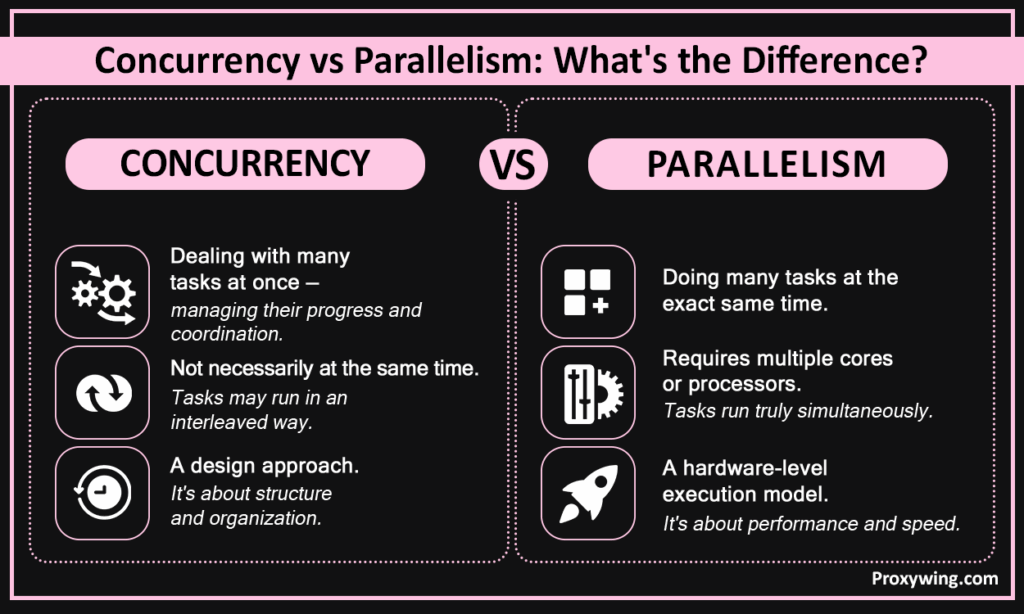
Concurrency is about dealing with many tasks at once — managing their progress and coordination. Parallelism is about doing many tasks at the exact same time. One is a design approach, while the other is a hardware-level execution model.
| Aspect | Concurrency | Parallelism |
| Execution | Interleaved | Simultaneous |
| Primary Goal | Manage multiple tasks | Execute faster |
| Hardware | Works on single core | Requires multiple cores (multiple processors) |
| Bottleneck Addressed | I/O-bound | CPU-bound |
| Complexity | Task coordination | Work distribution |
Here is an analogy that will help you understand these two concepts in simple terms. Concurrency is like one person juggling multiple tasks by switching between them. Parallelism is multiple people each handling a separate task at the same time. Both get more done, but in fundamentally different ways. Depending on the task, one method could be preferred over the other.
Modern CPUs with multi-core systems routinely use both as long as they optimize their program to utilize this capability. Multiple cores run tasks in parallel, while each core also manages concurrent executions and task switching within its own execution thread.
Most high-performance applications rely on both simultaneously. Applications that are optimized for both methods efficiently can significantly benefit from modern computer systems that have multiple CPU and GPU cores.
A Node.js server uses an event loop to handle thousands of simultaneous user requests on a single thread. While one request waits for a database response, the event loop moves on to process other requests. That means, the core being utilized never sits idle waiting for I/O. This ensures more efficient utilization of the CPU to achieve maximum output at any given moment.
A machine learning pipeline processing a large dataset splits the data into chunks and assigns each chunk to a separate worker process running on its own core. All chunks are processed simultaneously, cutting total processing time significantly. Machine learning tasks usually benefit from using GPUs since they typically have more cores than CPUs.
On a single-core machine, only concurrency is possible — the CPU switches between tasks but never runs two at the same instant. On a multi-core machine, tasks can run in parallel across cores, with concurrency still managing scheduling within each core. Most CPUs released in the last 15 years come with multiple cores.
Different languages provide different tools for concurrency and parallelism, each reflecting design priorities and hardware assumptions. Based on the language you choose to use, the goal is to ensure you implement each of these methods where necessary to improve the performance of your program.
JavaScript uses a single-threaded event loop model. Async/await and Promises allow non-blocking I/O operations so the program can continue executing while waiting on network or file responses — concurrency without multiple threads.
Python supports concurrency through asyncio for async I/O and threading for thread-based tasks. True parallel programming requires the multiprocessing module because the Global Interpreter Lock (GIL) prevents multiple threads from executing Python bytecode simultaneously.
Java provides threads, thread pools, and the java.util.concurrent package for both models. Go takes a simpler approach with goroutines (lightweight concurrent units) and channels for communication. These make it easy to write concurrent code that also scales to parallelism when multi-core hardware is detected.
When tasks spend most of their time waiting for I/O such as network calls, database queries, or file reads, concurrency is the right tool. The CPU stays productive by switching to other tasks during wait periods instead of sitting idle. This improves efficiency since the CPU doesn’t have to sit idle whenever a program is waiting for a certain input.
When tasks require heavy computation. Tasks like managing data processing, encryption, video rendering, or simulations require more computation than everyday. This is best handled by parallelism since it delivers real speed gains by distributing the load across different processors (cores) simultaneously. Developers design these programs to break down complex tasks into smaller chunks that can be distributed across different available cores to ensure maximum CPU utilization.
Unlike what some may assume, concurrency and parallelism are not competing models. They are in fact complementary methods that are used by modern programs to improve CPU utilization and efficiency.
Implementing concurrency keeps systems responsive under load, especially when handling tasks that require waiting for I/O. On the other hand, parallelism makes heavy computation faster since complex tasks are broken down into smaller chunks that can be handled by different cores.
Understanding which problem you’re solving (waiting or computing) is the key to choosing the right approach. Software meant to run on modern machines need both in order to fully utilize the capabilities of modern CPUs and GPUs.
Article written by:

Product & Support Operations Lead
Built Proxywing's support department from scratch — documented workflows, clear escalations, consistent quality. Now bridges the CEO and engineering, keeping infrastructure projects on track.
All articles by author (68)Not exactly. Multithreading is one way to achieve concurrency. However, concurrency can also be implemented with async programming, coroutines, or event loops without multiple threads.
Yes, you can. A single-core system can run concurrent tasks by switching between them, with no true simultaneous execution. The CPU can switch between tasks based on current demands from each to ensure execution in the least possible time.
Theoretically yes, but it’s rare in practice. Parallel systems almost always involve some level of coordination between tasks, which is concurrency.
It depends on the bottleneck. Concurrency improves performance for I/O-bound workloads. On the other hand, true parallelism improves systems performance for CPU-bound workloads that benefit from multi-core performance. Using the wrong model for the wrong problem yields little benefit.
Async programming is concurrency. It allows tasks to make progress without blocking. However, it does not necessarily execute multiple tasks simultaneously on separate cores.