


Proxy Authentication Methods Explained: Username/Password vs IP Whitelisting
06.10.2026 10 min
Amazon CAPTCHA appears when the platform detects unusual browsing or scraping activity. It protects the site from bot-driven abuse, unusual traffic, and compromised sessions. But Amazon CAPTCHA can also slow down researchers, analysts, and legitimate automation workflows.
In this article, you’ll learn how to bypass Amazon CAPTCHA safely, reduce interruptions, and keep your automation stack running smoothly. If you want accurate and stable data collection, keep reading. This breakdown shows exactly how to bypass it without risking bans or service issues.
An Amazon CAPTCHA is a security challenge Amazon uses to verify that traffic is from a real human rather than a bot. When Amazon detects unusual behavior, it displays an Amazon CAPTCHA asking the visitor to complete a small test. This prevents bots from abusing the platform and helps maintain a fair, secure shopping environment.
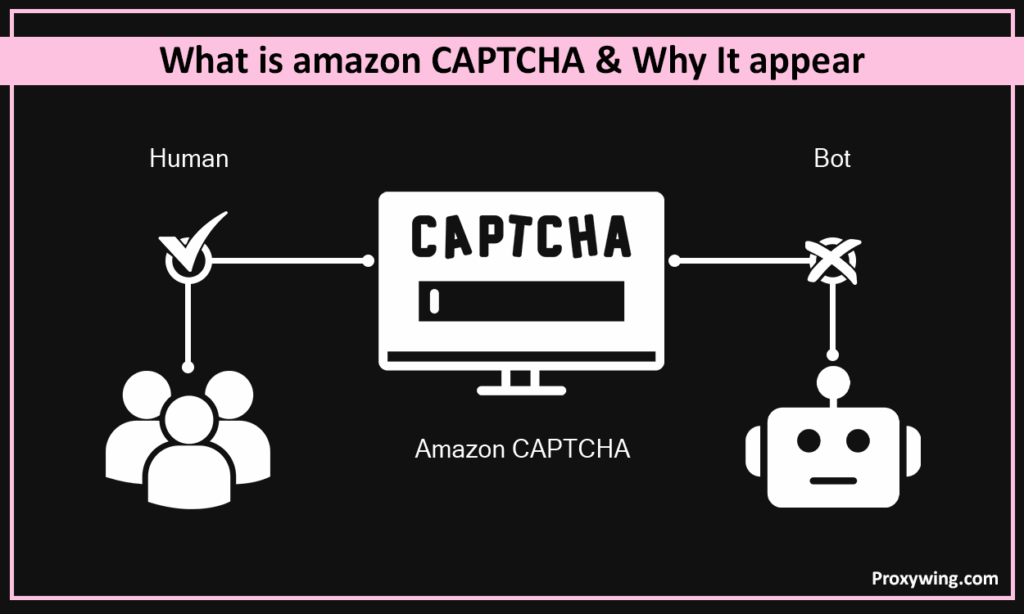
Amazon captcha is specifically for the e-commerce platform since the number of traffic accessed will be large on a per-hour basis. In the absence of this test, scrapers and automated tools would flood pages with negative implications on the marketplace data and cause harm to both clients and sellers. Amazon CAPTCHA is a filter: a human is able to complete it in a short period of time, whereas suspicious bots have some difficulties.
The standard CAPTCHA on Amazon can appear in several formats. Common types include:
Each one is designed to stop bots that cannot interpret visual or logical tasks easily. Sometimes the captcha appears repeatedly when traffic remains suspicious, even after solving the first one.
Amazon demonstrates a weakness in the case when the system suspects human behavior. These triggers tend to be of a scraping pattern, network problem, or automated scripts. Because it’s an authoritarian site, any light scraping can trigger the CAPTCHA.
Here are the most common triggers:
In case a request is interpreted to be a bot, it instantly shows a block page or CAPTCHA as a challenge to the visitor.
CAPTCHA enables Amazon to protect against severe automation. In its absence, scrapers would be able to gather product information on a massive scale and pollute internal infrastructure. CAPTCHA also reduces the speed of bots by putting a human obstacle to certain areas of control. It is also used to assist Amazon in keeping a fair usage, safeguarding price structures, and preventing abuse.
CAPTCHA is a cost-effective tool. It involves a very small level of processing and prevents a huge proportion of automated traffic. This is a friction to users who develop automation. It is not only your task to bypass CAPTCHA, but to make your traffic appear as natural traffic.
CAPTCHA is used by Amazon as an anti-bot filter, a fraud control system, and a security control. It defends product pages against mass scraping, prevents compromised sessions, and prevents credential-stuffing attacks. CAPTCHA is also used to secure account information, checkout code, and systems.
Without these safeguards, more attackers would try to bypass account controls, overwhelm product pages, or exploit traffic gaps. In security-heavy environments, CAPTCHA makes it harder to bypass safeguards and to bypass high-risk request patterns.
The platform relies on two main formats:
The platform switches between these based on risk scoring. When traffic looks suspicious, Amazon increases the difficulty or frequency of challenges.
Here are three safe, practical, and legally acceptable methods that reduce CAPTCHA frequency and help you operate efficiently.
In stealth automation, the movement, scrolling, and timing of the browsers are human-like. These browsers replicate natural patterns, making it difficult to identify scraping. Browsers such as Playwright and Puppeteer with stealth plugins can minimize the error of matching a fingerprint and reduce the Pat CAPTCHA rates. This is a stable method to bypass and is best suited to an accurate scrape method.
AI-solvents solve text puzzles and picture grids by machine learning. They are suitable in large scraping tasks that need to scale CAPTCHA. When they are set-up, they are capable of automation when dealing with challenges. This minimizes the downtime and keeps crawlers going. The accuracy of the solvers is dependent on the model, although most of the current solvers are very accurate with high pass rates.
External CAPTCHA solvers like 2Captcha and Anti-Captcha use distributed workers or ML pipelines. The CAPTCHA image is submitted to your script and a solved result is returned to your script in seconds. This is a fast setup and does not need much engineering manpower. Its greatest weakness is the repetitive expense and reliance on third-party services.
Below is a simple performance comparison:
| Method | Cost | Difficulty | Speed | Detection Risk | Scalability |
|---|---|---|---|---|---|
| Stealth Browser | Medium | Medium | Medium | Low | Medium |
| AI-Based Solver | Medium | High | Fast | Medium | High |
| External Solver | Recurring | Low | Fast | Medium | High |
Each solution works well depending on your scraping needs. If you want strong stability, stealth browsing helps. If you need volume, AI-based solvers or external APIs perform better.
Amazon APIs are much more stable when your aim is to have clean product data. They yield organized fields of products, minimize scraping overhead, and eliminate CAPTCHA issues. Prices, stock data, reviews, and variations are received without clicking on web pages. In case of long-term data programs, it is safest to use an API.
APIs offer structured output, reliable uptime, and fewer blocks. Pagination is built in. Response formats stay consistent. You avoid session issues and reduce infrastructure costs.
APIs shine in scenarios like:
If your scraping grows past a few thousand pages per day, APIs become the better investment.
If you still prefer building your own scraper, here is the basic outline.
Below is a simple Python example showing how to make requests with correct headers, retry logic and user-agent rotation.
import requests
import random
import time

agents = [
    "Mozilla/5.0 (Windows NT 10.0; Win64; x64)",
    "Mozilla/5.0 (Macintosh; Intel Mac OS X 10_15_7)",
    "Mozilla/5.0 (X11; Linux x86_64)"
]

def fetch_page(url):
    headers = {"User-Agent": random.choice(agents)}
    for attempt in range(3):
        r = requests.get(url, headers=headers)
        if "captcha" not in r.text.lower():
            return r.text
        time.sleep(2)
    return None

html = fetch_page("https://www.amazon.com/dp/example")
print(html)
This helps reduce CAPTCHA occurrences during light scraping.
To avoid blocks and repeated fingerprints, you should use residential or ISP proxies. They give unique IPs that look like normal household users, reducing the need to bypass Amazon CAPTCHA repeatedly.
For smooth sessions, ProxyWing offers both ISP and residential options that help maintain clean networks, reduce blocks, and improve access quality. Using rotating proxies ensures each request appears natural, lowering the risk of CAPTCHA flags.
CAPTCHA is employed as a security measure at Amazon. Although it may disrupt scraping or automation efforts, there are a number of valid strategies to minimize the number of challenges. Product Data API is the cleanest solution to large-scale work, though stealth browsers, AIs, and external solutions are helpful for different purposes.
Through thoughtful configuration, the correct use of proxies, and modeled human behavior, you can reasonably avoid the majority of disruptions and attain effective access to product data.
Article written by:

CEO
Founder of Proxywing. Drives growth across EU, US, and Asian markets, combining B2B strategy with a hands-on focus on product quality, 99% uptime, and responsive support.
All articles by author (64)CAPTCHA is needed by the platform to prevent bots, scraping abuse, and suspect activity. It assists in maintaining the platform against malicious automation.
Amazon employs text tests, puzzles with images and reCAPTCHA v2/v3 in order to confirm the presence of a human being.
Yes, using stealth browsers, proxies, or AI solvers or third-party solvers, you can reduce or safely circumvent Amazon CAPTCHA triggers.
CAPTCHA is not permissible to be bypassed in an abusive manner. Being legal and scraping with respect to the terms of the platform makes your activity harmless.
Many of the CAPTCHA types can be solved by AI with a high level of accuracy, and the performance depends on the complexity and the quality of the model.