

Proxy Authentication Methods Explained: Username/Password vs IP Whitelisting
06.10.2026 10 min
When you get private proxy access, you are actually purchasing an exclusive IP address of your own. There is no one to slow your connection or block server, unlike shared proxies. This type of proxy setup is the most effective at managing social accounts, web data collection, or browsing in another country without being blocked.
In 2026, a private proxy connection is the only way to stay safe from the mistakes of other users.
This guide shows you exactly how to find, buy, and set up a private proxy in simple steps.
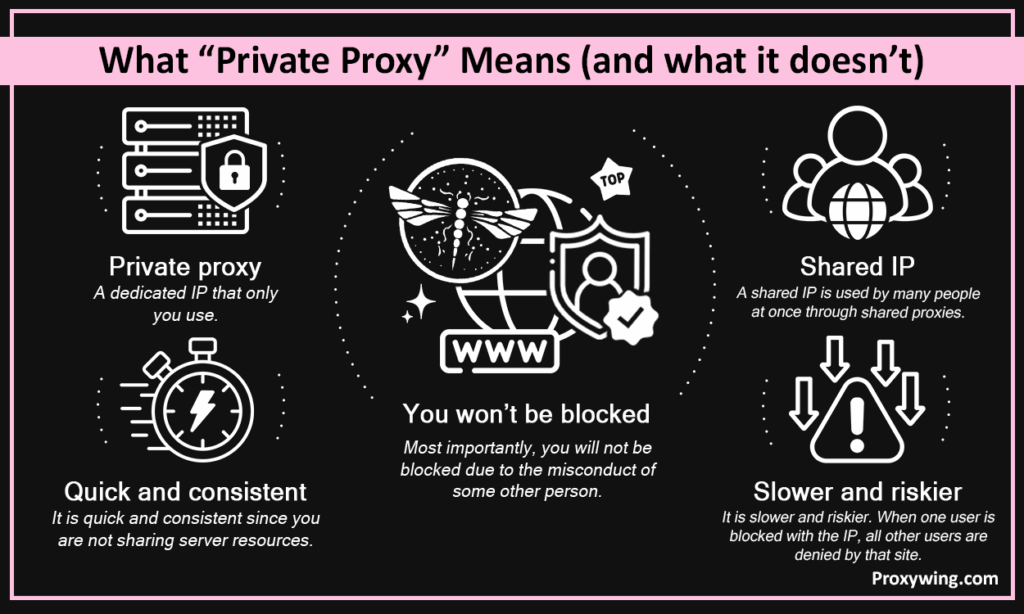
A private proxy is a dedicated IP that only you use. It is quick and consistent since you are not sharing server resources. Most importantly, you will not be blocked due to the misconduct of some other person.
A shared IP is used by many people at once through shared proxies. It is slower and riskier. When one user is blocked with the IP, all other users are denied by that site.
“Private” only means exclusivity—it says the IP is yours alone.
Both hide your location, but they work differently:
IPs are monitored on websites to locate bots. Sharing a single IP among multiple accounts raises suspicious login bans. A private proxy assigns each account a unique server, meaning that accounts are not connected or banned.
Automation tools require a consistent server connection to complete long tasks. Shared proxies are volatile and can crash at any time, leaving your tools to fail. The predictable performance and speed that is provided by the proxies help minimize the necessity of repeated failures.
A local search result or ad often requires a certain city or country IP. A private proxy allows you to choose an exact location. This will provide you with a localized, accurate picture of the web without being blocked by security filters.
Companies can manage private proxies more easily. You are able to give each employee a particular IP and monitor work. When a person departs, you can discontinue their access easily or alter passwords without impacting the entire team.
Setting up your connection is simple if you follow the right order. Use these steps to get private proxies that are fast, clean, and ready for your specific tasks.
Before you shop, use this checklist to make sure the private proxy fits your job:
Find a seller that has 99% uptime and 24/7 support for their proxies. They should have a replacement policy, which will issue you a new IP in case the one you have has been blocked. Need quick, clean IPs that will always work? ProxyWing is a good option.
The majority of tools require a certain type of text to operate. Usually, it looks like this: IP:Port:User:Pass. See whether your tool requires them individually or in a large list that you can copy and paste.
That is how the private proxy identifies you.
Stay organized. One private proxy account will be enough, or your accounts will be associated and terminated. Name them in a spreadsheet (e.g., Account 1 -> Proxy 1) to identify exactly what IP is doing what.
Test your private proxies as soon as you get them. Use an online “proxy checker” to verify:
These are data center-originated proxies. They are the cheapest and fastest private proxies. Apply them to quick things such as price checking or simple research. Strict websites can be blocked very fast because they do not resemble a home server connection.
These private proxies are hosted on high-speed servers with actual domestic internet addresses. They are consistent and well-trusted. Internet sites treat you like a human being at home, yet you get professional server speeds. These proxies are most suitable to remain logged in to an account for a few hours.
These private proxies use addresses from actual homes. A private version typically is a fixed residential IP that you own exclusively. These proxies are uncommon and costly, but the most effective in accessing websites that block most other methods.
These private proxies utilize 4G or 5G cell tower data. They cannot be blocked since websites might ban thousands of real phone users unintentionally. These proxies are more expensive and can only be used on very sensitive apps such as Instagram or TikTok.
These businesses have their own server. This is the most secure method to purchase when you have to procure a private proxy over time. They can also reconfigure their hardware so they can resolve issues quickly and provide you with a new address when your proxy is blocked. ProxyWing is a good example of a clean, fast IP.
Some stores sell only high-trust addresses such as mobile IPs or home IPs for advanced proxy use. They are more suitable when work is of high stakes, such as handling sensitive social media accounts. Their addresses are far more difficult to block by websites, as they are specific to a single thing.
These are similar to large malls that offer proxies in numerous locations. They work well in small, inexpensive jobs. All you need to do is have a clear policy on replacement. When they are unable to guarantee that the IP is clean, do not purchase it; you may end up with a permanently prohibited address.
When a private proxy is real, it must be paid by someone. Free private proxies are never private, as they are public and unsafe.
Make sure the setup works with your tools. Web browsers and simple scraping work better with HTTP(S). SOCKS5 is more liberal and can support nearly any application, including video or game apps.
Check the latency (delay) and throughput (data speed). Low latency is vital for fast browsing. Heavy scraping is best with high throughput. Also, check concurrency—this is the number of tasks you can run simultaneously.
An excellent provider must assure 99.9% uptime, or the service hardly ever goes down. You should have an effective replacement policy as well. They will also provide you with a free clean one in case you receive an already blocked IP from your IP pool.
Country-only is not always sufficient. You might require city-level targeting in activities such as checking local ads. Ensure the connection provider has IPs specific to the cities you require, not just the country.
The support is important when an IP is flagged. You require a team that can respond in minutes, not days. Find 24/7 live chat to have a new, working IP instantly in case something goes wrong.
Read the rules. Ensure the provider permits your task. Violation of their Terms of Service (ToS) or site rules will lead to closure of your account without refund.
This is typically a protocol mismatch. Browsers support HTTP/S with ease, whereas there are apps that need SOCKS5. Check your authentication as well. When an application cannot display a login box, you will need to enter an IP whitelisting in your proxy control panel rather than a password.
The high ping is typically an indication of being too distant to the server. Choose a point that is nearer to your target site. In case it remains slow, the node (server) may be overloaded. Try switching to a datacenter proxy for raw speed or ask for a different ASN (network).
It occurs when your IP reputation is bad. Strict sites can easily capture datacenter proxies. Use residential or ISP proxies to appear like a human being.
Check your credentials twice because of typing mistakes or an unnecessary space. Your home internet address could have changed in case you use IP whitelisting. Go to your proxy dashboard and change your authorized IP to the one that you are using.
Websites guess the location of an IP using various databases. When the city is incorrect, the provider may have mapped the IP wrongly. To resolve this, request a new IP or target the city to eliminate any error.
To provide the security, speed, and stability of online activities, it is better to obtain a private proxy. By opting to use a specific IP, you would eliminate the danger of shared connections and control over your online presence.
Also be sure to specify your location requirements, choose a provider that has a good replacement policy, and verify your IPs as soon as they are bought.
The only way to evade blocks in 2026 is to remain professional and to use clean and private addresses. Ready to start? Secure your high-speed, dedicated connection today at ProxyWing.
Article written by:

CEO
Founder of Proxywing. Drives growth across EU, US, and Asian markets, combining B2B strategy with a hands-on focus on product quality, 99% uptime, and responsive support.
All articles by author (64)They are usually the same thing. Both terms mean you are the only person using that specific IP address at any given time.
Yes. They hide your real IP address from websites, but the proxy provider can still see your traffic and who you are.
It is risky. Using one IP for many accounts on the same site can link them together, causing all of them to be banned at once.
Yes, if you need a more flexible connection. SOCKS5 works with more apps than HTTP and is generally better for complex tasks like gaming or streaming.
Visit a site like BrowserLeaks or Whoer. If the results show your real home city or your ISP’s name, your proxy is leaking.