


Proxy Authentication Methods Explained: Username/Password vs IP Whitelisting
06.10.2026 10 min
Datacenter proxies are known for offering the fastest speeds and lowest prices. When using datacenters proxies, users are assigned a static IP address, hence the name static datacenter proxies. This makes them reliable for use cases where having the same IP address throughout the session is necessary.
In today’s guide, we shall explore everything you need to know about static datacenters proxy servers, including their best real world applications, advantages, and more. Let’s jump right in.
It is a static proxy that routes your traffic through IPs of remote servers hosted in datacenters. In the process, it gives you a fixed IP address hosted in a data center. Unlike mobile and residential proxies, these IPs are not tied to a real household or carrier, but consistent across every session. Because of their nature, most providers usually have less coverage and small rotating pools for Datacenter proxies.
Some of the key features of datacenter proxies with static IPs include:
Datacenter proxies route your traffic through a datacenter server, which forwards requests using its own fixed IP. In the end, the target site sees the proxy’s IP, location, and ASN and not yours. This makes the connection anonymous and also gives you access to online services that might be blocked in your country.
Here is a step-by-step flow of traffic when using a datacenters proxy with static IP :
Note: IP whitelisting approves your device by IP with no credentials needed per request, which makes it ideal for fixed setups and automation. Username/password suits users relying on dynamic IPs.
A stable datacenter IP keeps session cookies intact, which reduces forced re-logins, and minimizes CAPTCHA triggers on platforms that flag frequent IP changes.
When accessing websites like e-commerce stores or social media that require signing in, frequent IP rotation easily triggers their security systems, resulting in forced re-authentication and CAPTCHA triggers. So, having a static datacenter IP address is the best option for accessing such websites and online services.
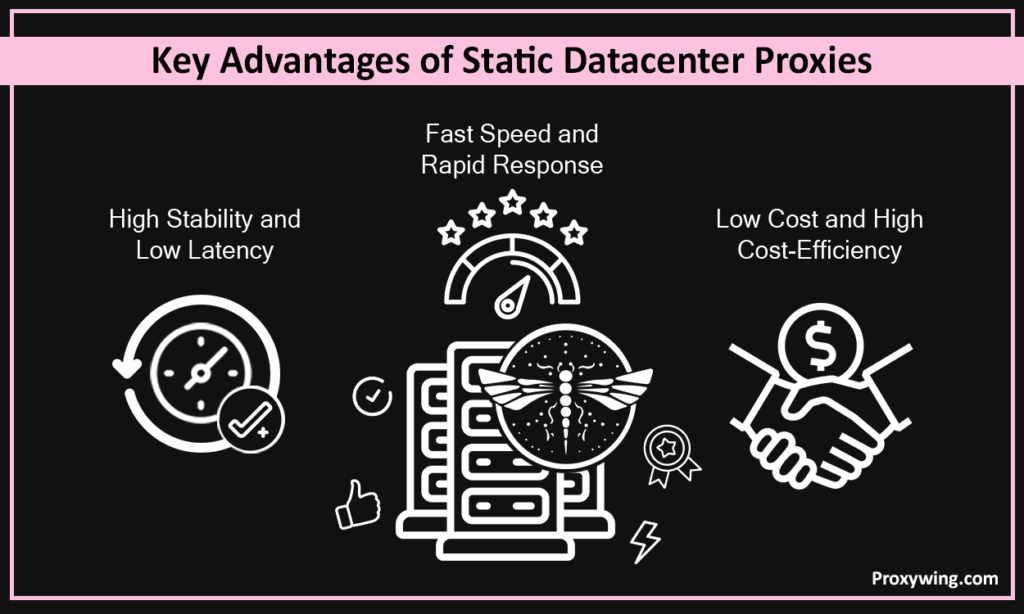
Datacenter IPs offer higher speeds than other proxy types since they rely on dedicated server infrastructure that delivers the fastest connection speeds and low response times. This makes them ideal for scraping, monitoring, high-volume automation, and any other high bandwidth tasks.
IPs sourced from data centers are usually cheaper for static proxy providers, allowing them to pass over those cost savings to their users. Datacenter IPs are also priced per IP rather than per GB, making them far cheaper than residential alternatives.
Fixed datacenter IPs mean predictable sessions and high uptime which minimizes disruptions from unexpected IP changes during long-running workflows. Proxies that rely on IPs running on mobile networks experience frequent IP changes. These frequent IP changes are not ideal for long-running workflows.
Their server-farm ASNs are well-known to anti-bot systems, which might be a disadvantage when accessing certain platforms. Avoid them for heavily fingerprinted platforms. Such platforms may include social sites, ticketing sites, and strict e-commerce targets. For such online services, we recommend using residential or ISP proxies instead.
ISP proxy solutions have static IPs, higher trust scores, and offer comparable speeds to datacenter IPs, which makes them great for accessing such sites.
When handling projects like web data scraping on sensitive websites, using datacenters proxies with static IPs is not ideal. Such tasks require IP rotation and high trust scores to prevent rate limiting and IPs from getting blocked. Datacenter proxies with static IPs are not the best choice if you need such capabilities.
A static datacenter IP keeps platform sessions stable and reduces repeated verification prompts across multi-store workflows. Datacenter IPs also deliver the regional consistency needed for e-commerce operations at a fraction of residential pricing. When managing more than one account, using different IPs helps to prevent account linking and restrictions. Most providers offer enough datacenter IPs for different regions to make this possible.
Several businesses rely on datacenter IPs to check their geo-targeted ads and to also see competitor placements from a fixed location. A consistent datacenter IP ensures repeated checks return accurate results without triggering access restrictions between visits.
Speed and low cost make datacenter IPs ideal for large-scale public data collection. For the best experience and high success rate, use proper headers, consider IP blocks, rate limits, and build in retry logic. On targets without aggressive bot detection, they outperform residential proxies on throughput and price.
Developers can use datacenter IPs to test the performance and availability of their apps or websites in different regions. These proxies may not show the perfect picture of the experience like residential or movie proxies, but considering their low price, they’re a great starting point for small businesses on a budget.
Datacenter proxies with static IPs offer the right balance of speed, stability, and cost for tasks that don’t require the high trust score you get with mobile and residential proxy solutions. For the majority of high-volume, structured workflows, including account management, ad verification, and data collection, they remain one of the most practical and cost-effective proxy options available.
One major downside you need to be aware of though is that datacenter IPs are the easiest to detect, which makes them the less ideal choice when accessing platforms with strict anti-bot systems. Most providers also offer smaller IP pools and less coverage for datacenter proxies compared to other types. This makes static proxies less useful when managing tasks that need frequent IP rotation or city-level targeting.
Article written by:

Full Stack AI Engineer
Full-stack engineer at Proxywing working across backend architecture, performance optimization, and AI-driven workflows. Node.js, React, cloud infrastructure, and RAG pipelines.
All articles by author (61)Static proxies maintain the same IP address across all sessions. Dynamic proxies rotate IPs per request or at set intervals. Using static IPs suits session-dependent tasks. Such tasks include account management. On the other hand, dynamic IPs suit scraping and anonymity-heavy workflows.
Unlike IP addresses assigned by ISPs, datacenter IPs come from known server-farm ASNs and hosting providers, making them easy for anti-bot tools to see as non-human traffic. Social platforms, ticketing sites, and major e-commerce targets are most likely to block them.
Yes, using datacenter IPs is legal in several countries. However, you must use them for ethical tasks. Some of these tasks include research, ad verification, and price monitoring. You must also always comply with the target site’s terms of service and local laws.