



Proxy Authentication Methods Explained: Username/Password vs IP Whitelisting
06.10.2026 10 min
Using proxies is one of the most reliable ways to bypass restrictions on the internet, allowing you to access geo-locked content and websites. The ISP proxy type is a popular choice because it offers speeds of datacenter proxies and the high success rate of residential proxies — relies on IPs assigned by local internet service providers.
If you’re searching for a reliable way to route your traffic without compromising performance and reliability, ISP proxy servers are a good option. In this guide, we will discuss all the details you need to know about ISP proxies, including their benefits, how they compare with other types, choosing the right provider, and more. By the end, you will have all the information you need to get started routing your traffic using reliable ISP-assigned IPs.
ISP proxies are IPs hosted in datacenters but registered with real internet service providers in different regions. When using this proxy type, your traffic is routed through IPs running in ISP-managed datacenters. The main advantage of this type is that they combine the residential-level trust with datacenter-level speed, allowing users to enjoy fast speeds without compromising reliability.
Your traffic routes through an ISP-assigned IP running in a datacenter within a specific region. Target websites see the IP of the proxy instead of your real one, making your traffic more anonymous and private. They also typically maintain the same IP address throughout your sessions, making them a great option for account management and other use cases that don’t benefit from random IP changes.
These proxies use ISP-registered IPs and stay fixed for longer sessions — hence the static residential label. For any tasks that require maintaining the same IP address for longer periods, this type is the best choice. Such tasks include account management, checkout flows, login-dependent workflows, and accessing any platform that flags sudden IP changes.
Faster and more stable than unstable IP sources, making them reliable for collecting public web data at scale. They’re especially a great option when scrapping data from platforms that require logging in to get full access. For such projects, maintaining the same IP per session is crucial to prevent frequent security prompts.
Consistent login locations per account reduce flags triggered by sudden IP changes. With static IPs, you can handle a given login session for extended periods without experiencing any random security triggers. When managing multiple accounts, we recommend assigning each a unique IP address to prevent any chances of account linking that could lead to restrictions.
Check how ads appear to your audiences across regions and identify fraud, incorrect placements, or geo-targeting errors. This allows businesses to see how their audiences view their ads and optimize them for better performance.
View region-specific prices, product availability, and competitor pages as a local user would. Businesses can analyze platforms like Amazon, eBay, and BestBuy using IPs of different regions to see how prices vary. This data can be used to further optimize their sales strategy or make choices like getting into certain markets.
Monitor fake listings, unauthorized sellers, and brand mentions across regions without exposing your real IP. You simply need to use IPs in different regions to see if there are bad actors in different regions that are using your brand to scam your audience. This is a common practice, especially in regions where your brand doesn’t officially operate.
Check localized SERPs and rankings from different regions without your real IP skewing results. This allows you to determine whether your SEO efforts are yielding the expected results. You can base on the results to further optimize your SEO strategy.
The IPs of ISP proxies are run on servers hosted on reliable infrastructure, which makes them faster and more stable than most rotating residential proxies that rely on home device IPs. This performance advantage makes them ideal for tasks like large scale data scraping that need the highest possible speeds.
ISP-registered IPs look more natural to websites, reducing the chances of blocks or rate limits. The high trust score of these IPs makes them a good choice for accessing and scraping data from sensitive websites. Most online platforms trust ISP-assigned IPs, minimizing any possibilities of having your connection blocked.
Essential for account management, checkout flows, and dashboards that flag sudden location changes. Platforms like Amazon, Instagram or TikTok view random IP changes during a session as an account security threat hence triggering re-authentication when that happens.
This type is a practical middle ground between cheap datacenter proxies and premium residential pools. If you need the reliability and high trust score of residential IPs without sacrificing performance, ISP IPs are the best choice — you get the best of both worlds.
Better IP reputation and harder sourcing push prices above standard datacenter options. For projects that don’t require highly trusted IPs, using datacenter IPs is still a better option since they are usually a fraction of the price when compared to other types.
When you need a massive, constantly changing IP pool, rotating residential proxies are a better fit. Most providers don’t offer large IP pools for this type when compared to the residential type. So, if your project involves cycling through thousands of IPs, this type may not be the best option.
IP quality depends on the provider’s sourcing and replacement policy — overused IPs still get flagged. Make sure to choose a reliable provider if you need to achieve a high success rate when using these proxies.
Your ISP can see you’re connecting to a proxy, but target websites see the proxy IP — not your real one. To some extent, this allows you to bypass restrictions to certain websites that your ISP might be implementing on behalf of the government or other regulatory authorities.
ISP proxies handle IP routing for specific requests, allowing you to access the destination service without revealing your real IP address and location. VPNs on the other hand encrypt all device traffic system-wide, making them a great tool for maximum privacy. They are different tools built for different purposes — choose one that fits your goals.
Why ISP Proxies Are Harder to Flag Than Datacenter Proxies
ISP-registered IPs don’t match known hosting ranges, so they pass as more natural user traffic. They rely on IP addresses assigned by legitimate internet service providers that most websites trust. This significantly minimizes any possibility of having these IPs blocked.
Despite their high trust score, ISP IPs can still be blocked for a number of reasons. Some of the common ones include poor IP reputation, aggressive request rates, mismatched locations, and suspicious browser fingerprints.
Use clean IPs, match proxy location to account behavior, avoid aggressive automation, and use browser profiles where needed. The goal is to make your traffic appear like it is coming from legitimate users.
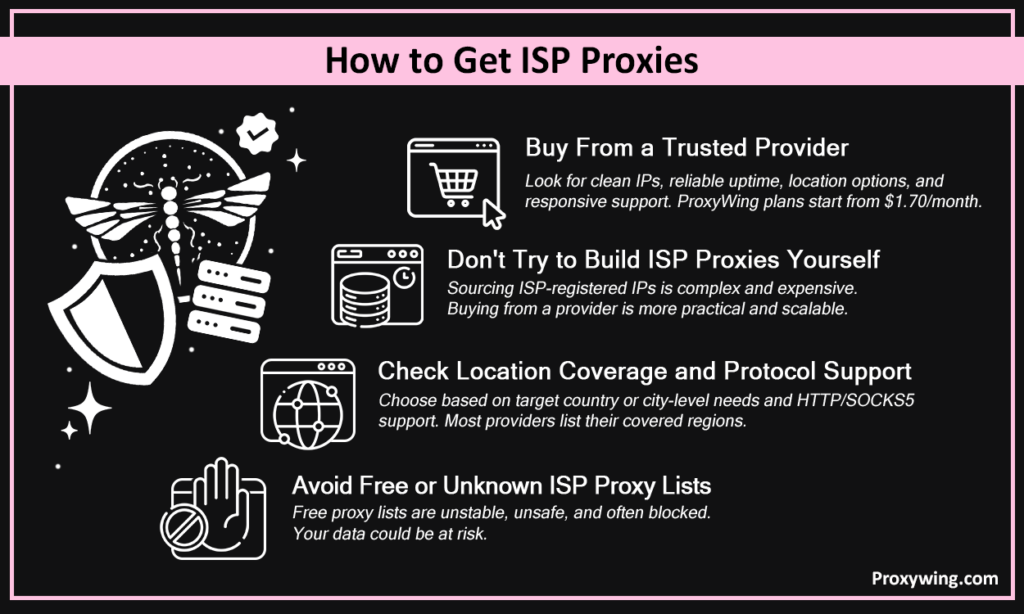
Look for clean IPs, reliable uptime, location options, and responsive support. ProxyWing covers all of these key metrics with plans from $1.70/month. It also offers other proxy types, allowing you to choose one to suit your current needs.
Choose based on target country, city-level needs, and HTTP/SOCKS5 support. Most providers specify the regions covered for each type — confirm that your target region is covered before proceeding.
Free proxy lists are unstable, unsafe, and often already blocked by major platforms. They also rely on their users’ data to generate revenue, putting your sensitive information at risk.
Sourcing ISP-registered IPs is complex and expensive, especially when you’re doing it on a small scale. Buying from a provider is far more practical and scalable since you don’t have to do any infrastructure management tasks by yourself.
| Setting | ISP Proxy | Residential | Datacenter | VPN |
|---|---|---|---|---|
| IP source | ISP-registered | Real devices | Hosting providers | Shared server |
| Speed | Fast | Moderate | Fastest | Moderate |
| Trust level | High | Highest | Low | Medium |
| Session type | Static | Rotating/Static | Rotating/Static | Static |
| Best for | Stable workflows | Trust-sensitive tasks | Speed-first tasks | Full privacy |
| Cost | Mid-range | Higher | Lowest | Low–Mid |
Some of the key factors to consider include:
Fresh, well-maintained IPs matter more than pool size. Burned IPs underperform regardless of quantity. Read reviews to see the experience of previous users.
Look for documented uptime guarantees and low-latency infrastructure that supports stable sessions. 99% uptime should be the bare minimum for a good experience.
Country and city-level targeting matter for SERPs, ad verification, and account workflows tied to specific regions. Make sure your target regions are supported for this proxy type.
Choose a provider that scales based on traffic volume, IP count, and session needs without large price jumps. This allows you to scale up whenever your needs change.
Check for setup support, troubleshooting help, and a clear policy for replacing flagged or problematic IPs. Your provider should also be offering various support channels to make reaching out more accessible.
Article written by:

CEO
Founder of Proxywing. Drives growth across EU, US, and Asian markets, combining B2B strategy with a hands-on focus on product quality, 99% uptime, and responsive support.
All articles by author (64)Not exactly. These proxies use ISP-registered IPs running in datacenters. Residential proxies on the other hand use real home device IPs. ISP proxies are faster while residential proxies offer slightly higher trust on strict platforms.
For most workflows, yes. They offer higher trust and are less likely to get flagged. Datacenter proxies are faster and cheaper but easier to detect.
Yes, for legitimate use cases. Always check the terms of service of platforms you access and the laws of the target region to avoid any legal implications.
They’re harder to detect than datacenter proxies, but poor IP reputation and aggressive behavior can still trigger blocks.
By default, these proxies are static. Some providers offer rotating ISP options, but stable sessions are the primary use case for this type.