

Proxy Authentication Methods Explained: Username/Password vs IP Whitelisting
06.10.2026 10 min
Building a brand takes several years of hard work, but can be ruined in just minutes. Businesses that care about the brand image should take a proactive approach to protect their reputation and intellectual property by monitoring global marketplaces, detecting counterfeits, and identifying unauthorized resellers before they cause lasting damage.
Most of this work happens on platforms that fight back. Marketplaces like Amazon, Walmart, and eBay, along with social apps like Instagram and TikTok, all show different content depending on where you connect from and how trustworthy your IP looks. That is why proxies for brand protection are the starting point for any serious monitoring program: they let you see the same listings, ads, and profiles a regular shopper sees in each market, so you can catch counterfeits, price violations, and impersonation before they spread.
In today’s guide, we will explore the best brand protection proxies providers, including their key features, pricing, pros and cons, and more. Let’s get started!
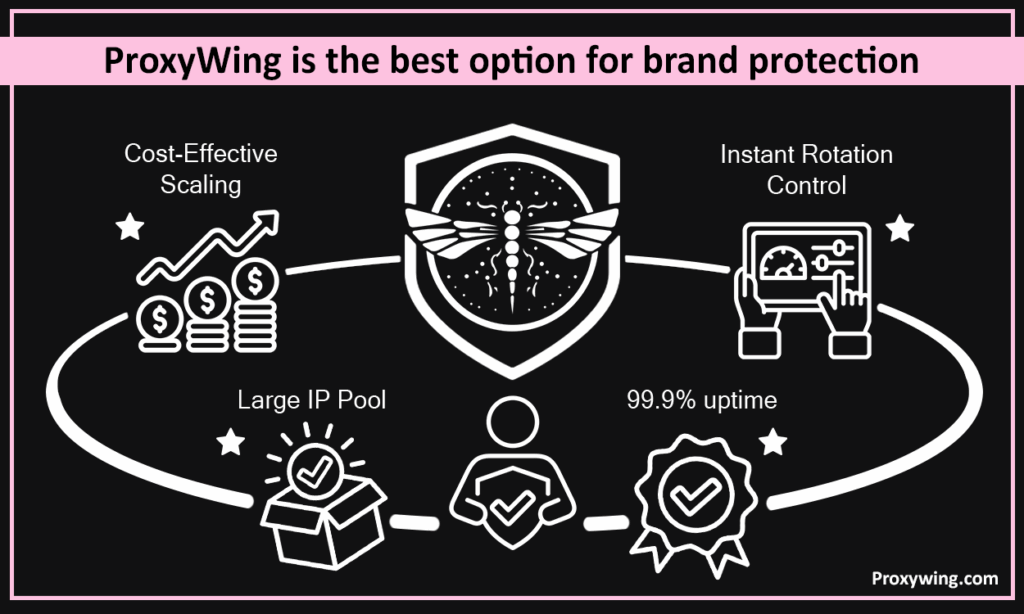
ProxyWing is the most balanced choice because of their focus on core aspects of proxy servers that businesses care about. Here is a summary of what you should expect when you go with ProxyWing:
We did not rank these providers on marketing claims alone. Each one had to perform on the things that matter for brand monitoring: real IPs in the countries where brands trade, a low block rate on protected marketplaces and social platforms, support for both rotating and sticky sessions, clear and current pricing, and clean, consent-based IP sourcing. The five below each win a different lane, from scalable everyday monitoring to enterprise-grade threat intelligence.
| Provider | Proxy Types | IP Pool | Geo Coverage | Best For | Starting Price |
| ProxyWing | ISP, Residential, and datacenter, Mobile | 70M + | 190+ Countries | Scalable Monitoring | $0.9/ per IP |
| Oxylabs | ISP, mobile, Residential, and datacenter | 177M+ | 188+ Countries | Enterprise Intelligence | $1.2 per IP |
| IPRoyal | ISP, mobile, Residential, and datacenter | 34M+ | 195+ Countries | Budget Protection | $1.39 per IP |
| Decodo | ISP, mobile, Residential, and datacenter | 125M+ | 195+ Countries | Scraping & Automation | $0.02 per IP |
| SOAX | Mobile, Residential, and datacenter | 190M+ | 195+ Countries | Geo-Targeting | $0.4/GB |
In this section, we will explore the top five proxy providers to consider for brand protection monitoring. You can choose any of these based on your needs and priorities.
ProxyWing is one of the best choices, thanks to its focus on the basics that users find crucial. It offers a large pool of IPs, high uptime, and an intuitive dashboard that makes proxy management easy for even beginners. ProxyWing is also known for its high-speed ISP and residential proxies that mimic genuine home users.
Oxylabs has been around since 2014, making it one of the providers on this list that have stood the test of time. Over the years, Oxylabs has become the “Gold Standard” for large-scale corporate data gathering. It offers features and a pricing structure that suits most enterprise customers.
IPRoyal has been around since 2020 and has built its brand around offering some of the most affordable plans. Many of its customers view it as the go to provider for “mom-and-pop” brands that don’t have big budgets. One of IPRoyal’s selling points is its “non-expiring traffic” option that allows businesses to use their proxies without worrying about data expiry. If you subscribe for most of their data-based proxy plan, you only get disconnected when your data is used up.
Smartproxy was founded in 2018, but later rebranded to Decodo in 2025. The reason behind the brand was to move away from a pure proxy infrastructure provider to a more comprehensive data access and automation platform. Over the years, this proxy provider has been known for being a powerhouse for automated scraping of marketplace listings. Automated scraping can be a crucial step during brand protection monitoring.
Ever since getting into the industry in 2019, SOAX has been gradually growing its business through expanding its IP network. SOAX mainly specializes in mobile and residential proxies with best-in-class geo-targeting. One of SOAX’s selling points is the Unified Subscription Model for its web scraping API, which allows you access to all proxy types with a single subscription.
Pricing depends on the proxy type and how much data you pull, not just on the provider. As a rough guide for 2026:
When you compare plans to buy brand protection proxies, the number that matters is not the lowest price per gigabyte but the cost per clean result. A slightly pricier pool with a high success rate on Amazon or Instagram beats a cheap pool that gets blocked, because a blocked request gives you no evidence to act on. For most small and mid-sized brands, a pay-as-you-go residential plan plus a small block of datacenter IPs covers the work without a large monthly commitment.
Brand protection in the digital world involves monitoring the internet to identify any malicious activities that could damage a brand’s reputation. Any company in 2026 must safeguard its intellectual property, online reputation, and revenue from malicious online actors. Since monitoring online activities involves traversing various online platforms in different regions, using proxies can help to bypass any resections they may encounter in the process.
Using standard tools that rely on your real IP may not be as successful since they are easily detected. Modern fraudsters use IP bans, geo-fencing, and advanced anti-bot systems to hide their activity. For instance, if they know your brand operates in the US, they can configure their fake website to block all IP addresses coming from the US. Bypassing these kinds of limitations requires using proxy solutions.
A residential proxy routes your traffic through IP addresses of real users in a given region, providing the highest anonymity when compared to other types. They are ideal for protection activities such as social media and marketplace monitoring where looking like a real customer is vital.
A datacenter proxy routes user traffic through high speed IPs of servers running in a given datacenter. Datacenter IPs are fast and affordable, making them the best option for scanning sites with basic security. However, these proxies usually offer limited geo-targeting and are also easier to detect and block.
These proxies will automatically swap your IP with every request or after a set time interval. IP rotation allows you to scan thousands of pages without triggering rate limits. These are ideal when scanning websites that don’t require logging in to gain access to the data you need.
An ISP proxy type relies on IPs of servers running in datacenters managed by internet service providers. Since their IPs are ISP-assigned, they are more trustworthy, offering users the benefits of residential proxies while maintaining high speeds just like datacenter proxies. They are a good option for investigating specific accounts or performing login-based brand monitoring.
A mobile proxy routes your traffic through IPs running on 4G or 5G cellular networks, making it seem like you’re connecting from a real mobile device. Mobile proxies are a great option for accessing web data on mobile-first platforms like Instagram and TikTok.
Knowing the proxy types is one thing; knowing which one to point at each job saves you money and cuts your block rate. Most brand protection programs end up using two or three types, not just one. Here is a simple way to match the threat to the right proxy.
| Brand Protection Task | Best Proxy Type | Why |
|---|---|---|
| Counterfeit listings on Amazon, Walmart, eBay | Residential | Marketplaces flag datacenter IPs fast; residential IPs look like real shoppers |
| MAP and unauthorized-seller checks | Residential (sticky) | Stable sessions keep seller pages and pricing consistent for clean evidence |
| Social media impersonation (Instagram, TikTok, Facebook) | Mobile or residential | Mobile IPs match the app context these platforms expect |
| App-store and mobile-ad scams | Mobile | Carrier IPs see the mobile-only content scammers serve |
| Typosquatting and fake-domain scans | Datacenter | High volume, low protection, speed and cost matter more than stealth |
| Trademark misuse in search results | Datacenter or residential | Datacenter for broad SERP sweeps, residential for protected pages |
A quick rule of thumb: rotate for discovery and stick for proof. Use rotating residential or mobile IPs to scan a lot of listings or profiles quickly, then switch to a sticky session when you need to capture one seller page, one ad, or one storefront cleanly enough to support a takedown.
By using rotating residential IPs, you shield your monitoring tools from being identified as bots. This ensures uninterrupted data flow and access to more platforms without encountering IP blocks.
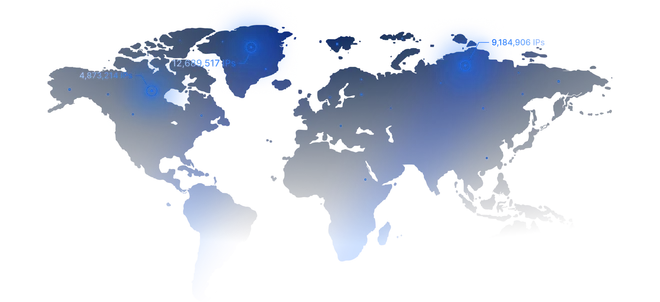
Proxies allow the use of IP addresses in almost any city. Most of the proxy providers we covered, including ProxyWing, offer IPs in more than 190 countries. This allows you to monitor malicious activities in almost any country to catch regional-specific scams without any geo-restrictions.
Distributed IP pools allow you to send multiple requests to the same platforms without encountering rate-limiting by using a unique IP for each request. This allows for large scale scraping of relevant data from many platforms with minimal hiccups.
Setting up proxies for brand protection is simpler than it sounds. Here is the basic workflow most teams follow.
Article written by:

Full Stack AI Engineer
Full-stack engineer at Proxywing working across backend architecture, performance optimization, and AI-driven workflows. Node.js, React, cloud infrastructure, and RAG pipelines.
All articles by author (61)These are intermediary servers that route your traffic through remote servers before sending it to the target websites you intend to scan for malicious activities. Using a proxy helps hide your IP address to ensure your connection remains anonymous.
Yes, they are better, especially when compared with datacenter proxies. Residential proxies rely on IP addresses of real home devices, making it hard to distinguish their traffic from real users.
Yes, proxies are effective for accessing websites of malicious actors selling counterfeits since they bypass any geo-restrictions these malicious actors might have put in place to block IPs from specific regions.
Yes, using proxies to protect your own intellectual property is a standard, legal business practice.
For small brands, a few dozen ISP IPs will do the job. For global enterprises, rotating pools of millions of IPs might be required to avoid IP bans.
For most brands, residential proxies are the best all-round choice because they clear protected marketplaces and social platforms. Add datacenter proxies for cheap, high-volume domain and search scans, and mobile proxies if you monitor app stores or mobile ads. Providers like ProxyWing, Oxylabs, and Decodo all cover these types.
Residential proxies with the location set to the market you are checking. Counterfeit listings on Amazon, eBay, and regional marketplaces are usually shown only to local shoppers, so a residential IP in the right country sees what the seller hides from out-of-region visitors.
MAP (Minimum Advertised Price) monitoring means checking that resellers are not advertising your products below the price you set. Because you read marketplace and retailer pages at scale, residential proxies with sticky sessions work best, since they keep pricing and seller data consistent across a check.
Yes. Mobile and residential proxies let you view public profiles and ads the way real users see them, which is how you spot impersonator accounts and knock-off sellers. Mobile IPs usually work best on these apps because they match the mobile context the platforms expect.
Monitoring publicly visible listings, ads, and profiles to protect your own brand is a recognized and widely used practice. The risk rises when you collect personal data, access logged-in accounts, or ignore a platform’s terms, so stay on public pages and keep clean records. This is general information, not legal advice — check with counsel before scaling a program.