


Proxy Authentication Methods Explained: Username/Password vs IP Whitelisting
06.10.2026 10 min
One of the reasons to choose datacenter proxies over the other types is their fast speeds and low costs. They usually offer the fastest speeds. Even though they are easier to detect compared to residential and ISP proxies, datacenter proxies can still be used for less critical applications like streaming and online gaming.
The provider you choose is one of the key factors that determines the overall experience you will get. In this detailed guide, we will discuss the best datacenter proxy providers, covering their core capabilities, benefits, limitations, and more.
By the end, you will have all the information you need to choose the best datacenter proxy provider for your needs. Let’s dive in!
| Provider | Starting Price | Proxy Types | Geo Coverage | Rotation | Traffic Limits | Support | Best For |
| ProxyWing | $0.90/mo (DC) | Datacenter, Residential, ISP, Mobile | 190+ countries | Yes | Unlimited (ISP and DC) | Dedicated 24/7 Live chat, docs | Best overall for scraping, account management, agencies |
| Oxylabs | $1.20/IP (DC) | Datacenter, Residential, ISP, Mobile | 188+ countries | Yes | Unlimited (ISP and DC) | Dedicated account manager, 24/7 | Enterprise-scale data collection |
| Decodo | $0.02/IP (DC) | Datacenter, Residential, ISP, Mobile | 195+ countries | Yes | Unlimited (ISP and DC) | 24/7 chat | SMBs, automation, scraping |
| Webshare | $$0.014/IP (DC) | Datacenter, Residential, ISP | 195+ countries | Yes | Unlimited on higher-tier plans; capped on entry plans | Email, docs | Beginners, light projects, budget users |
| Bright Data | $0.90/IP (DC) | Datacenter, Residential, ISP, Mobile | 195+ countries | Yes | Unlimited on higher-tier plans. Capped on entry plans | Dedicated support, 24/7 | Advanced users, large operations |
| IPRoyal | $1.39/IP (DC) | Datacenter, Residential, ISP, Mobile | 195+ countries | Yes | Unlimited (DC) | 24/7 live chat | Budget buyers, no-commitment plans |
| Proxy-Seller | $0.08/IP (DC) | Datacenter Residential, ISP, Mobile | 220+ countries | Yes | Unlimited (DC) | 24/7 live chat | Location-specific targeting, geo-diverse purchasing |
A datacenter proxy is an IP address hosted on a server inside a data center instead of being assigned by an internet service provider to a home connection. When you route your traffic through a datacenter proxy server, the target site sees the proxy’s IP rather than your own, which hides your location and usually delivers much faster, more stable speeds than residential IPs.
There are a few variations you will run into. Shared datacenter proxies split the same IP pool across several users, while dedicated (or private) datacenter proxies give you exclusive use of an IP. Some providers also separate static datacenter proxies, which keep the same IP across long sessions, from rotating pools that cycle through new IPs.
The main trade-off is detection. Because data center IP ranges are easy to identify, datacenter proxies work best on targets without aggressive anti-bot systems, such as public APIs, SEO tools, price monitoring, and general scraping. If you need maximum stealth, ISP or residential proxies are the safer choice.
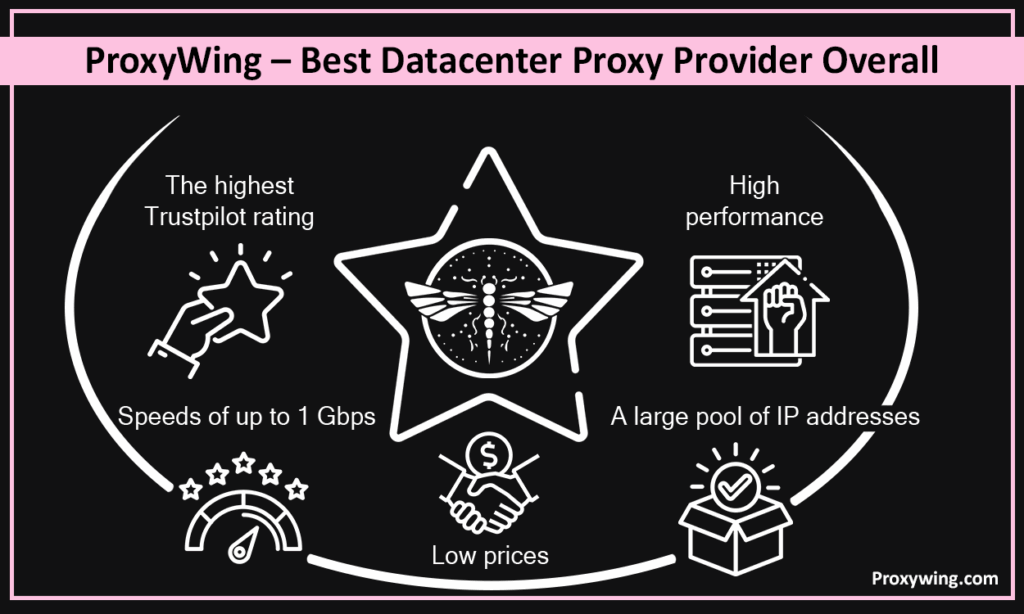
Overall, ProxyWing’s Datacenter proxy is our number one pick because it hits the right balance across the four things most users care about. These include price, scalability, great performance, and easy setup process. Plans start at $0.90/month, IP pools offer over 70 million IPs in 190+ countries, and a 99.9% uptime guarantee. ProxyWing is the right provider for individuals and small businesses searching for reliable proxy servers on a budget.
Trust Pilot Rating: 4.5/5 — one of the highest in the industry.
Digital marketers, web scrapers, e-commerce teams, agencies handling multiple accounts for clients, and beginners searching for reliable IPs.
Pros
Cons
Oxylabs has been in the proxy business for over a decade and has earned its reputation as the gold standard for large-scale data collection. Over the years, Oxylabs has focused on creating proxy solutions that are tailored for the enterprise customers, including both small and large organizatio. Its infrastructure is also designed for ultra-low response times and high bandwidth, with a pool of over 177 million IPs across 188+ countries.
Trust Pilot Rating: 4.1/5 — Not the highest, but still respectable
Large businesses, data engineering teams, and enterprises running continuous, high-volume operations with bigger budgets to match.
Pros
Cons
Formerly Smartproxy, Decodo rebranded in late 2025 to reflect its shift from a pure proxy provider to large scale data access and automation platform. It has been in business since 2018 and has gained several users, thanks to its focus on making the experience better without charging exorbitant prices. Decodo is also one of the most accessible platforms on this list, thanks to its beginner-friendly interface, fast to set up, and affordable pricing.
Trust Pilot Rating: 4.2/5 — Good enough compared to the competition
SMBs, solo operators, and small teams that need a clean user experience, quick deployment, and strong automation capabilities without enterprise overhead and pricing.
Pros
Cons
Webshare’s main draw is its accessible entry pricing and free proxy tier, which lowers the barrier for users who want functional datacenter proxies without committing to a monthly spend upfront. Users can access their premium services for as low as $0.0179/proxy, which is one of the lowest in the industry. However, their pricing significantly varies based on the number of proxies in the package you choose, making it more ideal for enterprise customers.
TrustPilot Rating: 4.1 — Not the highest but still very respectable.
Individual developers, enterprise customers, researchers, students, and budget-conscious users running lightweight scraping, testing, or smaller-scale projects.
Pros
Cons
Bright Data has been in the proxy business since 2014, making it one of the most established names on this list. This proxy provider has garnered a large user base, thanks to focusing on core capabilities that affect most proxy users. Its network and server infrastructure spans over 150 million IPs, including 770K datacenter IPs and its advanced “Super Proxy” servers automatically route traffic through the fastest available path.
TrustPilot Rating: 4.5/5— one of the highest in the industry
Advanced users, data engineers, compliance-focused teams, and enterprise customers that need granular control and broad proxy type coverage.
Pros
Cons
IPRoyal built its name on affordability and flexibility, which makes it a great choice for both small businesses and individuals on a budget. Despite being affordable, IPRoyal still offers one of the widest coverages for datacenter proxies. One of its major selling points is its non-expiring traffic — you buy data once and use it whenever you need it, with no monthly pressure. It’s a practical choice for users who need reliable proxies without ongoing subscription commitments.
TrustPilot Rating: 3.8/5 — One of the lowest among the top providers.
Smaller teams, individual account managers, occasional users, and cost-sensitive buyers who want dedicated IPs without long-term contracts.
Pros
Cons
Proxy-Seller has been in the proxy business for over ten years, making it one of the oldest providers on this list. It stands out for giving its users flexible control over country selection and package configuration, which makes it a strong choice for anyone whose use case is location-specific or requires mixing and matching proxy packages. It also has relatively wide coverage for its datacenter proxy IPs.
TrustPilot Rating: 3.9/10 — One of the lowest among the major proxy providers.
Users who prioritize specific geographic targeting and want the flexibility to configure purchases around precise location needs.
Pros
Cons
Each provider was scored across seven criteria, including:
It is important to note that some factors such as consistent real-world performance may carry more weight than impressive specs on paper. In the next section of this guide, we will discuss the detailed factors that you should consider when choosing a proxy for business or personal projects.
Before you compare providers, decide whether you need shared or dedicated datacenter proxies. This single choice affects your price, success rate, and block risk more than the brand you pick.
Shared proxies split a pool of IPs across multiple customers. They are the cheapest option and usually billed per GB, which makes them reasonable for testing, light scraping, and targets with little to no bot protection. The downside is that you inherit other users’ behavior, if someone else gets an IP banned on your target, that block becomes your problem too.
Best for: development, testing, low-volume scraping, and budget projects.
Dedicated datacenter proxies, sometimes sold as private proxies, give you exclusive access to specific IPs. Nobody else can burn your addresses, so your IP reputation stays clean as long as you manage your own request patterns. They cost more, usually billed per IP, but most plans include unlimited bandwidth.
Best for: production scraping, account management, SEO monitoring, and any task where a consistent, clean IP matters.
For most serious work, dedicated IPs pay for themselves through higher success rates and fewer wasted requests. If you only need a handful of IPs for occasional jobs, shared proxies will save you money without much downside.
A common question is whether datacenter proxies are enough or whether you should pay more for residential IPs. The answer comes down to your target and your priorities.
Stick with datacenter proxies when speed and cost matter more than stealth. They are several times faster than residential proxies and far cheaper per request, which makes them ideal for high-volume, low-sensitivity jobs like price monitoring, SEO tracking, and scraping public data or simple e-commerce pages.
Switch to residential or ISP proxies when your target actively blocks data center IP ranges, when you need to look like a real user for login flows and social platforms, or when you need precise city-level targeting. A quick test: run a batch through datacenter IPs, and if your block rate climbs past roughly 30%, move that workflow to residential.
The practical approach for most users is to start with datacenter proxies and only upgrade the specific tasks that force your hand.
Confirm whether the provider offers shared, dedicated, static, or rotating proxies. Make sure the proxy vendor also provides the popular proxy types, including, ISP, residential, and datacenter proxies. If you need mobile IPs, confirm that the option for mobile proxy is available in your preferred provider’s catalog.
It is also crucial to assess the choice between shared and dedicated proxies. Shared proxies cost less but inherit other users’ reputations, which could lead to frequent IP bans. Dedicated proxies on the other hand give you exclusive access. This makes dedicated IPs the best choice for sensitive tasks such as account management and scraping sites with strict security policies.
City-level targeting matters for geo-specific workflows like localized content access or regional price monitoring. Choose vendors that offer the largest pools of datacenter proxy IPs in most countries and also confirm their geo-targeting capabilities. Broad country coverage alone won’t be enough for precision-dependent use cases. Most reliable providers offer datacenter IPs in at least 50 countries.
It is also important to note that most providers advertise their coverage for residential proxies since they usually offer the widest. But when you dive deep, you will likely notice that their coverage for datacenter proxies is usually significantly lower.
Some providers charge per GB, others per IP or via flat subscriptions. Calculate your actual usage cost under each model to determine what suits your usage. You will notice that headline prices rarely reflect what you’ll pay once you scale up. The starting prices advertised usually require subscribing to a significant number of IPs.
IP whitelisting suits fixed-location setups. If you intend to use a single router from home or office, IP whitelisting is more ideal and convenient. On the other hand, username/password authentication offers more flexibility, especially for users on the go.
For automated tasks, confirm support for APIs or proxy manager compatibility to reduce manual overhead. Most providers offer integration for popular automation tools used for data scraping and other similar tasks.
Like with any online services, users may face issues whether during set up or usage. The most important thing is to ensure your provider of choice offers fast support and clear setup documentation as these help save significant time during onboarding and when issues arise.
You could also go for providers that offer different channels for support and well-maintained docs. A provider that offers different channels to access their support makes it easier and more convenient for users to get support services whenever they need them.
Low-cost proxies often sacrifice IP quality, uptime, and support. What looks affordable upfront can cost more in lost time and repeated purchases when performance falls short. You also need to consider the pricing for the datacenter proxies specifically. A provider may offer the cheapest residential proxies, but relatively higher prices for their datacenter options.
Shared datacenter proxies carry the baggage of every previous user. If those users triggered bans, you inherit their problems, which could mean experiencing frequent IP bans when accessing websites with strict security policies. Dedicated datacenter proxies are usually more pricey than shared. But they can be worth it for users that value uninterrupted proxy usage. Know the difference between the two before purchasing.
Scraping, account management, SEO monitoring, and browsing have different requirements. A rotating pool optimized for scraping will frustrate anyone who needs stable session IPs. The key difference to take note of is the availability of static and rotating IPs. Scraping for instance requires rotating IPs while stable session tasks like account management require static IPs.
Take time and check the provider’s renewal rates, bandwidth caps, thread limits, and add-on fees. What’s affordable at entry level can become costly once you hit usage thresholds. Most top datacenter IP providers offer unlimited bandwidth for their datacenter proxy. Data caps are usually implemented for rotating residential proxies.
Datacenter proxy pricing usually follows one of two models: per IP or per GB of traffic. Per-IP plans suit dedicated proxies and almost always come with unlimited bandwidth, so heavy users are not punished for the amount of data they pull. Per-GB plans are common for shared pools and look cheap at first, but the cost adds up fast once you scale.
Entry prices in 2026 vary widely. Shared datacenter proxies can start around $0.02 to $0.30 per IP, while dedicated datacenter proxies typically run from roughly $0.90 to $3.00 per IP per month. The cheapest plan is not always the best value, very low prices often mean smaller pools, recycled IPs, or thin support that costs you more in failed requests later.
If you are hunting for cheap dedicated datacenter proxies, look past the headline price and check three things: whether bandwidth is truly unlimited, how large and how diverse the IP pool is, and whether the per-IP rate holds when you only need a small number of proxies. ProxyWing, for example, keeps dedicated datacenter plans affordable from $0.90/month with unlimited bandwidth, which is the balance most scrapers and account managers are actually after.
ProxyWing is the best Datacenter proxy provider for users needing reliable, affordable, and easy-to-set-up datacenter proxies. Oxylabs is the right provider for enterprise-scale operations, and Decodo suits most SMBs and automation-focused teams. For users on a strict budget, IPRoyal is the strongest pick, thanks to its flexible and no-commitment plans. As shared earlier, you need to assess your specific needs and then select a provider that meets them at the lowest possible price.
Article written by:

Product & Support Operations Lead
Built Proxywing's support department from scratch — documented workflows, clear escalations, consistent quality. Now bridges the CEO and engineering, keeping infrastructure projects on track.
All articles by author (68)Their common use cases include web data scraping, price monitoring, SEO tracking, ad verification, account management, and bypassing geo-restrictions.
They’re relatively faster and cheaper than residential proxies. However, they are also easier to detect, which makes them a worse option for scraping websites with strict security policies. Their value is more noticed dealing with tasks that are not as sensitive.
You can choose the best provider based on key factors such as the proxy type, location coverage, billing model, authentication options, and custom support reliability. To get the best Datacenter proxies, the goal should be choosing a provider that offers all the features you need without having to overpay for them.
Dedicated proxies are the best option for tasks needing a clean and consistent IP. Shared proxies are cheaper and also work well enough for light use where IP reputation is less critical. However, for a more reliable experience, we recommend going with dedicated IPs in datacenters.
Yes, they are good especially considering they offer the fastest speeds. Their only downside is that they are easier to detect. For websites and online services with advanced anti-bot systems, rotating residential or ISP proxies perform better since they rely on IP addresses assigned by internet service providers that are more trusted by most online services.
A datacenter proxy server is a machine in a data center that routes your traffic and replaces your IP with one of its own. It is the infrastructure behind every datacenter proxy, and it is what gives these proxies their high speed and low cost compared to residential options.
Webshare, Decodo, and Proxy-Seller offer some of the lowest per-IP datacenter pricing, and ProxyWing is a strong pick for cheap dedicated datacenter proxies that still include unlimited bandwidth. When comparing cheap options, always confirm the IP pool size and bandwidth terms so a low price does not cost you in failed requests.
Most dedicated datacenter proxy plans include unlimited bandwidth because they are billed per IP rather than per GB. Shared and rotating plans are more likely to cap traffic, so check the limits before you buy if you plan to move large volumes of data.
IPv4 datacenter proxies use the older, widely supported address format and work with almost every target site, which is why they cost more. IPv6 datacenter proxies are cheaper and available in larger volumes, but many websites do not fully support IPv6, so they fit a narrower set of use cases.
They overlap but are not identical. Dedicated means the IP is assigned only to you, while static means the IP does not change between sessions. Most dedicated datacenter proxies are also static, which is what you want for account management and other tasks that need a stable, clean IP.