



Proxy Authentication Methods Explained: Username/Password vs IP Whitelisting
06.10.2026 10 min
Go and Python are two of the most popular programming languages in 2026. If you’re someone getting into software development, you might be wondering which of the two to start with and why. The good news is that both options are meant for different use cases, so what you intend to use them for will be a main factor when making your choice.
Besides use cases, there are other factors to consider such as ease of use, learning curve, memory efficiency, and more. In this Go vs Python languages comparison, we will dive deep into all the major differences to help you make your decision from an informed position. We will cover the key features of each, best use cases, pros and cons, and more. Make sure you read to the end.
Go is an open-source programming language created by Google in 2009. The main objective behind creating it was to solve real infrastructure problems at scale. It was designed from the ground up for high speeds, simplicity, and efficient concurrent programming.
It was created at the time when cloud computing was still in its early days, which is why it is the most suited option for all tasks related to cloud architecture, scaling infrastructure, and systems programming.
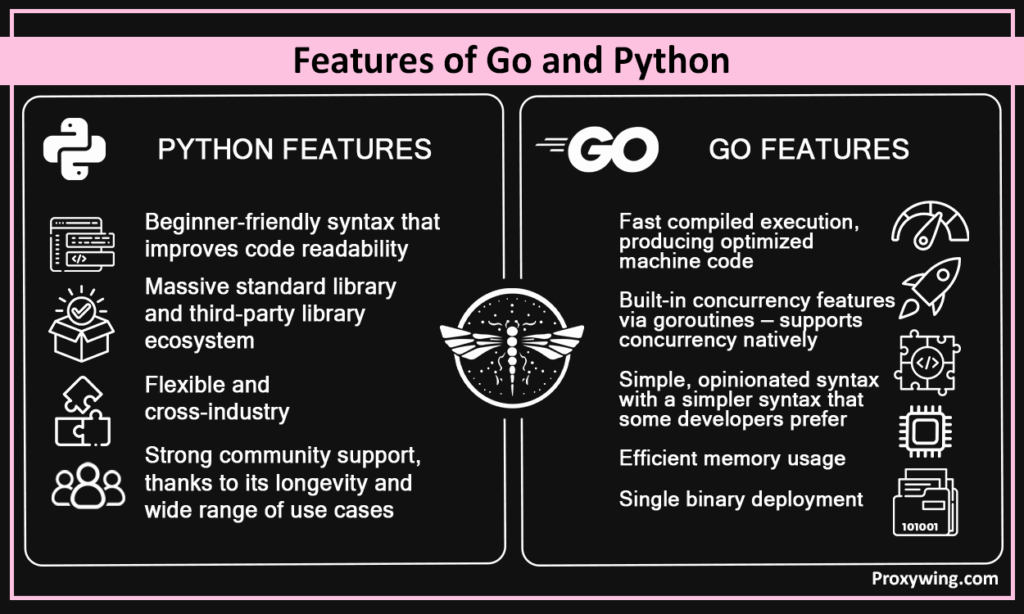
Go is a compiled, statically typed language with a clean, minimal syntax. It compiles directly to machine code, which makes it faster than interpreted languages. Its built-in goroutines make concurrent programming straightforward. A single Go program could handle tens of thousands of goroutines without crashing or slowing down, making it one of the most efficiently compiled languages in 2026.
Some of the common real-world use cases of Go include cloud infrastructure, backend development, microservices, and DevOps tooling. Major tools like Kubernetes, Docker, and Terraform are all written in Go.
Golang is also used in management systems for cloud-native environments. Overall, Go is the dominant option for building the underlying cloud infrastructure itself. If you’re handling cloud-related tasks, Go is a must-learn.
Python is a general-purpose open-source, interpreted language first released in 1991. It’s widely regarded as one of the most beginner-friendly options. It is known for its readable syntax, flexibility, and one of the largest library ecosystems in programming. Being around for longer also means a larger community compared to most modern languages.
Python belongs to the family of interpreted languages and is dynamically typed, which means variable types are checked at runtime. This makes it great for use cases where development speed matters more than anything else.
Python’s syntaxes read almost like plain English, and it ships with an extensive standard library plus thousands of third-party packages. This allows programmers to write programs for a wide range of applications without starting from scratch.
| Features | Go | Python |
| Learning curve | Moderate | Beginner-friendly |
| Speed | Fast (compiled) | Slower (interpreted) |
| Scalability | Excellent | Good with right architecture |
| Ecosystem | Focused | Massive |
| Best for | Backend, infra, APIs | AI, data, scripting, web |
One of the key factors to consider when choosing a programming language is its syntax and code readability. Python’s syntax is minimal and highly readable, making it the preferred first language for beginners. Even after 35 years of existence, Python is still one of the first languages recommended for beginners.
Golang also has a simpler syntax compared to many older compiled languages, but is stricter. It is known for enforcing clean code through rigid formatting rules and explicit error handling. This is mainly meant to make it more efficient, but it turns out to be a little harder for beginners to adopt than other options.
Go compiles directly to machine code before execution, which means faster runtime performance. The Python interpreter on the other hand runs code line by line, adding overhead that shows up under heavy workloads. Go’s approach makes it way faster for high-throughput systems.
Go’s static typing catches errors in data types at compile time, which improves reliability in large software projects and larger applications. This prevents bugs from reaching production since errors are caught before the code ever runs. Python’s dynamic typing allows faster development speed but can surface bugs only at runtime. So, Python enables faster prototyping but makes your code riskier.
Performance is one of the key factors you must consider when choosing a programming language. Here is how the two compare in this regard:
Go is faster. Since it is a compiled language, it converts code to machine code before execution, eliminating the interpreter overhead experienced with Python. In benchmarks, Go handles significantly more requests per second than Python under equivalent conditions. Golang is also several times faster than Python for HTTP API throughput. For instance, it handles 8.6x more requests per second than Python’s fastest framework (FastAPI).
Go typically consumes less memory in production environments, making it more efficient than Python for many workloads. The Python interpreter adds overhead, and its dynamic typing requires more memory allocation at runtime. In some use cases, Go uses more than 65% less memory, which could lead to significant cost savings especially when running at larger scales.
Go was built for concurrent programming. Its goroutines are lightweight and managed by the Go runtime, allowing thousands of concurrent applications to run efficiently. Python’s GIL prevents true parallel thread execution, making it weaker for CPU-bound concurrent systems. In CPU-bound tasks, Go outperforms Python by 5x to 40x depending on the task, giving Go superior concurrency support.
Python has mature web frameworks like Django and Flask that make web development fast and straightforward. These web frameworks are strong choices for development teams prioritizing development speed and a rich plugin ecosystem.
Since Python has been around for a longer time, you will find plenty of libraries to use for most component tasks, including web applications of various kinds, which can make development faster.
Go is increasingly preferred for high-throughput backend systems and web services where performance and low latency matter. Its lightweight binaries and native concurrent programming capabilities make it well-suited for microservices architectures.
Go excels in backend development. In 2026, a large number of web platforms use microservices, which is why Go is more popular than ever.
Web scraping tasks involve a lot of scripting and automation, making Python default choice for many. Python also dominates web scraping thanks to libraries like BeautifulSoup, Scrapy, Selenium, and Playwright. The ecosystem is mature, well-documented, and easy to get started with, enabling developers to build scrapers with minimal setup.
Go is a strong choice when scraping at scale. Running high-volume, concurrent requests benefit from Go’s goroutines and lower memory usage. Golang excels at concurrent programs that require processing many requests simultaneously. If speed and efficiency matter more than ecosystem convenience, Go delivers.
Whether you’re scraping with Python or Go, using rotating proxies is essential to avoid blocks and IP bans. These proxies allow you to automatically rotate IP addresses for requests, which makes it hard to experience disruption due to IP bans and rate limits. Proxies also make it possible to scrape data from websites and online services that are only available in certain regions.
ProxyWing offers 70M+ clean IPs across 190+ countries, with sub-1-second latency and providing support for both HTTP/S and SOCKS5 protocol, enabling high-volume scraping workflows.
Python scales well for most standard applications, especially when paired with web frameworks like Django. However, you need to properly architect your applications with caching and load balancing in place.
Go is the preferred choice for cloud-native systems and microservices that need to handle extreme concurrency. Its lightweight goroutines and more efficient resource usage (especially memory) make it easier to scale without proportional infrastructure cost increases.
When it comes to machine learning and AI, Python is the most dominant language in the space. Libraries such as NumPy and pandas make it the default choice for everything from data analysis to deep learning model training. This strong library ecosystem is one reason Python remains a good choice for any AI-related project.
Go is rarely used for model training, but it has a growing role in ML infrastructure. Golang excels at building data pipelines, serving models in production, and wrapping Python-based ML services in fast, reliable APIs. So, both languages are used in this space, but for different tasks.
Python demand continues to rise, especially in 2026, thanks to the significant growth in AI, data science, and automation. It consistently ranks among the most popular languages in developer surveys and job postings across virtually every industry.
Go adoption is growing steadily, particularly in cloud computing, DevOps, and backend development. Its developer salaries also rank among the highest in the industry, and demand is strong in companies building scalable infrastructure — which is almost every company that uses the cloud.
Go and Python are both useful and popular programming languages. However, they were built with different objectives in mind, so the choice between the two will largely depend on what you intend to build. Your goal is to ensure the chosen language handles the task better. Every experienced developer knows what they need, but beginners may have to think harder before making this choice.
Python is the better choice for machine learning, data work, scripting, and rapid development. Go is the better choice when performance, concurrency, and scalable backend systems are the priority. There are better ways to approach each task and your choice depends entirely on what you’re building and your needs.
Article written by:

Product & Support Operations Lead
Built Proxywing's support department from scratch — documented workflows, clear escalations, consistent quality. Now bridges the CEO and engineering, keeping infrastructure projects on track.
All articles by author (68)Go is best for building high-performance backend systems, APIs, microservices, cloud infrastructure, and DevOps tooling. It works best for scenarios where speed and concurrency are critical.
Python is best for machine learning, data science, automation, web development, and scripting. It is a good choice for applications where development speed and library availability matter most.
For high-volume, concurrent scraping, Go has a performance advantage. However, for ease of use and library support, Python is generally the better starting point. So, the choice will largely depend on your priorities.
The official name is Go. “Golang” became common because the original website was golang.org. However, the language itself is simply called Go.
Go is relatively harder to learn due to static typing and stricter syntax rules. Python is considered easier for beginners. However, Go is still regarded as one of the simpler compiled languages to learn compared to other options like C, Java, C++, and Rust.
Not entirely. Go and Python are meant for different use cases. Go excels in performance-critical backend systems while Python dominates in machine learning and data science. Most development teams use both.