


Proxy Authentication Methods Explained: Username/Password vs IP Whitelisting
06.10.2026 10 min
Tasks like doing in-depth research or training AI models require a massive amount of data and one of the most effective ways to create large datasets is through web scraping. To effectively collect data from the web, there are several tools you need and proxies are among the most useful ones. Proxy servers enable your web scrapers to create rotating IP addresses for every request, allowing them to bypass rate limits and IP blocks.
Using proxy solutions also allows your web scrapers to access websites and other online services whose access is limited to specific regions. If you need to launch an AI web scraping pipeline that extracts data from various online resources, this guide is for you. In today’s guide, we will discuss the core steps for building your AI web scraping pipeline and how to integrate proxies. Let’s get into it!
An AI web scraping pipeline is a workflow that collects, cleans, enriches, and processes web data using automation and AI components working together in sequence. The main goal of this workflow is to provide clean and relevant data needed for AI model training and other research projects. To achieve this goal, it is important to ensure each step of the workflow is correctly executed.
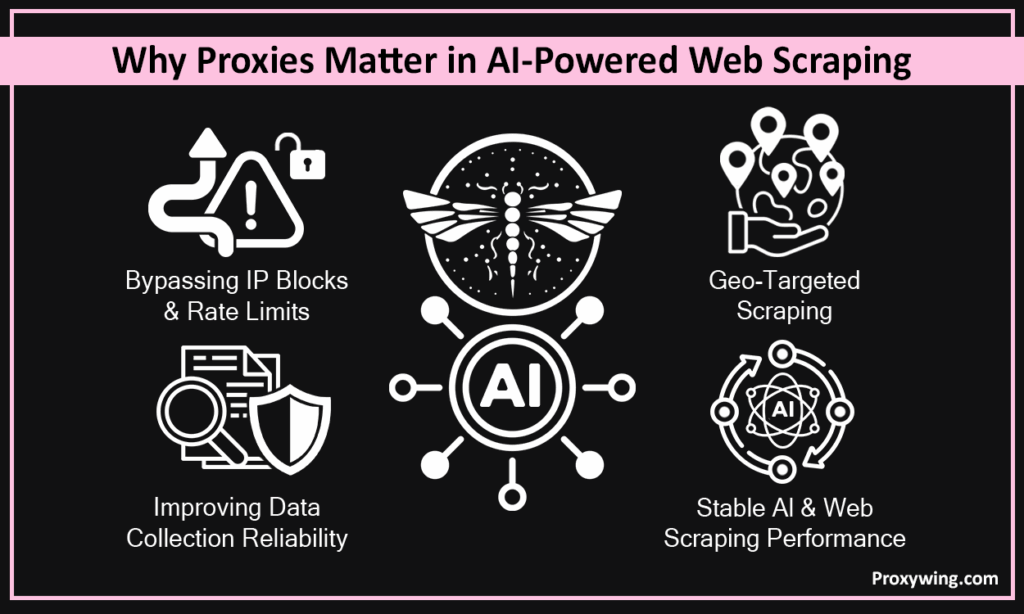
Proxy helps your web scraper to distribute requests across multiple IPs, reduce blocking risk, enable geo-targeting, and keep AI web scraping stable when running at scale.
Sending too many requests from one IP may trigger security systems of certain websites which can lead to IP bans or rate limits. Proxy servers spread your web scraper’s requests across different IPs, keeping access to target sites intact. The website will assume the requests from your web scraper are coming from different users, minimizing the chances of experiencing IP bans during the web scraping process.
Since proxies allow you to use IP addresses from any location, your web scraper will be able to seamlessly access websites in any region with no restrictions. This allows your web scrapers to view localized prices, search results, and region-specific pages by routing traffic through IPs in the target country or city. The region of IPs you choose to use depends on the target.
When extracting data from the web, frequent IP bans and rate limits can interrupt your workflow, potentially leading to incomplete web scraping. Proxy rotation and session control reduce these interruptions, improving overall success rates for your web scrapers across long or high-volume runs.
In this section, we will explore some of the core parts of any AI web scraping pipeline:
The pipeline first identifies which pages, listings, or endpoints to scrape. This can be done through sitemaps, crawling, or predefined URL lists to create a target page inventory. The target URL discovery is the very crucial part as it affects what data makes it into your AI web scraping pipeline — if you miss pages at this stage, you miss the data on them entirely.
This layer manages headers, user agents, retries, throttling, and proxy rotation to avoid detection and maintain consistent access. Without proper request handling, even a well-built web scraper will hit rate limits or get blocked before it collects all the data needed. The role of proxy servers at this stage is to distribute requests across different IPs to keep access consistent.
After fetching the page, your web scraping pipeline needs to read it. Static HTML pages can be parsed directly with tools like BeautifulSoup or lxml. JavaScript-heavy pages on the other hand need a headless browser like Playwright or Puppeteer to fully render the page before any data can be extracted. You must use the right method to avoid getting back an empty or incomplete page.
Your AI models are as good as the quality of the data used to train them. Raw scraped content is usually not ready for use. It needs to be normalized to create a consistent, usable structure. This process includes removing duplicates, fixing formats, and organizing fields into a consistent, usable structure. Having clean data makes all the next steps much smoother and more effective.
This is the stage where AI brings in capabilities that are not present with rule-based systems. AI handles tasks like entity extraction, content classification, pattern detection, and turning unstructured text into labeled, structured output. Traditional rule-based systems would struggle with all these processes.
Final data is now delivered to its final destination. This destination can be a relational database, data warehouses, spreadsheets, or external tool via API or webhook. Formatting for the end consumer, whether that is an analyst running queries, a dashboard pulling live data, or an automated system acting on the output is also handled at this stage.
This section will walk you through the seven steps for building an effective web scraping pipeline:
Decide exactly what data you need, which sites it comes from, and how frequently it needs to be collected before writing a single line of code. Having all these details will save you a lot of time down the road.
The choice of the web scraping method you go with is largely dependent on the target. Use simple HTTP requests for static sites, browser automation for JavaScript-rendered pages, and APIs where they’re available and sufficient. Using the wrong method can significantly affect the quality and quantity of data you collect at the end of the day.
As earlier stated, proxy servers are necessary for bypassing geo-restrictions and preventing IP bans/rate limits. Make sure to match the proxy type to target difficulty — use residential proxy servers for high-trust sites, datacenter for simpler targets, and ISP for stable mid-difficulty web scraping. ProxyWing offers all these three types with plans starting from $0.90/month.
This is the step where you build the real code (script) that defines the core aspects of how your web scraper will actually collect data. When building your logic, you must define how the web scraper accesses pages, what it extracts, how it handles pagination, and what it does when a request fails or returns an error. You may need to try your logic a couple of times and refine it gradually until it achieves your web scraping goals.
This is basically the data cleaning phase and it is effectively executed by using AI solutions. Feed raw scraped output into an AI model to clean messy data, classify content, or convert unstructured text into structured, usable fields. Using AI helps speed up the process and also minimizes the possibility of human error if such tasks were to be done manually.
Save the output to your chosen destination and run checks to create a validated, accurate dataset before using it downstream.
Depending on your goal, you can set up failure alerts before you launch recurring runs. The pipeline can also be slightly configured if you need to access new targets or collect different kinds of data in the future.
We briefly covered how the choice of the proxy types does affect the effectiveness of your web scraping pipeline. Let’s now go deeper into each option so you can make the right call before setting one up:
Residential proxy solutions route your traffic through real household ISP-assigned IP addresses, making your traffic seem like it is coming from real residential users. This makes them the best choice for web scraping high-trust scraping targets with strong anti-bot systems. Since traffic looks like it comes from real home users, it is harder for the targets to detect and block it.
With datacenter proxy servers, traffic is routed through IP addresses of servers running in a mainstream datacenter. These IPs are sourced from hosting services and cloud providers, making them much faster and cheaper than residential IPs. Datacenter proxies are best suited for simpler or less protected targets where detection risk is lower.
ISP proxy services route your traffic through IPs of servers running in an ISP-managed datacenter. This type combines datacenter speeds with stronger trust signals of ISP-assigned IPs. It is generally a reliable middle ground for targets that block obvious datacenter IPs. ISP proxies are also much cheaper than residential proxy servers.
Rotating IPs frequently is necessary for high-volume web scraping. When sending too many requests to the same target, using the same IP could lead to rate limits and IP blocks, so rotation is necessary. Use sticky sessions (static IP) when your workflow requires logins or maintaining a consistent session state. If your workflow involves signing in to access, frequent IP rotation can trigger re-authentication and unnecessary re-captchas.
AI interprets inconsistent layouts and semi-structured content that breaks rule-based web scrapers, reducing the need for constant selector maintenance. Advanced AI tools can extract meaning from data that may not make sense to traditional rule-based web scrapers.
AI automatically labels products, articles, and listings to create organized, searchable data. Having categorized data also makes it easier for the targets to use it effectively.
AI condenses large text datasets into concise summaries to create useful insights for market research. This can also help in situations where data storage efficiency is crucial. In such cases, storing the summary of the data is prioritized over maintaining all the raw data.
These are common when accessing targets with advanced security systems. Slowing down your request rates and rotating user agents creates traffic patterns that resemble real users. This reduces CAPTCHA triggers on protected sites. The goal is to make your traffic appear like it is coming from real users.
Sites update layouts very often without warning. Your web scrapers must include flexible selectors and set up alerts that flag when expected data fields stop returning results. You must also always be ready to frequently update your logic if required to take care of such random changes when they happen.
To achieve better performance, run concurrent requests, use a request queue, cache repeated lookups, and choose low-latency proxies to keep throughput high at scale. When using proxies, choosing ISP proxies over residential proxies can also help boost performance.
Always validate your data fields on ingestion, deduplicate by URL or unique identifier, and standardize formats before you launch any downstream processes. Remember the quality of your data matters just as much as the quantity.
Article written by:

CEO
Founder of Proxywing. Drives growth across EU, US, and Asian markets, combining B2B strategy with a hands-on focus on product quality, 99% uptime, and responsive support.
All articles by author (64)