



Proxy Authentication Methods Explained: Username/Password vs IP Whitelisting
06.10.2026 10 min
The internet protocol (IP) is what allows different devices on any given network, including the internet, to send and receive data packets. IPv4 and IPv6 are the two common versions that you can choose from based on your use cases and other preferences.
On the surface, devices and systems using IPv4 or IPv6 will almost work in the same way, but there are a few differences under the hood that could affect certain use cases and could influence your choice.
In this IPv4 vs IPv6 guide, we will discuss everything you need to know about these network protocols to help you choose one that suits your use case. We will start off with the basics of the internet protocol itself to ensure everyone is up to speed before diving into the differences of the two standards.
So, without wasting any more of your time, let’s jump right into this IPv4 vs IPv6 proxy comparison.
| Feature | IPv4 | IPv6 |
|---|---|---|
| Address Size | 32-bit | 128-bit |
| Notation | Decimal (e.g. 192.168.1.1) | Hexadecimal (e.g. 2001:0db8::1) |
| Total Addresses | ~4.3 billion | 340 undecillion |
| NAT Required | Yes | No |
| Built-in Security | Optional (IPSec) | Native IPSec support |
| Scalability | Limited | Virtually unlimited |
An IP address or Internet protocol address is a unique numerical label assigned to every device on a network. This label allows devices to find and communicate with each other across the internet. Every device that connects to the internet needs to have a unique IP address, so all traffic it sends and receives bears its IP address.
Internet Protocol is the set of rules that governs how data packets are addressed, routed, and delivered across networks from source to destination. This protocol was first introduced in the early days of personal computing with the goal of enabling efficient communication between devices on local networks at the time. It was later adopted once the public internet went live in the mid 80s.
Address space refers to the total number of unique IP addresses a protocol can generate. For instance, IPv4’s limited 32-bit space produces only ~4.3 billion addresses, and exhaustion of that pool is what drove the development of IPv6. This disparity is one of the reasons certain tasks may be handled better using IPv6 over IPv4.
IPv4 is the fourth version of the Internet Protocol and still the most widely used today. It uses a 32-bit addressing system, supporting around 4.3 billion unique addresses. A typical IPv4 address looks like this: 192.168.0.1 — four groups of numbers separated by dots, each ranging from 0 to 255. Before the introduction of IPv6, all earlier devices were communicating using IPv4. Using an IPv4 proxy routes your traffic through an IPv4 address.
IPv6 is the successor to IPv4, built on a 128-bit addressing system that supports a virtually unlimited number of unique addresses to meet the demands of a growing internet. A typical IPv6 address looks like this: 2001:0db8:0000:0000:0000:0000:0000:0001 — eight groups of four hexadecimal characters separated by colons.
As already shared, IPv4 addresses are written as four groups of numbers separated by dots, such as 192.168.0.1. Each group ranges from 0 to 255, making the format relatively easy for humans to read and recognize. Most people are familiar with this format.
IPv6 addresses are written as eight groups of four hexadecimal characters separated by colons, such as 2001:0db8:0000:0000:0000:0000:0000:0001. The longer format accommodates a vastly larger address pool.
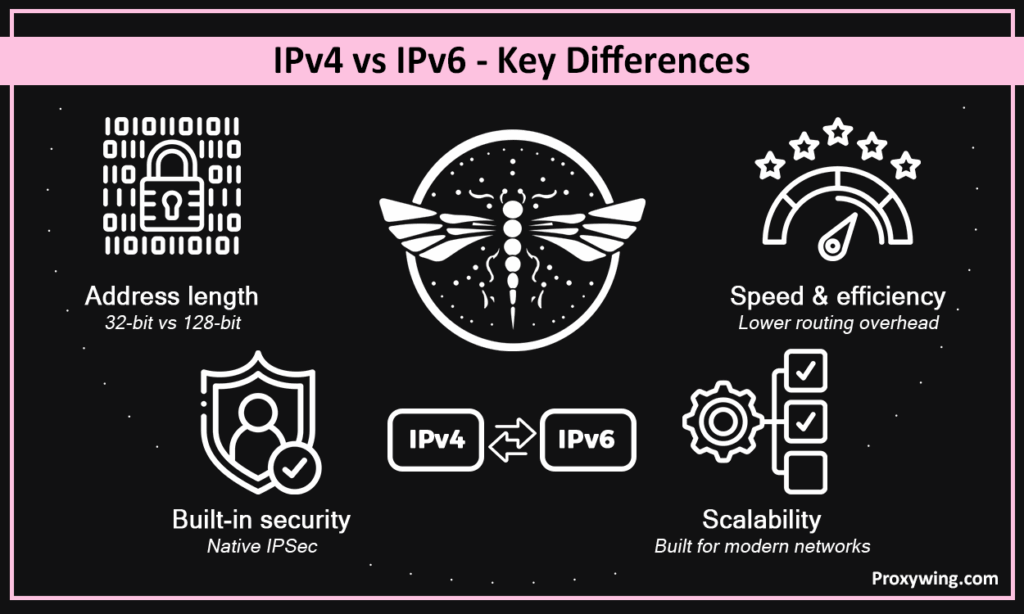
The two protocols differ in address length, performance characteristics, security design, and readiness for modern network environments. Let’s explore these differences in detail:
IPv4 uses 32-bit addresses, producing around 4.3 billion unique IPs. IPv6 on the other hand uses 128-bit addresses, producing enough unique IPs to assign trillions to every person on earth. That difference is the core reason IPv6 exists.
In practice, the speed difference is often almost negligible for most use cases. However, IPv6 can be more efficient in environments where NAT overhead is eliminated and routing tables are simpler, resulting in marginally lower latency.
For some applications like video streaming and real-time communication, this efficiency gain can be more noticeable. IPv6 packet headers are also simpler and fixed at 40 bytes since they drop fields like checksum and fragmentation, which can speed up router processing.
IPv4 supports IPSec optionally and inconsistently. IPv6 was designed with IPSec as a native component, offering stronger built-in support for encrypted and authenticated communication. However real-world security still depends on proper configuration even with IPv6.
IPv4 remains dominant across most consumer devices, ISPs, and legacy software. IPv6 compatibility depends on the device, ISP infrastructure, hosting provider, and application. Adoption is growing but uneven, which is why most systems still default to IPv4 and only have IPv6 as an option.
IPv6 is better suited for IoT deployments, large-scale networks, and future internet growth, thanks to its almost infinite number of addresses. Its flat addressing structure and elimination of NAT make it the more practical long-term choice for expanding infrastructure.
Neither protocol is universally better. The right choice depends on your infrastructure, use case, and how much legacy compatibility matters. But if you only consider technical capabilities, IPv6 is a better version.
IPv4 remains preferable for legacy systems, older hardware, services that don’t yet support IPv6, and environments where simplicity and broad compatibility take priority. It is still the default choice for most systems and that is yet to change even in 2026.
IPv6 is the better option for new deployments, scalable cloud infrastructure, IoT networks, and any environment built for long-term growth where address space and routing efficiency matter. It will inevitably become the go to choice as more ISPs, hosting providers, and device manufacturers complete their transition away from IPv4.
The internet is moving toward IPv6 because IPv4 addresses are exhausted. The transition has been gradual because billions of devices, routers, and services still run on IPv4, making an immediate switch impractical.
Most networks now run both protocols simultaneously during the changeover period. But even with IPv6 adoption accelerating, full migration is still years away given the sheer scale of existing IPv4 infrastructure worldwide.
IPv4 and IPv6 coexist through transition mechanisms like dual-stack (running both protocols simultaneously), tunneling (encapsulating IPv6 traffic inside IPv4 packets), and translation layers that allow communication between devices using different protocol versions. This will continue to be the case for the next couple of years until the transition is fully completed.
IPv4 was introduced in 1981 during the early days of personal computing and became the foundation of the modern internet. Its simplicity and broad adoption made it the default standard for decades, supporting the growth of the web, email, and networked computing globally.
IPv6 was standardized in 1998 and has seen accelerating adoption over the past decade. It is the long-term solution to address exhaustion and the only protocol capable of supporting the continued expansion of connected devices and internet infrastructure.
These benefits make it inevitable that IPv6 will eventually replace IPv4 as the dominant protocol, even if full adoption remains a gradual, decades-long process.
If a VPN routes IPv4 traffic but fails to handle IPv6, your device may send IPv6 requests outside the VPN tunnel, exposing your real IPv6 address without any warning. Before adopting a VPN service, make sure it supports IPv6 traffic tunneling to prevent possible data leaks.
An IPv6 leak occurs when a VPN protects IPv4 traffic but leaves IPv6 traffic unrouted or unblocked, allowing websites and services to see your actual IPv6 address.
On most desktop operating systems, IPv6 can be disabled in network adapter settings.
Look for a VPN that either fully routes IPv6 traffic through the tunnel or blocks it entirely to prevent leaks. Your VPN provider should explicitly document their IPv6 leak protection. If they don’t mention it, assume it may not be handled.
Article written by:

Head of Partnerships
Leads partnerships at Proxywing with hands-on knowledge of residential, ISP, datacenter, and mobile proxies. Works with affiliates, bloggers, and tech communities, bridging tech and partner needs.
All articles by author (23)IPv4 uses 32-bit addresses with a pool of ~4.3 billion IPs. IP version 6 on the other hand uses 128-bit addresses with a virtually unlimited pool. IPv6 also eliminates NAT and includes native security support, which can slightly help improve security and performance.
Not significantly in most cases. IP version 6 can reduce latency in environments where NAT overhead is removed, but the real-world speed difference is often negligible for everyday use.
IPv4 addresses are exhausted. IP version 6 provides the address space needed to support billions of additional devices, making it the only viable protocol for long-term internet growth as more and more devices get connected to the internet.
Only if your VPN doesn’t support IP version 6 and you’re concerned about leaks. In most cases, keeping IPv6 enabled is fine and increasingly necessary as adoption grows. However, disabling will likely not affect the routing of your traffic as well.
Yes. Most modern networks run dual-stack configurations that support both protocols simultaneously, allowing devices and services to communicate regardless of which version they use.