


Proxy Authentication Methods Explained: Username/Password vs IP Whitelisting
06.10.2026 10 min
In 2026, internet users are increasingly prioritizing privacy, flexibility, and a restriction-free online experience. Proxies allow you to browse with minimal restrictions while masking your real IP address (network address) and location, making your connection more anonymous.
Netherlands proxies are a top-tier choice due to the country’s robust server infrastructure and high-speed networks. If the Netherlands is your preferred proxy region, this guide discusses the top 10 proxy providers in this country to help you choose the right one for your needs. Let’s dive in!
If you need a Dutch IP today and don’t want to read the full breakdown: ProxyWing is the best overall pick for the Netherlands: residential, ISP, and datacenter IPs in one account, 1 Gbps ports, and residential traffic that doesn’t expire. Bright Data is the enterprise option when you need ZIP and ASN-level targeting with compliance paperwork. Webshare is the cheapest way to get a working Dutch IP for low-risk tasks.
Everything below is the reasoning: what each provider actually gives you in the Netherlands, what it costs per GB or per IP, and which proxy type fits which job.
Here is a summary of our top choices for the different use cases
| Use Case | Recommended Provider | Why it wins |
| Best Overall | ProxyWing | ProxyWing offers the balance of great performance (up to 1Gbps), robust dutch infrastructure, and non-expiring residential data. |
| Good for Scraping | Oxylabs | Offers the industry-leading success rates (over 99%+) |
| Good Value | Webshare | It offers some of the lowest proxies for their dutch proxy servers and networks. |
| Good for Enterprise | Bright Data | It prioritizes compliance (GDPR/ISO), offers massive scale and the most reliable precise ZIP-level targeting in the NL. |
| Good for Static ISP | IPRoyal | Offers very stable stable “sticky” Dutch network connections for long sessions |
| Good for Mobile | Soax | Provides a large 5G/4G mobile IP pool with precise city targeting in the Netherlands. |
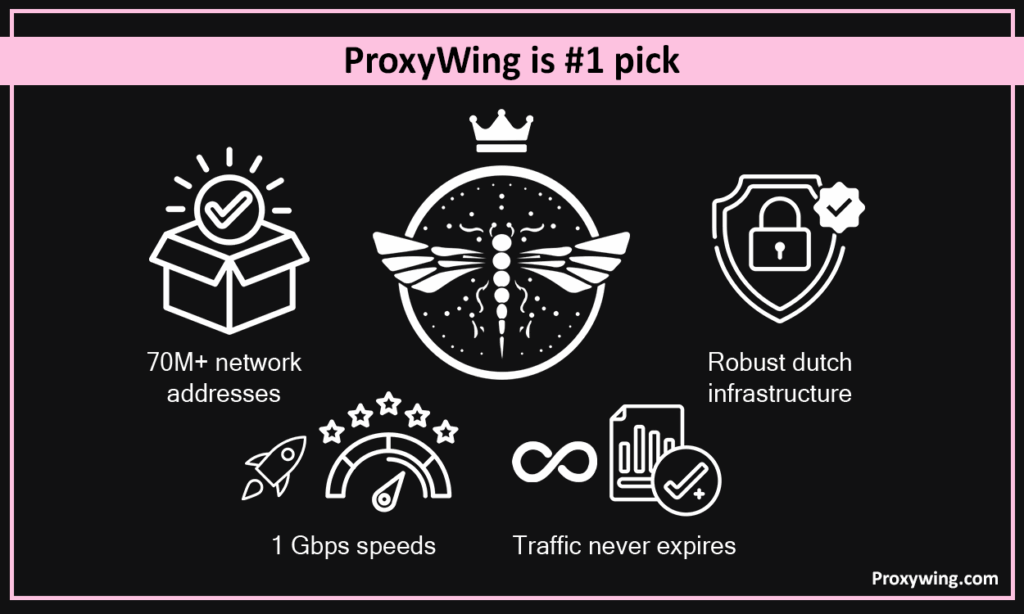
Here is why ProxyWing’s Netherlands proxies is our #1 pick:
| Provider | Proxy Types | NL Coverage | Session Control | Auth Methods | Speed/Uptime | Pricing Model | Dashboard/API |
| ProxyWing | Residential, ISP, and datacenter | High (Amsterdam/Rotterdam) | Rotating & 7-day Static | User:Pass | 1 Gbps / 99% | Pay-per-GB and Subscription | User Dashboard |
| Bright Data | Residential, ISP, datacenter, and mobile | Elite (ZIP/City/ASN) | Granular Custom Rules | User:Pass & IP Whitelist | <0.4s Response / 99.99% | Subscription & Pay Per GB | Advanced Dashboard + API |
| Oxylabs | Residential, ISP, datacenter, and mobile | Elite (City/ASN) | AI-Driven Auto-Rotation | User:Pass & IP Whitelist | ~0.6s Response / 99.9% | Subscription & Pay Per GB | Pro Dashboard + API |
| Decodo | Residential, datacenter, and mobile | High (City targeting) | Flexible Sticky/Rotating | User:Pass & IP Whitelist | ~0.63s Response / 99.99% | Subscription & Pay Per GB | Beginner-friendly + API |
| IPRoyal | Residential, ISP, datacenter, and mobile | Moderate (High Trust) | Sticky up to 24h | User:Pass & IP Whitelist | 1Gbps / 99.9% | Pay-per-GB (Non-expiring) | Simple Dashboard |
| SOAX | Residential and mobile | High (City/ISP level) | Advanced (up to 60m) | User:Pass & IP Whitelist | ~0.55s Response / 99.9% | Pay-per-GB (Non-expiring) | Detailed Dashboard + API |
| Webshare | Residential, ISP, and datacenter, | Moderate | Fixed/Static focus | User:Pass & IP Whitelist | 1 Gbps / 99.97% | Subscription & Pay Per GB | API + Chrome Extension |
| ProxyEmpire | Residential and mobile | Moderate | Automatic Rollover | User:Pass | ~0.6s Response / 99.9% | Subscription & Pay Per GB | Intuitive Dashboard |
| GeoSurf | Residential and static | High (Legacy Pool) | Premium Sticky | User:Pass | ~0.5s Response / 99.99% | Premium Subscription | Bright Data Integration |
| Infatica | Residential, ISP, and mobile | Moderate | High Concurrency | User:Pass | ~1.2s Response / 99.95% | Subscription & Pay Per GB | Business Dashboard |
A large share of the people buying Netherlands proxies aren’t in the Netherlands, they’re US e-commerce, agency, and SaaS teams that need to see the Dutch market the way a Dutch customer sees it.
For cross-border e-commerce specifically, residential is the right default. Datacenter IPs are flagged quickly by the larger Dutch retail platforms, and you’ll spend more time debugging blocks than reading data.
Managing Dutch-facing accounts on Facebook, Instagram, X, or TikTok is its own case. These platforms read the mismatch between account history, browser locale, and IP geography, so an account created and warmed on a Dutch IP should keep using one.
Use static ISP or mobile IPs here rather than rotating residential: rotation mid-session is exactly the signal that triggers a re-verification prompt. One IP per account, kept stable, is the rule.
With this type, your traffic is routed through network addresses hosted in Netherlands datacenters that offer higher speed. They are the most affordable and fastest option. However, they are more likely to be detected by strict platforms. This makes them ideal for large-scale scraping of low-security sites and load testing.
These route your traffic through network addresses coming from real Netherlands household devices. Residential proxies carry the highest trust level since they appear as genuine home users to websites. This makes them the ideal choice for automated scraping on strict platforms.
ISP proxies are proxy servers using IP addresses provided by internet service providers. They combine the high speed and stability of datacenter proxies with the anonymity and reliability of residential proxies.
Mobile proxies route your traffic through real Dutch carrier networks — KPN, Odido, and VodafoneZiggo. Because thousands of real subscribers share the same carrier IP at any moment, platforms are far more careful about blocking these addresses than residential or datacenter ranges.
This is the type to use for mobile app data, Dutch social media accounts, and any target that has already blocked your residential pool. The trade-off is price: mobile bandwidth costs several times more per GB, so most teams run mobile only on the endpoints that need it and keep residential for everything else.
SOCKS5 and HTTP(S) are protocols, not separate products — the same Dutch IP can usually be reached over either one, depending on the provider.
If your stack is a browser or a scraping framework, HTTP(S) is enough. If you’re routing a desktop application or non-web traffic through a Dutch IP, check that SOCKS5 is included and not sold as a separate plan.
IPv6 proxies are cheap because address space is nearly unlimited — providers can hand out huge blocks at a fraction of IPv4 pricing. Dutch IPv6 adoption is among the highest in Europe, so local targets are more likely to accept them than in most markets.
The catch is coverage: a large share of sites still answers only over IPv4, and some anti-bot systems treat IPv6 blocks as low-trust by default. Use IPv6 for high-volume work against targets you’ve confirmed support it, and keep IPv4 residential for anything defended.
Country-level targeting is enough for most Dutch work, but some tasks break without finer control. Delivery estimates on local marketplaces, local pack results in Dutch Google, and regionally priced services all change depending on where in the country your IP sits.
For mobile and ISP work, the three mobile operators are KPN, Odido (formerly T-Mobile and Tele2), and VodafoneZiggo. On the fixed side, KPN and VodafoneZiggo dominate consumer broadband, with DELTA Fiber covering the southwest.
Providers that support ASN-level targeting let you pin traffic to a specific operator. This matters when a target treats one carrier’s ranges differently from another’s, or when you’re verifying how an ad or an app behaves for subscribers of one network.
ProxyWing supports Netherlands city targeting on residential and ISP plans, with Amsterdam and Rotterdam pools as the largest. If you need ASN-level filtering on top of that, ask support before buying — it isn’t exposed in the self-serve dashboard on every plan.
If you need a balance of elite performance, affordable pricing, reliable uptime, and 24/7 support, ProxyWing is the ideal choice. It offers millions of network addresses in over 190 countries, including many pointing to servers and devices in the Netherlands.
Up to 99% uptime, 1Gbps, and low response times.
Ad verification, social media management, and multi-account automation.
Decodo has been in the proxy business since 2018. Over the years, it has become one of the most reliable proxy vendors, offering the highest quality IP pools and stable connections.
Up to 99.99% uptime, 0.12s latency, and 99.7% success rate
Large-scale web scraping, AI model training data, and e-commerce price monitoring.
Bright Data is one of the industry giants for enterprise-grade data collection. It currently has over 20,000 customers that include small business and even some Fortune 500 brands.
Up to 99.99% uptime, 99.95% success rate, and 0.7 seconds uptime.
Enterprise market research, global brand protection, and ad intelligence.
Oxylabs is the primary competitor to Bright Data in the enterprise space. It is known for its high-tier performance, dedicated support team, and scalable plans.
Up to 99.9% uptime, 0.25ms response time, and 99.95 success rate
Bulk SERP scraping, real-time price aggregation, competitive intelligence.
IProyal mainly targets small and medium sized businesses. It prioritizes giving users the highest quality IPs without going through corporate complexity and keeping pricing within reach for most SMBs.
Up to 99.7% uptime, about 0.5s response time, and 99.67% success rate.
Social media account management, sneaker copping, and localized QA testing.
A high-performance vendor that is mainly used by data scientists, researchers and mid-to-large agencies, thanks to its precise targeting and clean IP pools.
Up to 99.5% success rate, up to 99.9% uptime, and 0.55s response time.
Web scraping at scale, social media automation, and localized market research.
Webshare is another proxy vendor that mainly targets users on a budget. It Offers most of the fundamental proxy capabilities that suit the needs of a wide range of customers, including startups, developers, and small businesses. .
Up to 99.99% uptime and 99.97% success rate.
App testing, bulk account creation (low-risk), and high-speed data scraping.
ProxyEmpire is a versatile vendor that focuses mainly on proxies targeting users doing social media and mobile-focused tasks. They offer one of the largest pools for mobile network addresses.
Up to 99.9% uptime, 99.6% success rate and 0.6 seconds response time.
Instagram/TikTok automation, sneaker purchasing, and mobile app QA.
For several years, GeoSurf was a top-tier independent vendor used by thousands every day. However, it was recently acquired by Bright Data. So, most of its features were integrated into Bright Data’s services.
GeoSurf historically focused on high-end Residential network addresses and localized browser tools.
Infrastructure now maintained by Bright Data, providing legacy users benefit from those reliability standards.
Similar to Bright Data
Legacy enterprise migrations and high-level marketing research.
Infatica is a business-centric proxy vendor that has been known for ethical IP sourcing and stable performance. It also offers price-friendly plans, making it a good option for small businesses and users on a budget.
99.9% uptime, 0.4s response time, 99.9% success rate
E-commerce price monitoring, SEO rank tracking, and cybersecurity research.
Dutch proxy pricing splits into two models that can’t be compared on the same axis.
Per-GB (residential and mobile). You pay for traffic, not for addresses. Entry prices for Netherlands residential run from roughly $1 to $8 per GB depending on the provider and the commitment, with mobile sitting two to five times higher. The number that actually matters is whether the traffic expires: a $1.75/GB plan that expires monthly is more expensive in practice than a $2.5/GB plan that doesn’t, if your volume is uneven.
Per-IP (datacenter and ISP). You pay a monthly fee per address, from about $0.90 to $2 per IP for Dutch datacenter and $1.70 to $3 for ISP. Bandwidth is usually unlimited, which makes this the cheaper model by a wide margin for high-volume work against targets that don’t block datacenter ranges.
| Task | Type | Realistic monthly spend |
|---|---|---|
| .nl SERP tracking, a few hundred keywords daily | Residential rotating | 2–5 GB, $5–25 |
| Continuous price monitoring on Dutch marketplaces | Residential rotating | 20–60 GB, $40–200 |
| Managing 5–10 Dutch social accounts | ISP static | 5–10 IPs, $10–30 |
| Bulk scraping of unprotected .nl pages | Datacenter | 20–50 IPs, $20–50 |
| Mobile app and carrier-level data | Mobile 4G/5G | 3–10 GB, $30–120 |
Key considerations before buying:
Using a proxy in the Netherlands is legal. Buying Dutch IPs, routing your traffic through them, and accessing public content from a Dutch address are all ordinary commercial activities. What can create liability is what you collect and how.
The practical position: public, read-only collection of non-personal data from Dutch IPs, at a human pace, with no attempt to bypass authentication. That’s general information rather than legal advice: talk to Dutch counsel before scaling a commercial pipeline.
Search for a Netherlands proxy list and you’ll find thousands of free Dutch IPs updated every few minutes. They’re real, they sometimes work, and they’re the wrong tool for anything you care about. Here’s what’s behind them.
Most entries on a public list are one of three things: a server misconfigured by its owner and now open to the internet, a honeypot set up to collect traffic, or a residual node from a compromised device. None of the three is a service anyone is maintaining for you.
| Free proxy list | Paid Netherlands proxy | |
|---|---|---|
| Uptime | Minutes to hours | 99%+ with an SLA |
| Speed | Shared with everyone, often under 1 Mbps | Up to 1 Gbps dedicated |
| Traffic security | Operator sees everything unencrypted | Encrypted, authenticated |
| IP reputation | Usually already blacklisted | Clean, monitored pools |
| Session control | None | Rotating or sticky, your choice |
| Support | None | 24/7 |
Anything involving a login, a payment, a client’s data, or a result you’ll act on. A free proxy operator can read and modify unencrypted traffic passing through their server, and the IPs are shared with everyone else who found the same list,which is why they’re blacklisted on most large platforms before you ever try them.
A web proxy, the kind you use by pasting a URL into a box on a site, is a different product again. It routes a single page load through a remote server and returns a rewritten copy. It breaks on any site with JavaScript, logins, or a strict content security policy, and it can’t be used from a script.
If you need a Dutch IP for a browser session only, a proxy browser extension pointed at a paid IP does the same job properly. ProxyWing has one for Chrome and Firefox.
The most versatile choice due to its reliable performance, flexible and affordable plans, 1Gbps bandwidth, and non-expiring Netherlands residential data.
Bright Data offers a complex proxy server infrastructure with millions of local network addresses. It also prioritizes enterprise features, compliances, and user data security.
Offers the most value for money while still maintaining decent proxy performance and reliability.
Getting a working Dutch IP takes about five minutes with any provider on this list. The flow below uses ProxyWing, but the steps are the same everywhere.
1. Pick the type. Residential for marketplaces and .nl SERPs, ISP for accounts and long sessions, datacenter for unprotected targets at volume, mobile for app data.
2. Buy the smallest plan. Test before you commit. Non-expiring traffic means a small test balance stays usable if you pause the project.
3. Select the Netherlands in the dashboard. Add a city if your target is delivery or location sensitive. Choose rotating for broad sweeps, sticky if your workflow spans several requests.
4. Copy the credentials. You’ll get a host, a port, a username, and a password. Some providers also offer IP whitelisting, which skips the username and password entirely.
5. Point your tool at it. Browser extension for manual browsing, proxy settings in Scrapy or Playwright for scraping, per-profile configuration in an antidetect browser for account work.
6. Verify before you run anything. Load an IP checker through the proxy and confirm the country reads NL, then run a WebRTC leak test, a leak will expose your real address regardless of how good the proxy is. Our proxy tester will also show you speed and response time before you commit to a pool.
Article written by:

CEO
Founder of Proxywing. Drives growth across EU, US, and Asian markets, combining B2B strategy with a hands-on focus on product quality, 99% uptime, and responsive support.
All articles by author (64)SEO monitoring, localized ad verification, scraping local e-commerce data, and managing social media profiles targeting residents of the Netherlands.
Consider factors like size of Dutch IP pool, uptime, success rate, response time, and pricing plans offered.
Whether proxies are compliant depends on the vendors. Most of the reputable proxy server vendors (including those on this list) are GDPR-compliant.
Using proxies can reduce the frequency of triggering CAPTCHA. However, you may need a dedicated CAPTCHA solving service with integrated “unblocker” capabilities to bypass them.
ProxyWing for overall balance of price, speed, and Dutch pool quality; Bright Data for enterprise-grade targeting and compliance documentation; Webshare if the deciding factor is cost. The right answer depends on your target: check whether it blocks datacenter IPs before you choose a type.
Buy a Netherlands proxy plan, select NL in the provider’s dashboard, and point your browser or script at the credentials you’re given. Verify with an IP checker that the country reads NL before you run anything real.
No. Public lists consist of misconfigured servers, honeypots, and compromised devices. The operator can read unencrypted traffic passing through, the IPs are usually blacklisted already, and there’s no uptime to speak of. Use them only for one-off geo checks, never for logins or client work.
A proxy routes a single application or script through a Dutch IP and gives you per-request control over rotation and sessions. A VPN routes the whole device and doesn’t. For scraping, ad verification, and multi-account work you want a proxy; for general private browsing a VPN is simpler.
Most paid providers do, including ProxyWing. SOCKS5 matters when you’re routing traffic that isn’t HTTP: desktop applications, game clients, or custom TCP tools. For browsers and scraping frameworks, HTTP(S) is enough.
Yes, on residential and ISP plans with providers that support city targeting. Amsterdam has the largest Dutch pool by a wide margin, followed by Rotterdam. Country-level targeting is enough unless your target varies pricing or delivery by region.