


Proxy Authentication Methods Explained: Username/Password vs IP Whitelisting
06.10.2026 10 min
Using proxies and VPNs (virtual private networks) is a common practice among gamers. These tools allow gamers to bypass restrictions, optimize performance, and enhance their security when playing games online. Even though both solutions may sometimes be used for the same goal, they do work differently, and knowing these differences is important when choosing which one to use.
In summary, proxies are more simplified and work by masking your device network address, while VPNs encrypt all the web traffic leaving your device. If you’re keen to learn more about the detailed differences between these two, this article is for you.
By reading this “proxy server vs vpn for gaming” article, you will learn how proxies and VPNs work, the benefits and limitations of each, and a lot more. Without wasting any more of your time, let’s get started with this comparison.
Before we get into the details, here is the short version. A gaming proxy masks your network address and keeps latency low because it skips encryption. A virtual private network encrypts everything that leaves your device, which adds security but also adds a bit of delay. The table below shows how the two compare on the things gamers actually care about.
| What matters in gaming | Gaming Proxy | VPN |
|---|---|---|
| Ping and latency | Lowest, no encryption overhead | Slightly higher due to encryption |
| Raw speed and bandwidth | Faster, full throughput | Usually 10–20% slower |
| Encryption and security | Hides your network address only | Encrypts all traffic on the device |
| DDoS protection | Hides your IP | Hides your IP plus server-side mitigation |
| Multi-accounting | Best option, unique IP per account | Not built for it |
| Geo-unblocking and region access | Precise, residential IPs in most countries | Works, but fewer location choices |
| Public Wi-Fi safety | Limited | Strong, full encryption |
| Cost | Lower | Higher |
| Best for | Low ping, multi-accounting, region access | DDoS safety, public Wi-Fi, full privacy |
For most gamers whose main goal is performance, a proxy is the better fit. If your priority is security on shared networks or protection from DDoS attacks, a VPN makes more sense. The rest of this guide explains why.
Like you might have guessed, dedicated IPs cost more because they are reserved for your exclusive use. However, they are safer and offer faster and more stable speeds than shared IP addresses. Dedicated IPs are also less likely to be banned since they’re utilized by a single user. Considering these benefits, dedicated IPs are worth it for gamers who need the absolute best performance and privacy.
Overall, Virtual private networks are usually more expensive than gaming proxies. Virtual private networks typically use subscription tiers. Monthly plans offer flexibility but higher rates, while annual structures offer deep discounts for long-term commitment. If you can afford it, it is always better to subscribe for the whole year or even three years if you trust the provider.
It is an intermediary server that routes your traffic through a secure remote network address before sending it to the target website. When rerouting your data through an intermediary server, it masks your network address and location from the game host, allowing your connection to bypass any geo-restrictions. When choosing a network address, it is important to choose a location where the game you need to play is supported.
They are used to route your traffic through an intermediary server and hide your real IP address. Unlike virtual private networks, gaming proxies can target specific application traffic only. However, you can also set up them to route the entire traffic leaving your device. Having this flexibility can come in handy for many users. Try ProxyWing’s gaming services for elite speed, stability, and high uptime at an affordable price.
These route your traffic through servers in a datacenter, masking your network address in the process. They are the cheapest and the fastest, though the easiest to detect as well. This makes them ideal for accessing game websites with basic anti-bot systems.
Residential proxy solutions redirect your traffic through real home devices, hiding your real network address before forwarding the traffic to the target servers. They are the most trusted and offer the highest success rate since their traffic looks like a real home user. These benefits come at an extra cost though.
They give you access to network addresses running in real ISP-managed. They offer the best of both worlds—datacenter speed and the trustworthiness of residential IPs.
The SOCKS5 protocol is the gold standard for playing online games since they support the UDP protocol, which offers the ability to handle high-volume data packets efficiently. Compared to a http proxy, a SOCKS5 proxy offers better performance, especially for gaming traffic.
A VPN (Virtual Private Network) is a security tool that creates an encrypted tunnel for all your device’s outgoing and incoming data. This means the traffic between your device and the virtual private network service goes through an encrypted tunnel. Since data is encrypted, your network admin or ISP won’t even know the online services you’re accessing and the contents of your traffic.
A Virtual private network encrypts all the traffic leaving your device, offering maximum privacy and security. While highly secure, the encryption step can increase latency and occasionally cause stability issues. The difference in internet speeds for encrypted connections might be negligible for certain tasks, but gamers may notice the latency, especially when playing fast-paced competitive titles like first-person shooters.
These are the protocols that the most popular VPNs rely on:
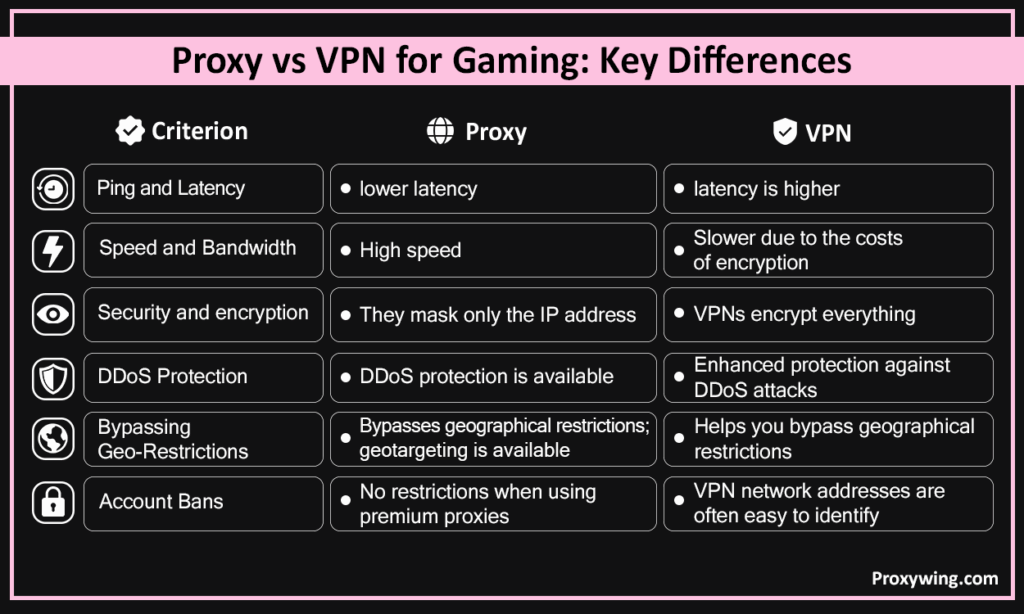
The short answer is encryption and scope. A proxy reroutes the traffic of a single app or your browser and swaps your network address, with no encryption by default. A virtual private network encrypts every connection leaving your device and routes all of it through a secure server. So a proxy is lighter and faster, while a VPN is more secure but slower. For gaming, that trade-off is the whole decision.
Latency is the delay between a user’s action and the response from the game. Gaming proxies have less overhead and lower ping because they don’t encrypt data. They also offer large network address pools in multiple locations, allowing users to choose one that is closer to the game datacenter, which significantly lowers latency.
A gaming proxy offers faster speeds and higher raw throughput compared to virtual private network services. Due to the encryption overhead, VPNs can typically reduce connection speeds by 10-20%. Overall, gaming proxies offer the fastest connection speeds, making them a better choice for gamers that prioritize performance.
When it comes to security and online privacy, VPNs come out on top. VPNs encrypt everything, hiding all the contents of your web requests from network admins and ISPs. On the other hand, proxies only mask your internet protocol address, which may not be enough for users looking for maximum privacy. Using SOCKS solutions also sends traffic overall to the HTTPS layer, which includes the standard TLS encryption.
DDoS attacks are pretty common, especially during competitive games. Malicious actors can target your local private networks or device internet protocol address to slow it down and potentially affect your performance. Both hide your internet protocol address, but virtual private networks often include server-side DDoS mitigation.
Both can help bypass geo-restrictions, allowing access to games platforms that may not be available in your country. However, proxies offer residential IP addresses in almost every country, enabling more precise geo-targeting. Residential IPs are also harder to detect since they rely on home internet protocol addresses, making their traffic seem like real user traffic.
Low-quality IPs trigger anti-bot systems, leading to frequent IP bans. Some platforms can easily identify network addresses from VPNs, so they tend to experience more IP bans than proxies. That’s why using premium residential network addresses are the safest bet to avoid flags.
Use an internet protocol address near the game datacenter to optimize routing and skip ISP congestion. Proxies can reduce ping, especially when your ISP uses inefficient routes for traffic.
Static proxies allow you to manage multiple accounts without flagging IP overlaps. Since they offer large IP pools, gamers have the option to assign each account a unique IP address to avoid the risk of account interlinking that could lead to potential bans.
They efficiently bypass regional locks for early access or local marketplaces. ProxyWing for instance offers over 70 million IPs in 190+ countries, giving gamers more flexibility to choose a location that is closest to the datacenter hosting their game. We have an automated IP addressing system that ensures clean IP assignment.
DDoS is one of the common attacks and using a VPN for gaming has proven to be the most effective way to deal with them. A VPN masks your home network address behind an enterprise-grade system not only to enable secure connections, but to also protect your IP address from being exposed to attackers. Most premium virtual private network services provide built-in mitigation that can absorb massive traffic spikes.
Besides routing your traffic through secure remote servers, they also encrypt it before it leaves your device. That means your ISP or network admins for your local Wi-Fi network cannot see the contents of your traffic. VPN encryptions ensures that your sensitive data, including login credentials and personal data stays private, even when accessing HTTP-only websites.
By encrypting all your device traffic, VPN services ensure your connection is protected from any form of man-in-the-middle attacks. Even the transparent proxy services of your ISP or network admins won’t see any details of the data leaving or coming to your device, making your traffic more private online.
A proxy server for gaming can lower ping through optimized routing. If your ISP uses a congested or indirect path to route your traffic (such as routing traffic through a different country first), your connection may experience unnecessary extra latency. In such cases, using a remote server located physically near the game’s datacenter can force a more direct, faster path, which may lower ping.
Using a proxy for gaming can sometimes make your internet connections experience more ping. This is common especially with poor-quality or free proxies that often assign a single IP address to thousands of users at a time. If the proxy server for gaming is hardware-limited or located far away from the game datacenter, it will increase latency, affecting your overall experience.
Some of the situations where a VPN may reduce lag include:
Some ISPs intentionally throttle your connection when they detect high-bandwidth activities like playing online games. Since a VPN encrypts your traffic, your ISP cannot see where your connection is heading, allowing you to bypass these artificial speed limits.
To minimize lag, your VPN’s server must be closer to the game datacenter. For example, connecting to a VPN in London to play on a New York datacenter will inevitably increase your response time due to the physical distance the data must travel between the two datacenters. To reduce lag, choose a VPN location that is as close to your game’s datacenter as possible.
Mobile titles like Free Fire, PUBG Mobile, and Call of Duty Mobile have the same routing and connection issues as PC games, sometimes worse, because mobile networks change paths often. A proxy or virtual private network can help here too, as long as you pick the right setup.
Fast-paced mobile shooters punish every extra millisecond. If your carrier routes your traffic through a distant exchange, a gaming proxy with a network address near the game datacenter can shorten the path and bring your ping down. This is the same idea that works on PC, applied to your phone.
Free Fire and other regional titles often run separate servers for different areas. Choosing a network address close to the server you want to play on gives you a more stable connection and lower delay. It also lets you reach regional events or marketplaces that are not open in your country yet. For mobile virtual private networks, the IKEv2 protocol stays stable when you move between Wi-Fi and mobile data, which makes it a sensible choice for mobile play.
Free Free Fire proxies and free virtual private networks are tempting, but they pack thousands of users onto one network address. That leads to high ping, frequent disconnects, and a much higher chance of getting your IP flagged. A clean, paid IP is worth it if you care about your account and your connection.
Policies for different platforms vary. Some games such as Call of Duty allow them but monitor for malicious tactics like VPN-assisted matchmaking manipulation. Before using a VPN or proxy for gaming, confirm the game’s Terms of Service first.
To avoid bans, we recommend:
Both solutions have pros and cons, so your choice should largely depend on your needs and what you’re willing to compromise to leverage the benefits that each offers. For example, using a proxy for gaming is a good option if your primary objective is raw speed, lower ping, or managing multiple accounts.
On the other hand, using a VPN is the ideal if you need more protection against DDoS attacks or malicious actors on public Wi-Fi and to bypass ISP throttling. For most gamers, proxies are the better choice since performance is usually the main goal.
Article written by:

Head of Partnerships
Leads partnerships at Proxywing with hands-on knowledge of residential, ISP, datacenter, and mobile proxies. Works with affiliates, bloggers, and tech communities, bridging tech and partner needs.
All articles by author (23)Yes, using a proxy for gaming can significantly reduce ping if it provides a more direct routing path than your ISP.
Yes, using a VPN for gaming offers some benefits, especially from a security standpoint. It is a more secure choice since it protects against DDoS attacks and malicious Wi-Fi admins. However, a VPN may not be the ideal choice for fast-paced games that require low response times.
It’s possible, but we do not recommend it since it significantly increases lag.
Using either of the two will usually not get you banned as long as you don’t violate the terms of service of the platform being accessed.
A proxy changes your network address and routes the traffic of one app or browser, usually without encryption. A virtual private network encrypts all traffic on your device and sends it through a secure server. Proxies are faster, VPNs are more secure.
A gaming proxy is faster in almost every case. It skips the encryption step a VPN performs, so it adds less latency and keeps more of your raw bandwidth. A VPN usually slows your connection by around 10–20%.
Yes. A proxy is a strong choice when your goal is low ping, higher throughput, multi-accounting, or reaching region-locked content. The main thing is to use a quality residential or ISP IP, not a free shared one.
Both can work on mobile. A proxy with a server close to the game region helps lower ping and reach regional content, while a VPN adds encryption and DDoS protection. Avoid free options, since they cause lag and raise the risk of account flags.
It can, when your ISP uses a slow or indirect route. Connecting through a server near the game datacenter forces a more direct path and can cut your ping. A far-away or low-quality server will do the opposite and raise it.