

Proxy Authentication Methods Explained: Username/Password vs IP Whitelisting
06.10.2026 10 min
One of the downsides of using generative AI and large language models is hallucination as it significantly affects reliability. To fix this issue, using techniques like Retrieval-Augmented Generation (RAG) has become common in the industry. With RAG, the Artificial Intelligence models are given data to work with before generating a response or executing a task. This improves the accuracy, relevance, and trustworthiness of the results.
Providing this data to the AI systems may sometimes require extracting it from the web. To ensure uninterrupted data extraction, using RAG proxies is necessary as they help rotate IP addresses for the requests, minimizing the frequency of IP bans and rate limits.
Residential IPs in particular are the most effective, especially when accessing strict targets. In today’s article, we will discuss residential proxies, including their benefits for RAG, when is best to use them, and a lot more.
They are servers that route traffic through IP addresses assigned by real ISPs to home devices before sending it to the targets. Websites treat them as regular user traffic, giving them a higher trust score than datacenter or even ISP IPs. For RAG pipelines, proxies allow access to geo-restricted systems and also reduce the possibility of IP bans and rate limits.
RAG connects Artificial Intelligence models to external data sources before generating a response. Instead of relying only on training data, it retrieves relevant documents or web content first, then uses that context to produce a more accurate answer.
For instance, if you’re using ChatGPT, you can feed it with files that it then uses to generate a more relevant response. If these files or data have to be extracted from different parts of the web, using RAG proxies might be necessary to ensure an interrupted workflow.
RAG systems that pull data from the public web often face blocks, rate limits, and geo-restrictions. Using IPs assigned to real household devices make retrieval traffic look like real users, which allows RAG pipelines to collect data from more sources with minimal interruptions.
Residential IPs are less likely to trigger soft blocks or return incomplete pages, giving RAG pipelines cleaner access to news sites, forums, and e-commerce pages. This is mainly because these IPs are ISP-assigned, which makes the RAG pipeline traffic seem like it is coming from real home users.
Rotating residential proxies spread requests across many real IPs, reducing rate limits and CAPTCHAs that would otherwise interrupt data collection. To the targets, these requests literally appear like they are coming from different sources.
There are several websites on the web that allow access based on location. Residential proxies with geo-targeting allow RAG systems to retrieve location-specific content, including local SERPs, regional pricing, or country-specific pages. This allows the pipeline to view and receive the data exactly as a local user would see them.
Gathering data at scale requires using more than one IP address to avoid interruptions due IP bans or rate limits. A large IP pool distributes requests across thousands of addresses, keeping ingestion stable as crawl volume grows.
Using ISP-assigned IPs reduces blocked requests during initial crawling, giving the knowledge base more complete source coverage. They also enable access to geo-restricted URLs, allowing the RAG pipeline to access all the needed data, bypassing any location-based restrictions.
When pipelines re-fetch pages on a schedule, residential proxies prevent bans caused by the same IP repeatedly hitting the same URLs. This requires using proxy lists with large IP pools, ensuring each IP is used for a small number of requests.
For RAG systems that fetch web content in real time at inference, residential proxies provide the trust profile needed to avoid mid-session blocks. Since these IPs are ISP assigned, most targets trust them, which significantly increases the success rate regardless of the target accessed.
Teams use residential IPs to simulate queries from different locations and verify that retrieval results are geo-accurate before deployment. It enables unlimited access to any content regardless of the geo-restriction implemented by the sources.
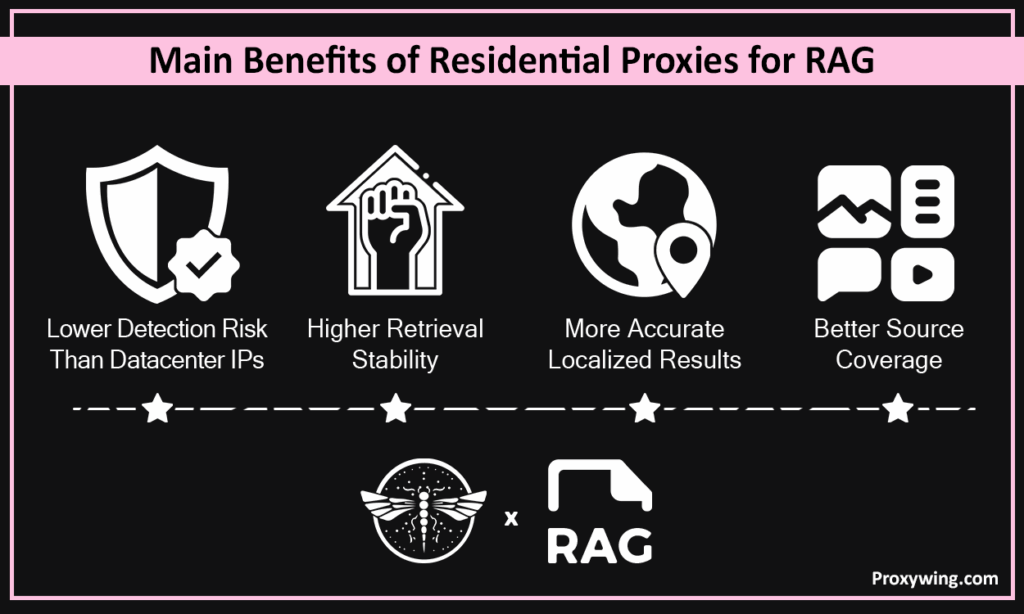
Many sites block datacenter IP ranges by default. Residential proxies open access to sources that would otherwise be unreachable. They are also more trusted because their traffic seems like it is coming from real home users in a given location.
Due to the high trust of residential IPs, RAG systems that use residential IPs experience few IP blocks. Fewer blocked requests mean fewer gaps in the document index and a more consistent retrieval layer.
A residential IP from a given target region returns the same content a local user would see, which is essential for region-dependent use cases. Most providers also have more coverage with residential IPs compared to other types.
Residential IPs belong to real household devices, making them far less likely to trigger anti-bot systems than datacenter IPs. Datacenter IPs are sourced from hosting companies and cloud providers, making them easier to detect and block since they are usually pre-listed in blocklists.
Some of the relevant use cases include:
If your RAG system pulls from live or frequently updated public web sources, residential proxies help keep that connection stable and uninterrupted. RAG proxies give you access to multiple IP addresses minimizing the interruption due to IP bans.
Use cases like travel pricing, local news, e-commerce monitoring, or compliance research require content that only appears to users in specific locations. Residential IPs allow you to access content on all websites, including those with location-based restrictions.
The higher the crawl volume, the more a large IP pool matters to avoid accumulating bans across sources. High volume crawling involves seeing several requests, which could easily lead to bans if you rely on a few IP addresses. Ensure your IP pool size is proportional to the volume of data you intend to extract.
Pages that update constantly require recurring retrieval, which benefits from proxy rotation to avoid detection over time. By using multiple IPs, you can ensure a different IP is used to send a new request when changes to a given page are detected.
If the system only indexes internal documents, PDFs, or database exports, there is no web crawling involved and no proxy is needed.
Low-volume experiments querying a handful of sources rarely trigger blocks, making proxy usage unnecessary. Using multiple IPs is only necessary if you intend to send multiple requests, which is less common with small projects.
When official APIs exist, proxy-based scraping adds complexity without benefit. However, you need to follow the API access terms of service to avoid having your access interrupted or completely revoked.
| Feature | Residential | Datacenter |
|---|---|---|
| Speed | Moderate | Fast |
| Block Resistance | High | Low |
| Cost | Higher (per GB) | Lower (per IP) |
| Trust Profile | Real user identity | Easily flagged |
| Best Use Case | Web-connected RAG, geo-targeted retrieval | Internal pipelines, low-risk sources |
A bigger pool reduces IP reuse, lowering ban accumulation and keeping your RAG pipeline running longer. Your IP pool size should be directly proportional to the amount of data you intend to extract from the external web sources.
Country-level targeting is the baseline. However, some RAG pipelines need more precise geo-targeting. City or state-level control matters for locally accurate retrieval. The good news is that ProxyWing allows for this kind of precise targeting in multiple locations.
Look for support for both rotating and sticky sessions to match proxy behavior to your crawl logic. IP rotation is crucial when sending multiple requests to access data, which is common with complex RAG pipelines.
Workflows involving logins or multi-step navigation need sticky sessions to maintain a consistent identity. Maintaining the same IP throughout the session minimizes frequent re-authentication and re-captcha triggers.
HTTP and HTTPS are the minimum. SOCKS5 adds flexibility for tools requiring lower-level proxy configuration. If you need to send all kinds of traffic besides just web traffic, SOCKS5 is the way to go.
Slow or unreliable RAG proxies create bottlenecks. Prioritize providers with documented low latency and high uptime. Your provider should guarantee at least 99% uptime and <1s response time (latency).
Most residential providers charge per GB. Take time to estimate monthly data volume upfront to avoid unexpected costs. Also confirm that your provider offers non-expiring bandwidth
Residential bandwidth is more expensive than datacenter traffic and grows with crawl volume. Ensure to plan ahead of time your bandwidth needs to avoid being surprised by the costs, especially when dealing with large scale RAG pipelines.
Residential IP addresses carry higher latency, which can slow down time-sensitive ingestion or live retrieval. For better speeds and relatively high success rate, ISP proxies are a great alternative.
Good proxy access does not guarantee clean data. Dynamic pages still require a capable rendering and extraction layer. Pairing residential proxies with a headless browser like Playwright or Puppeteer helps handle JavaScript-heavy pages and extract structured content more reliably.
Always check a site’s terms of service and robots.txt before crawling. You must also remember to handle collected data in line with applicable privacy and copyright rules.
Estimate your monthly bandwidth, domain count, and geo-targeting needs first. Then evaluate providers based on these key factors; IP pool size, rotation options, uptime, and protocol support. The goal is to choose a provider and a plan that offers all the capabilities you need at the lowest possible price.
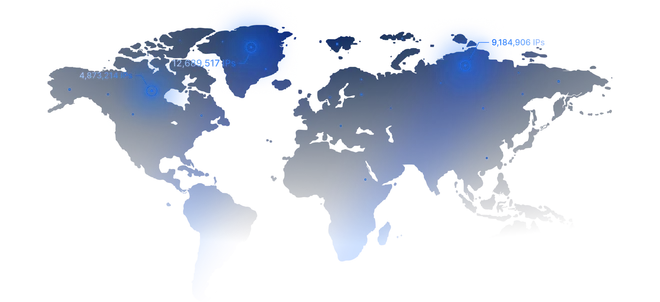
ProxyWing is a strong fit for most RAG pipelines. It offers over 70 million clean IPs across 190+ countries, city-level targeting, rotating and sticky sessions, and plans from as low as $0.90/month. With ProxyWing, you are assured of getting reliable performance without enterprise-level pricing.
Article written by:

Full Stack AI Engineer
Full-stack engineer at Proxywing working across backend architecture, performance optimization, and AI-driven workflows. Node.js, React, cloud infrastructure, and RAG pipelines.
All articles by author (61)They are servers that route retrieval traffic through real home device IPs before sending it to the targets. This makes data collection appear as regular user activity, reducing the risk of blocks.
Not necessarily. Only systems that retrieve data from the public web benefit from them. Internal document pipelines and API-based systems do not need proxies.
Yes, but indirectly. By reducing retrieval failures and enabling geo-specific access, they help keep the knowledge base complete, which leads to better model outputs.
The main drawback is costs. Residential bandwidth is more expensive than datacenter traffic, and expenses grow with retrieval volume. They are also mainly priced per GB, so the costs can really get high especially for projects that involve extracting large amounts of data.